Sunday, September 12, 2010

Sunday updates - September 12

Bear with me while I endeavor to get Tobacco Road back on track. The hiatus was not intentional, but necessary due to my current schedule. I hope the pace will be less hectic in 2011.

Okay, I have a few updates and items for you today.


Penny Harter sent this update:

Hi,

Three poems from my book Lizard Light: Poems from the Earth are featured on the wonderful site "Poets for Living Waters" that was begun after the Gulf oil spill, and has continued since as an ecologically affirmative site. You can spend hours exploring the moving and provocative work there. I'm honored to be included.

You can read the poems, my "eco-statement," and see a photo of the beach cottage at Barnegat Light, Long Beach Island, that I remember from family vacations when I was a child. The photo was taken in 1933!

Hope you enjoy the poems, and that you're savoring these waning days of summer / early days of fall.

Warmly,
Penny

http://penhart.wordpress.com/


From Pamela Babusci:

MOONBATHING
A JOURNAL OF WOMEN'S TANKA

EDITOR
Pamela A. Babusci 

Moonbathing Issue 3 is now accepting submissions.

Moonbathing will publish two issues a year: Fall/Winter and Spring/Summer.

SECOND MOONBATHING CONTEST:

For the Premier Issue and yearly, the Editor is sponsoring a "Moonbathing" tanka contest. Tanka poets may submit one tanka on the subject of “Moonbathing”,whatever that means to you for consideration, in addition to their regular submission. The winner will be featured in issue 3 of Moonbathing and receive two issues of Moonbathing as the prize. Be sure to label your tanka “Moonbathing contest” if sending along with your regular submission.

SUBMISSION GUIDELINES: 

Moonbathing will feature only women poets. Send a maximum of 10 tanka per submission period. Submission deadlines:

Fall/Winter Issue: In-hand Deadline:  Dec. 15th Fall/winter or non-seasonal themes only.

No previously published tanka or simultaneous submissions; no tanka that has been posted on-line, whether on a personal website/blog or on a tanka discussion group; and no publicly workshopped tanka will be considered or accepted.

SUBMISSION ADDRESSES:

Send your tanka IN THE BODY OF AN E-MAIL to: Pamela A. Babusci:  moongate44(at)gmail(dot)com PLEASE NO ATTACHMENTS. E-mail submissions ONLY.

I hope that all tanka poets who have their work accepted will support Moonbathing by purchasing a copy or a subscription. If Moonbathing is to survive it will need your support and I will be most grateful for it.
DONATIONS MOST WELCOME.

DISCLAIMER:
Moonbathing does not assume liability for copyright infringement or failure to acknowledge previously published tanka.

COPIES/SUBSCRIPTIONS:

Subscriptions: $10 for one year (two issues) U.S. and Canada; $5 for one copy. International: $14 U.S. dollars; send cash or international M.O.—payable to Pamela A. Babusci to: Moonbathing Editor
150 Milford Street Apt. 13 Rochester, NY 14615-1810  USA

The Editor of Moonbathing is looking forward to receiving your best tanka. If you have any questions, feel free to e-mail Pamela A. Babusci moongate44(at)gmail(dot)com

Respectfully submitted,

Pamela A. Babusci, Editor of Moonbathing


Saša Važic' sent two updates:

2010 Francine Porad Award for Haiku 

Haiku Northwest is pleased to announce the seventh annual Porad Haiku Contest, cosponsored by Haiku Northwest and the Washington Poets Association. The contest is named for Francine Porad, founder (in 1988) of Haiku Northwest, former president of the Haiku Society of America, and editor for eight years of Brussels Sprout, an international journal of haiku and art. We welcome your haiku submissions!

More information is available at this web site.

~ ~ ~

Mu First International Contest

Submissions are open for the Mu First International Contest. The submission deadline has been extended to September 30th.

More information is available at the contest web site.


The editor of HaikuPix sent this:

We are starting a new paper review, Haiku Pix, devoted to haiku and other short forms of Japanese origin. Currently we are seeking submissions.

Haiku Pix, a new paper review, seeks brief poems employing 'word-pictures' to evoke emotion. Subscriptions: $20. Submit 1-10 poems. Your name, address, email on each page. Bio required. Deadline: October 31. Submissions: Haiku Pix Review, 11F, No.489, Tian-fu Rd., Hsinchu 30058, Taiwan. For more information, visit: www.haikupix.com/

Yours sincerely,

Marie Kasprzak
Editor
editor@haikupix.com


Jeffrey Woodward sent this:

ANNOUNCEMENT: Haibun Today (September 2010) is now online.

The autumn quarterly issue of Haibun Today is now online for your reading pleasure at http://haibuntoday.com

Contributors to the current issue include Dan Allawat, Roberta Beary, Nathalie Boisard-Beudin, Marjorie A. Buettner, Glenn G. Coats, Tish Davis, Cherie Hunter Day, Albert DeGenova, Phuoc-Tan Diep, Lynn Edge, Jeffrey Harpeng, Maureen Scott Harris, Michele L. Harvey, Ed Higgins, Ruth Holzer, Gerry Jacobson, Gary LeBel, Chen-ou Liu, Victor Maddalena, Francis Masat, Robert Moyer, Ralph Murre, Eduardo N. del Valle, Stanley Pelter, Dru Philippou, Patricia Prime, Ray Rasmussen, Mark Ritchie, Bruce Ross, Cynthia Rowe, Adelaide B. Shaw, Mark Smith, Richard Straw, Linda Jeannette Ward, Theresa Williams and Jeffrey Winke.

This issue also features an in-depth interview with Ruth Holzer by Patricia Prime, an article on "The Ghost in Haibun" by Jeffrey Harpeng and book reviews by Tish Davis, Dru Philippou and Mark Smith.

Writers are now invited to submit haibun, tanka prose and articles for consideration in the December 2010 issue of Haibun Today. Consult our Submission Guidelines at Haibun Today. Forward any submissions by email to Jeffrey Woodward, Editor, at haibun.today@gmail.com


For readers who do not have a Facebook account, here is a message I posted a few days ago:

Peggy Lyles' daughter, Leslie Middleton, added a message to Tobacco Road. Scroll down to the 10th reply to see her post.

http://tobaccoroadpoet.blogspot.com/2010/09/sad-news-peggy-lyles.html

~ ~ ~

I will return later today with an addition to Haiku - Three Questions.

I also have a new Poets and Poems contribution to post later in the week.

For now, I'll close with a poem by Richard Peek.

Monday, September 6, 2010

Sad news - Peggy Lyles

I've received news from Dave Russo that Peggy Lyles passed away last Friday, September 3.

Peggy nurtured me as a poet, took me aside after a Haiku Holiday workshop to critique my poems. Words cannot convey the deep sense of loss I feel, the entire haiku community feels today. Peggy was a sister in the art of haiku, a mentor, and friend. My sincere condolences to Bill and family.

Thank God her poems live on and will continue to mentor future generations of poets.

Read Peggy's bio at The Haiku Foundation.

A photo from 2004. Peggy, Bill, and me.

Wednesday, July 14, 2010

Several updates - July 14, 2010

Folks, I apologize for the lack of updates. Summer can be a busy time for me. I've also spent more time writing. So far, July has been great for the creative juices.

Okay, on to the updates, a few that you probably already know about.


Penny Harter was featured on the Geraldine R. Dodge Foundation's "Poetry Fridays" blog-post on Friday, July 9th. This series features the "Festival Poets" who have been invited to read at the 2010 Dodge Poetry Festival, to be held October 7th -10th at the Performing Arts Center in Newark, NJ. In addition to linking to some of her longer poems, the post featuring Penny links to one of her haibun and a haiku, as well as to her "Three Questions" responses on Tobacco Road. You can find it at:

http://blog.grdodge.org/2010/07/09/poetry-fridays-festival-poet-penny-harter

And see the rest of the list of "Festival Poets"---with a briefer profile of Penny (click on her name) at:

http://www.dodgepoetry.org/festival-2010/festival-poets

She feels honored to have been asked, and she hopes to see some of you there. She'll be reading sometime on the weekend, yet to be announced. You can visit the Dodge Poetry Festival web site from time to time as they refine the schedule: http://www.dodgepoetry.org/festival-2010. (Four-day and weekend only tickets are available now on the site. Individual day tickets go on sale mid-August.)


Hi Curtis,

First, let me say I enjoy getting your blog updates very much. It's truly become the key source of information for our field. Keep up the good work!

Second, I have 2nd editions of my two books available in all ebook formats (e.g., for Apple's iPod/iPadf, Kindle, Sony Reader, etc.). Soon, these books will be available at each product's online ebook stores, but
are ready now at the links below.

Small Events: Haibun by W. F. Owen (Expanded 2nd Edition):

http://www.smashwords.com/books/view/18520

Note: This book won the Kanterman Merit Book Award for Best Haibun in 2008.

Haiku Notebook Second Edition:

http://www.smashwords.com/books/view/17633

I hope you can include this information in a future update please.

Thanks and take care,
Bill


Dear fellow haiku poets & friends:

I am proud to announce the publication of my chapbook; Wrecking Ball & other Urban Haiku from Accents Publishing. A haiku chronicle of the seasons in my home city, Philadelphia, it collects poems that have appeared in haiku journal in recent years, with some new poems as well.

Perfect bound, 30 haiku, 30 pages; just $5 dollars. Reviewed in the current edition of Frogpond.

It is available from the publisher Accent Publishing: http://www.accents-publishing.com, from http://www.amazon.com or from me:

Barry George
2011 Chestnut st., #11G
Philadelphia, Pa. 19103

($5 plus $1 shipping & handling, within the USA). Please make Check out to: Barry George.


Norman Darlington sent this:

Call for Content - Journal of Renga & Renku

We're ready to begin accepting offers of content for the first issue of Journal of Renga & Renku (formerly billed as The Renku Journal). While some details remain to be ironed out, the journal will be:

1. published near the end of 2010
2. available in hardcopy only
3. available for purchase online using Paypal


We're looking for a variety of content along the lines of:

1. Academic/polemic articles on any aspects of the genre

2. Translations of old renga and renku

3. News of renku groups and happenings

4. Book articles/reviews

5. and of course, a showcase of current examples of the genre:

a) in English

b) in any other language, accompanied by an English translation

c) previously published or not (just let us have details of prior publication so we can acknowledge properly)

d) simultaneous offers are fine too, again provided you advise us of prior publication for purposes of acknowledgement

e) in any of the standard forms: kasen, triparshva, nijûin, jûnichô, shisan, rokku, hyakuin, yotsumono, etc.

f) in any explorations of the above forms in terms of experimentation with one-line, zip, 5/7/5 or other fixed counts and even rhyme

g) solo and group work

h) with (preferably) or without notes/reflections on the poem/process from sabaki or renju or both

6. We are also considering holding a contest, but have not finalised our thinking on that. Please send us any ideas you may have and/or indication as to whether you'd be interested in entering and/or reading the results

7. We're open to discussing content ideas we've not covered above so please write

8. All communications will be acknowledged within one week

9. We are regretfully unable to pay contributors for content at this stage


Please send all contributions and other communications to RengaRenku AT gmail DOT com.

We look forward to hearing from you.

Norman Darlington
Moira Richards
Journal of Renga & Renku


Liam Wilkinson sent this update:

SUBMISSION CALL : 3LIGHTS AUTUMN 2010
http://3lights.wordpress.com

3LIGHTS Journal of Micropoetry invites you to submit haiku, senryu, tanka and other micropoems for its autumn issue. The autumn issue's theme will be FAIRGROUNDS & THE CIRCUS.

Please submit up to ten unpublished micropoems on a theme of fairgrounds and the circus to threelightsgallery [at] yahoo [dot] co [dot] uk. We no longer require biographical details, but please include your name and location. The deadline for all submissions is September 1st 2010 and the issue will be published online in October.

Whilst we continue to accept and encourage submissions of quality haiku, senryu and tanka, from the autumn issue onwards we are also keen to receive submissions of micropoems (poems of no more than 140 characters including spaces). Micropoetry is a swiftly growing literary form and, thanks to microblogging sites such as Twitter, poets are continually discovering new forms of concise expression. As a result, 3LIGHTS now opens its arms to submissions of these short poems and dedicates itself to promoting these brief and engaging works.

For our complete submission details and to read our past issues, please visit http://3lights.wordpress.com. We look forward to receiving your work. Please feel free to share this submission call widely.

Our forthcoming issue, 3LIGHTS Summer 2010, will be released in August, featuring a selection of new poetry from some of the finest writers of short-form poetry. We're also delighted to present a selection of haiku and tanka from our featured poet André Surridge.

Best wishes,
Liam Wilkinson

3LIGHTS : Journal of Haiku & Related Forms
Edited by Liam & Diane Wilkinson
http://3lights.wordpress.com


Lenard D. Moore forwarded this information to me about the 


Click the above link to download or view the pdf document.


Charlotte Digregorio
sent this update:

The Haiku Society of America's National Quarterly Meeting in Mineral Point, WI, will be from Friday, Sept. 10 through Sunday, Sept. 12. It's a biggie, and we're expecting people from outside the Midwest Region.

THE CRADLE OF AMERICAN HAIKU FESTIVAL 2: SEPTEMBER 10-12, 2010

Friday, September 10
2:00-7:00  Registration at The Foundry Books: 105 Commerce Street/Mineral Point
5:00-7:00  Opening Reception Sponsored by Modern Haiku
7:00-8:30  MEMORIES OF BOB SPIESS – Speakers to include Bob’s friends associates. MEMORIES will be followed by readings of Bob’s haiku and "Speculations."
8:30-9:30  Open Haiku Reading

Saturday, September 11
Breakfast On Your Own
7:30-8:00    Tai Chi Warmup -- Jayne Miller
9:00-9:55    Robert Spiess: A Poetics for Modern Haiku --Randy Brooks
9:55-10:10   Break
10:10-11:05  Robert Spiess’s Muse -- Lee Gurga
11:05-11:20  Break
11:20-12:15  Verbs in Haiku -- Charles Trumbull
12:15-1:15   Lunch On Your Own
1:15-2:45    Hat Haiku: A Midwest Workshop -- Francine Banwarth & Dubuque Haiku
1:15-2:45    Traditional Approach to Haiga -- Lidia Rozmus
1:15-2:45    Experience Kodo (Japanese Incense): Enjoy the Subtleties and Nuances of Incense from Japan -- Jerome Cushman
3:00-4:30    A Journey to the Back of Beyond: Risk-taking in Haibun --Roberta Beary
3:45-5:15    Repeat Lidia Rozmus
4:15-5:45    Repeat Jerome Cushman
4:45-5:45    Instant Feedback: One-on-one mini conference sessions with award-wining haiku, senryu, rengay, and haibun writers, editors, and  publishers.
6:00-6:45     Cocktails and Social at TFB
6:45-7:45     Midwest Style Picnic/Tailgate at TFB
7:45-8:15     HAS and Midwest Regional Announcements and Presentation of the Haiku North America banner to Randy Brooks
8:15-9:15     Open Reading

Sunday, September 12
Breakfast On Your Own
9:00-10:30   Shake Rag Alley Kigo
10:30-11:00  Announcement of Kukai Contest Winners
11:30-?       Lunch and Haiku Reading--Location TBA


Francine Banwarth sent this:

2010 Bernard Lionel Einbond Renku Competition Results

The Haiku Society of America announces the results of the 2010 Bernard Lionel Einbond Renku Competition. Thank you to our judges Jerry Ball and Merrill Ann Gonzales, to all who entered, and congratulations to the winners!

Grand Prize:  Ron Moss, Ferris Gilli, Matthew Paul, Paul MacNeil for TIDE SWELL

First Runner-up:  Christopher Herold and Carol O'Dell for STEAMY WINDOWS

Second Runner-up: Origa (Olga) Hooper, Hana Nestieva, Valeria Simonova-Cecon for EVER REVIVING

The deadline for the next Einbond Competition is in-hand February 28, 2011.


And finally, here's a local news story that I hope you'll find interesting. ;-)

An eye for beauty

  Click the above link to view the story.

Thursday, July 1, 2010

Poets and Poems - Jack Brae Curtingstall


The Unknowable River

No more can you know its flow than the flow
of blood in your wrist, the branched veins that show
before bedding into the palm of your hand:
the mountain streams that cut the higher land,
that hide the arrowed fish that go where they go.

So you'll climb to the place where the sun's glow
betrays the gravelled channel of springs. No
map is detailed enough or fully planned.
No more can you know

the clear dream of water that moves so slow,
where mountain trout hug the anti-shadow
of speed, the nemesis of ground stone, sand
so fine it niggles deep, grits in your mind
to the eeled spawning-beds of fear below.
No more can you know.

Jack Brae Curtingstall

[Originally appeared on Politely Homicidal]

Photo by Gerard Sexton

Thursday updates - 7-1-2010

The July issue of The Dead Mule School of Southern Literature is online. Southern Legitimacy Statements are available on the poetry page. After reading the SLS, click the poet's name to read their poems.

Appearing in this issue are Kevin D. Blankenship, Tim Peeler, CL Bledsoe, Joseph Lisowski, Cynthia Staples, Brad Vogler, Katrina Parker Williams, Rose Auslander, Jim Solomone, Natasha Wall, Thomas Cochran, and yours truly. :)


Issue 4 of Prune Juice : Journal of Senryu & Kyoka has been published. The new issue features poetry by Sanford Goldstein, Ed Baker, Patricia Prime, M. Kei, Alexis Rotella, Bob Lucky and many more fine writers of senryu and kyoka.

Visit http://prunejuice.wordpress.com to read the new issue or go straight to http://www.scribd.com/doc/33737884/Prune-Juice-Issue-4.

Submissions for issue 5 (Winter 2011) are now being accepted. Please send up to twenty senryu/kyoka to prunejuicejournal [at] yahoo [dot] co [dot] uk. We no longer require biographical details. Deadline: December 1st 2010.

Please feel free to spread this information as widely as possible. Your continued support is very much appreciated.

Best wishes,
Liam Wilkinson
Ed. Prune Juice
[I've embedded the new issue here, too.]
Prune Juice Issue 4


Scott Owens sent this:

Lots of stuff going on.

First, a reminder that the next Poetry Hickory is July 13 and will feature Maureen Sherbondy and Richard Krawiec.  Open Mic readers that night will be Tony Ricciardelli, Doug McHargue, and Stony Walker.

Second, don't forget that Writers' Night Out on July 13 will consist of a poetry workshop taught by Sherbondy and Krawiec.  Cost of the workshop is $10 per person.

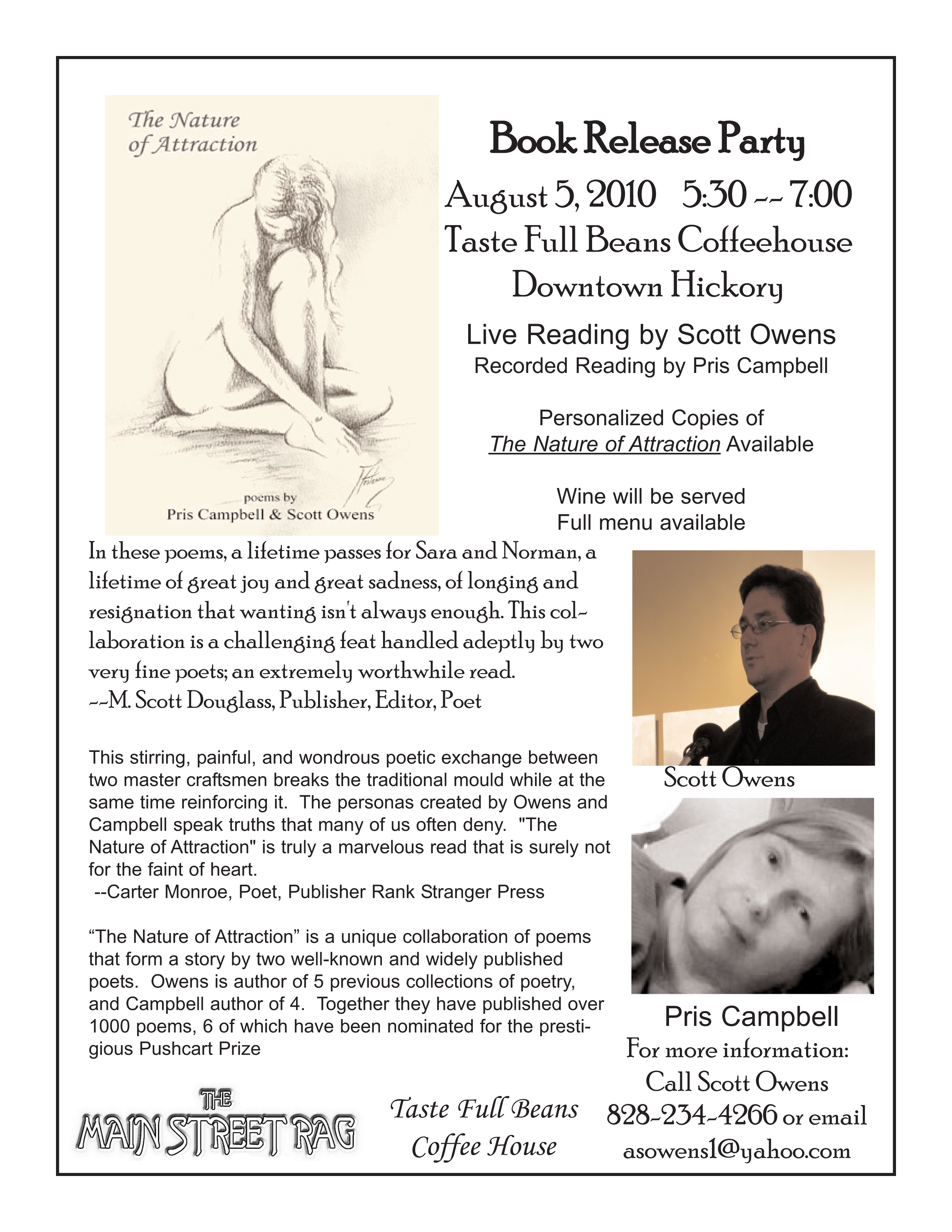
Finally, if you haven't heard yet, we'll be holding a Book Release Party for "The Nature of Attraction," my new collaboration with Pris Campbell, at Taste Full Beans on August 5, from 5:30 to 7:00.  The event will include a live reading from me and a recorded reading from Pris.  Wine and snacks will be served.  A promotional flier is below.  Feel free to share it with anyone you think might be interested.

Scott Owens
www.scottowenspoet.com
www.scottowensmusings.blogspot.com
www.poetryhickory.com
www.wildgoosepoetryreview.com
www.poetrycouncilofnc.wordpress.com
Click the image to view a larger document.


A new issue of Haiku Reality is online:

http://haikureality.webs.com/indexeng.htm


Anatoly Kudryavitsky sent this:

IHS International Haiku Competition 2010

The Irish Haiku Society International Haiku Competition offers prizes of Euro 150, Euro 50 and Euro 30 for unpublished haiku/senryu in English. In addition there will be up to 7 Highly Commended haiku/senryu.

Also, there will be prizes from Dóchas Ireland of Euro 100, Euro 30 and Euro 20 for unpublished haiku/senryu in English or in Irish Gaelic (with an English translation) about Ireland in the changing world + up to 3 Highly Commended haiku/senryu in this category. This category is only open for participants born or residing on the island of Ireland.

http://irishhaiku.webs.com/haikucompetition.htm

Sunday, June 20, 2010

Pravat Kumar Padhy - Three Questions

Pravat Kumar PadhyPravat Kumar Padhy, is a Petroleum Geologist, ONGC, in India. He received his Masters in Science and Ph.D in Applied Geology from Indian School of Mines, Dhanbad, presently lives with wife Namita at Rajahmundry (AP), India. He is blessed with two daughters, Smita and Rupa. He has published literary articles and poems in leading English news papers, journals, anthologies and e-zines. His literary work appears in 'Interviews with Indian Writing in English', Indian Literature, Anger in Action: Exploration in Indian Writing in English, Spectrum History of Indian Literature in English, Alienation in Contemporary Indian English Poetry, A Survey of Indian English Poetry etc. Awarded "Certificate of Honour" from Writer's Life Line, Canada. He was included in the International Who's Who in Poetry and Poets, Literary article titled "Abstract Poems" adjudged as the 2nd best entry in the Asian American Poetry e-Journal. Member, World Society of Poets, USA, Honoured as "Featured Poet" in Poetry Street e-Journal, UK, Editors' Choice Poet award by Poetbay, USA. Poetry award from Writers Guild of India. His haiku and tanka appeared in World Haiku Review, LYNX-Aha Poetry, Akita Haiku International Network, The Four Seasons Haiku, Notes From the Gean, Anglo-Japanese Society (Tanka Online) etc. Credited publication of verse, 'Silence of the Seas'.

Blog: http://www.pkpadhy.blogspot.com


1) Why do you write haiku?

Of late I came across the Japanese shorter version of poems and I respect the age old exquisite poetic work of iconic literary pursuits of Japanese poets. I always wish to express the poetic essence in a compressed way so as to make the reader feel a continuous journey through the preserved meaning of the flow of poetry. We all are integral part of nature entwining the philosophy of science and arts. The tiniest object of nature has its genuine worth in this world and it is associated with us in different forms. It is the discovery of this truth that has given rise to genesis of a haiku poem. Haiku give the meaning of cause and response of each entity through the aesthetic way of presentation. Haiku imparts life to every object with the help of vivid imagery. Essentially the genre of expression acts as a diligent medium of wide spectrum of exploration. Moreover, it gives a liberty of expressing the experiment. Writing haiku unveils the poetic essence and lively moments associated with all the entities within the fold of nature and human observations. Essentially it explores the uncommon in the common. This is the precise reason I like the shorter version, like haiku, senryu, tanka etc.

Recently I have the opportunity of reading the scholarly articles by A C Missias, Jeanne Emrich, Jim Kacian, Jane Reichhold , Elizabeth St Jacques and others. Alice Frampton (Associate Editor, The Heron's Nest), Hidenori Hiruta (Editor, Akita Haiku International Network), Lorin Forn (Editor, The Notes From the Glean), rendered immense encouragement about haiku and I always remain grateful to them. I share my poetic regards to Valarie Vandegriff , Beatrice V, Colin Stewart, Leislipaints, Anna, Yousei Hime, Hisashi Nakamura, Michel D. Brown, R K Singh, Aju Mukhopadhyay, Urmila Kaul, Kala Ramesh and other well wishers for their support.

My special regards to Poet Curtis Dunlap for rendering this beautiful opportunity to share my feelings to poet brothers and sisters of the world.

2) What other poetic forms do you enjoy?

I used to enjoy poetic feeling of expression at an early age. I always feel acknowledging nature, social feelings and metaphysical intuition in my writings. In an interview for the collection, edited by Atma Ram, I said, "Poems come to my mind as fragrance to flower. Anything I see, it creates a symbolic frame in my mind......... when I see a small grain of seed, I feel it is tiny / because it nests with care / the mightiest in it.

Earlier I wrote both longer and shorter versions of free verses. I feel more comfortable writing shorter poems, giving enough energy for unveiling the touch of beauty through brevity. Earlier I was not fully versed with the Japanese short verses and I used to compose concise style of poems and named the minimalistic expression as "Abstract Poems".

Recently I tried to express the perspective of poem writings, its essence in a mini autobiographical way, directly bridging the poets inner feeling and his relationship with the society. Moreover, such writings candidly export the poetic essence to society from the poet himself.

I also love to write senryu and tanka. These type of poems give an opportunity to pronounce human and philosophical excellence . Recently I have coined an idea of "Astro-Poetry" assimilating the essence of scientific entities in poetic canopy. In one of my poems titled "The Other Being" I wrote : At times I wonder/Perhaps we are the/Living images/Of distance cosmic rays/At an imaginative focal length.

I also enjoy reading haiga and haibun.


3) Of the many wonderful haiku you've written, what do you consider to be your top three?


creation is mystical
vast value of life
compressed in a seed

World Haiku Review, Issue 2, August, 2009


Dog is misspelled
the child discovered
the Great

LYNX-Aha Poetry, XXV:1 February, 2010


Desert land
measuring sand dune height
a lone lizard.

The Notes From the Gean, Vol.2, Issue 1,June 2010


If you've been enjoying this weekly series and have not contributed, please consider sharing your response (whether it be for haiku or tanka) to the three little questions that Pravat Kumar Padhy answered. You must be a published poet to participate.

Sunday, June 13, 2010

Alan Summers - Three Questions

Alan Summers lives in the UK. He was introduced to haiku when he walked into a local branch library in Ipswich, Queensland, and found two copies of The Haiku Handbook. Coincidently the following year Bill Higginson issued a call for his Haiku Seasons Project which resulted in the books: The Haiku Seasons: Poetry of the Natural World; and Haiku World: An International Poetry Almanac.

Alan had two flying fox haiku published in Haiku World. Bill's warmth and incredible day to day contribution to the haiku community is still a constant and very important inspiration to him. He urges everyone to buy copies of all three of these books, saying you won't regret it for a single second of your life.

Alan has since been published in Japan; as well as in numerous American; British; European; and Australasian magazines; plus Japanese newspapers such as Yomiuri Shimbun and Mainichi Daily News.

He is the renga/renku editor for Notes from the Gean, a Journal of Japanese Short Forms; and Haijinx (humor in haiku) editor for the United Kingdom; Ireland; Australia; New Zealand; Africa and the Indian Sub-Continent.

Alan Summers is a Japan Times award-winning writer for haiku and renga and was recently involved in what is believed to be the world's first Sign Language Renga (see Notes from the Gean). Alan runs various live renga/renku events around Britain and has just been commissioned for a six months renga project involving a city in Yorkshire.

Alan also runs The With Words International Online Haiku Competition with the next one being planned for later this year.

His Website: http://www.withwords.org.uk
His blog "Area 17" is at http://area17.blogspot.com/


1) Why do you write haiku?

My reasons have changed over the years, but mostly it sharpens my observational skills. We so easily overlook the smaller incidents of life which actually enrich our day to day existance.

2) What other poetic forms do you enjoy?

I write a hybrid form of ekphrastic poetry:

http://current.com/entertainment/music/89180182_the-searchers-by-paco-pomet-alan-summers.htm

It was high praise from artist Paco Pomet when he said:

"I was really moved by [the poem] and it is definitely the best compliment a painting can have." Paco Pomet, artist, SPAIN

3) Of the many wonderful haiku you've written, what do you consider to be your top three?

I often gauge what might be considered a "wonderful haiku" of mine when the general public get excited about a simple haiku at a reading or performance; workshop; or other activity that I do under the banner of With Words. For my flying fox haiku please buy a copy of the Haiku World.

The first of my chosen haiku is one of my most anthologised haiku and was featured in a full colour spread article in the Bristol Evening Post.

The second poem is a favourite of live audiences, and was also filmed live on BBC TV as part of a regional arts feature.

The third haiku was recently published in Wing Beats: British Birds in Haiku http://www.wingbeats.co.uk and has also been professionally illustrated by a friend of mine: http://tiny.cc/summerwind


the rain
almost a friend
this funeral

(first publication and selected)
Snapshots 4, Snapshot Press ISSN 1461-0833, Highly Commended, Haiku
Collection Competition (1998)
The New Haiku Snapshot Press, ISBN 1-903543-03-7 (2002)
First Australian Haiku Anthology ISBN 0 9577925 9 X ( 2003)


lime quarter ...
an icecube collapses
over jazz

(first publication and selected)
Presence haiku magazine ISSN 1366-5367 (2001)
Haiku Friends Vol. 1 ed. Masaharu Hirata, Osaka, Japan (2003)
City: Bristol Today in Poems and Pictures ISBN: 0954811704 (Paralaia 2004)
Twitter: Seven By Twenty (May 2010)


summer wind
a sparrow re-rights itself
at the peanut cage

(first publication and selected)
Wing Beats: British Birds in Haiku Snapshot Press ISBN 978-1-903543-24-5 (2008)
Haiku Friends Vol. 3 Ed. Masaharu Hirata Osaka, Japan (2009)
(earlier version) Azami haiku magazine, Osaka, Japan (1997)


If you've been enjoying this weekly series and have not contributed, please consider sharing your response (whether it be for haiku or tanka) to the three little questions that Alan answered. You must be a published poet to participate.

Sunday updates - 6-13-2010

Haiku Featured on Seattle Japanese Garden Audio Tour

Michael Dylan Welch has recorded two presentations about haiku for the new audio tour of the Seattle Japanese Garden. These professionally recorded and mixed tracks include koto and shakuhachi music performed by Elizabeth and John Falconer. One of these tracks, titled "Haiku and the Japanese Garden" (9:21 in length), is now available for free download or online listening. Check it out at http://itunes.apple.com/podcast/seattle-japanese-garden-audio/id370304184. Or visit http://www.seattle.gov/PARKS/parkspaces/JapaneseGarden/JapaneseGardenTour.xml. You can also download the CD liner notes at http://www.seattle.gov/parks/parkspaces/japanesegarden.htm#podcast. The second track, titled "Only in Seattle: An Introduction to Haiku Poetry" (approximately 22 minutes in length), will be broadcast on KSER radio sometime in June. On Sunday, June 6, 2010, the Seattle Japanese Garden celebrated its 50th anniversary.

Through the summer of 2010, the Haiku Northwest group has been holding its monthly meetings at the garden too, in their new meeting room. The May 13 meeting featured a presentation on Issa by Michael Dylan Welch. On June 10, Tanya McDonald talked about the haiku of Jack Kerouac. And on July 8, Richard Tice will talk about the haiku of Chiyo-ni. The August 12 presentation is still to be announced.

Seattle will also host a national quarterly meeting of the Haiku Society of America over the weekend of June 25-27, mostly at the Seattle Asian Art Museum, which is currently featuring an exhibit of Japanese woodblock prints (including Hokusai's "Great Wave").


M. Kei
has announced a special section at Atlas Poetica:


Saša Važic'
sent these updates:


Sunday, June 6, 2010

Anne Curran - Three Questions

Anne Curran is a Hamiltonian, New Zealander. She began writing haiku during the summer of 2009. Before that she was writing other forms of short verse. She lived in Japan for two years and enjoys many aspects of the Japanese aesthetic. Anne studied English and Communications at the University of Waikato, Hamilton. Her writing is inspired by the Hamilton landscape,and people. Hamilton is home to many wonderful artists. I have been encouraged by teachers
and family to write.


1) Why do you write haiku?

I started to write haiku during my summer holidays in New Zealand. I found it relaxing to sit down and produce haiku. This form also appealed to me because of its Japanese origins. I lived in Japan for two years in my twenties and found many aspects of the Japanese aesthetic coherent and peaceful. Perhaps then the haiku spirit is something I may have experienced and like to experience in my own life. I have gone on a haiku journey over the last five months. I started to write them possibly breaking all the rules and then with the guidance of a generous editor started to slowly integrate some of her advice into my work. I write about topics pertaining to my everyday urban life, local nature walks, and relationships. In the course of this learning curve I have really started to work on my editing processes as therein lies the challenge. I like the idea of haiku as an art form, the responses that a haiku might fetch from its readers, for example the questions it might raise, or the swallow of recognition.

2) What other poetic forms do you enjoy?

I enjoy haibun. I also enjoy longer poetic forms and have done some writing of this kind of poetry myself. I particularly enjoy poems about landscape and animals. Two of my favourite American poets are Robert Frost and Robinson Jeffers. Two of my favourite New Zealand poets are Adrienne Jansen and Anna Jackson. The poem of Adrienne’s that I most enjoy is titled ‘The Rain and the Spade’. Anna’s poem that I most enjoy is titled, ‘Hen of Tiredness’.

3) Of the many wonderful haiku you've written what do you consider to be your top three?


arms flung over a pool rung
a ripple wakes the surface
gossip between friends

Kokako 12, April 2010


as she turns to leave
my mother’s
girlish smile

Valley Micropress, June, 2010


beside the lake
a smiling tabby
bites a baby’s finger

(unpublished)


If you've been enjoying this weekly series and have not contributed, please consider sharing your response (whether it be for haiku or tanka) to the three little questions that Anne answered. You must be a published poet to participate.

Sunday updates - 6-6-2010

Saša Važic' sent this link to the

FWEE First Annual International Hydropower Haiku Writing Contest

http://www.fwee.org/haiku/contestinfo.html


Gabriel Rosenstock sent this link to Emerging from Absence: An Archive of Japan in English-Language Verse.

http://www.themargins.net/archive.html


The June issue of The Heron's Nest is online:

http://theheronsnest.com/


Shamrock Haiku Journal Issue 14 is online:

http://shamrockhaiku.webs.com/currentissue.htm


The fifth issue of Notes From the Gean is now online.

http://www.geantree.com/indexcover.html


Haiku Chronicles: Episode 12 - The Four Pillars Part I, The Narrow Thread has been posted.

http://www.haikuchronicles.com/


The next meeting of the Southeast Region of The Haiku Society of America will take place on Saturday, July 10 between 10:30 a.m. and 1:00 p.m.

For directions and other details, please contact meisterp@uah.edu.

Allow several days for a response, as I’m not online every day in the summer.


Commemorate Shinran Shonin's 750th Memorial Observance with Poetry Calling for Haiku and Tanka

http://www.ingassho.com/haikucontest/haikucontest.html


25 Tanka for Children: Call for Submissions

The Special Features section of the Atlas Poetica web site is seeking submissions for a collection of ’25 Tanka for Children’ edited by M. Kei. Selections should be suitable for children ages 6 - 12 (1st - 6th grade reading levels), and should address topics that will appeal to children (and their educators and families). Upbeat, fun, and silly tanka are welcome, but so are serious tanka that address topics children may have to deal with in their lives, such as the loss of a pet, divorce, disabilty, bullies, etc. However, the purpose of the collection is to engage children with tanka poetry, so serious subjects should be handled in a positive and entertaining way. Poets should speak to children, not ‘about’ children.

Form: Tanka, kyoka, waka, gogyohka, cinquain, cinqku, and other recognized variants of tanka in English are all welcome. Poems should be untitled. Although tanka are not usually rhymed, anything that engages the attention of children is a welcome addition to the work. Shaped tanka, acrostic tanka, and visual tanka are all welcome. No illustrations. All work should be reproducible in text only. The collection will attempt to present different variations of tanka, such as sanjuichi, SLSLL, 2-3-2-3-3 beats, free form, and the variants, such as cinquain, but literary value and appeal to children are paramount.

Limericks: One or two limericks may be published to compare and contrast tanka with the five line poetic form most likely to be known to children. Limericks should be the author’s original work and adhere to the guidelines. The editor reserves the right to omit limericks for any reason.

Pedagogic Value: Vocabulary and grammar should be age appropriate, with proper English syntax. Although poems will be selected based on their appeal to children (test them out on any children you might have access to), poems will also be evaluated for their value in teaching basic elements of literature, such as alliteration, rhythm, metaphor, simile, etc.

Possible Teachers Guide: Poets who work with children in any capacity are invited to share their credentials and to comment briefly upon their poems regarding pedagogic value. These comments might be edited and expanded to become a ‘teachers guide,’ and poets understand that their commentary, if used, will receive a credit. The ‘teachers guide’ is not a firm project, and there is no guarantee that it will happen.

Age: The general Atlas Poetica guidelines apply, therefore poets must be 16 or older. Please visit http://atlaspoetica.org/ for complete guidelines and to view previous Special Features. Poems should be contained in the body of an email. Please query before sending attachments.

Submissions: Poets are invited to send up to ten poems each, but only one poem will be chosen by each poet, in keeping with the theme and format of the ’25 Poems’ features on the Atlas Poetica website. Send to: editor@AtlasPoetica.org, with a subject line of ‘Tanka for Children.’

Deadline: Deadline for submitting to ’25 Tanka for Children’ is September 15, 2010. The planned publication date is Winter 2010/2011. Special Features are published on an irregular schedule.

Email address for submissions: Editor (at) AtlasPoetica (dot) org -- subject line: 25 Tanka for Children


Hi All:

This has been the busiest year ever at Red Moon Press, with half a
dozen new titles already prepared for the new year (our 18th), and a
couple more coming soon. We think you'll find something for every
haiku reader and taste.

Here's what's new:

Individual Collections

• Stephen Addiss — Cloud Calligraphy
This volume finds Addiss at his most playful and features 6 of his
inimicable haiga as well. “Stephen Addiss creates an interconnected
meditation with both brush and ink. Each
poem starts on the page, but finishes in the reader’s mind! His
poems are so full of movement they have the power to stop us, and put
us back in the moment.” —Stanford M. Forrester, Editor, bottle
rockets


• Dimitar Anakiev — Rustic
Anakiev’s fourth book with RMP (At the Tombstone, Kosovo Peonies,
balcony) features 50 recent poems, each reflecting upon a different
keyword, and each with copious notes as to the origins of the poem
and the concept at hand. ". . . a literary historian’s dream,
providing the author’s statement of intent and detailed notes.
Reading the individual poems in context shows them to be simple and
profound, inviting the reader to join the poet in contem-plating
culture, history, and our collective roots in the natural world,
including chaos and war.” —Johnye Strickland, Professor Emeritus,
University of Arkansas


• Jim Kacian — where i leave off / waar ik ophoud
Produced by ’t schrijverke of the Netherlands in a bilingual
(English / Dutch) edition, this is Kacian’s 15th book devoted to
haiku. This one explores the one-line haiku, and includes a mini-
essay on the subject, as well as more than 50 examples, along with a
selection of his miniature “one-bun,” haibun where the prose is
limited to a single sentence. "Kacian breaks new ground by
systematically exploring the possibilities of one-line haiku in
English.” Max Verhart, Editor, Vuursteen


• Dietmar Tauchner — as far as i can
This is Tauchner’s long-awaited first full-length book of haiku in
English, and he doesn’t disappoint. The book pivots about a visit to
the Mauthausen Prisoner Camp, which provides perspective on the
poet’s life and pursuits. “Lean and quiet, the haiku in this
excellent collection convey deeply felt connections with nature,
other people, and the inner self. They dignify the commonplace and
affirm the unknown and mysterious within the familiar.” —Peggy
Willis Lyles, Editor, The Heron’s Nest


• Jim Westenhaver — long enough
This poet’s first book of haiku suggests he will be a name to watch.
This elegiac meditation on the fleeting touch between two people will
stay with you. “What is unsaid pulses through long enough, and yet
this slim collection of 27 poems overflows itself. Each haiku speaks
to the next; the white space between vibrates with increasing energy
until the last poem ricochets back to the first, demanding the book
be re-read wholly anew.” —Eve Luckring


Annual Publications

• where the wind turns: The Red Moon Anthology of English-Language
Haiku 2009
The fourteenth volume of the most decorated series in haiku history,
where the wind turns features 161 poems, 12 linked forms, and 6
critical essays on the reading, writing and study of the genre.
“Simply the best thing out there.” —Charles Trumbull, Editor,
Modern Haiku


• contemporary haibun Volume 11
This eleventh volume of the only series devoted to the best haibun
and haiga produced in English features 70 poems and 32 haiga..
“contemporary haibun has stood alone, for nearly a decade, as the
chief vehicle and bulwark of the burgeoning haibun movement in
English.” —Jeffrey Woodward, Editor, Haibun Today


Special Publications


• Ruth Franke — Schwerelos Gleiten / Slipping through Water
This innovative new book combines short prose and verse (haibun) with
visual artistic impressions by the renowned German artist Reinhard
Stangl. The 22 haibun invite the reader to enter the atmosphere of
the different scenes and allow the multi-layered content to take
effect. English versions by David Cobb and Celia Brown. Preface by
Jim Kacian. A magnificent production by Wiesenburg, distributed in
North America by Red Moon Press.


Coming Soon


• Carolyn Hall — How to Paint the Finch’s Song
Hall’s second major collection, out in June.

• Robert Boldman — Selected Haiku
Boldman’s return to haiku after a 25-year hiatus. Publication date
to be determined.


You can find these, and much more, at <www.redmoonpress.com>.
As always, thank you for your continuing support.


Jim Kacian
Red Moon Press

Sunday, May 30, 2010

John W. Sexton - Three Questions

John W. Sexton (Republic of Ireland) was born in 1958 and is a novelist, radio scriptwriter, short-story writer and poet.

He is the author of four poetry collections: The Prince's Brief Career, (Cairn Mountain Press, 1995); Shadows Bloom / Scáthanna Faoi Bhláth, a book of haiku with translations into Irish by Gabriel Rosenstock (Doghouse, 2004); Vortex (Doghouse, 2005); and Petit Mal (Revival Press 2009).

He is also the blog poet Jack Brae Curtingstall.

He is a past nominee for The Hennessy Literary Award and his poem The Green Owl won the Listowel Poetry Prize 2007. In 2007 he was awarded a Patrick and Katherine Kavanagh Fellowship in Poetry.


1) Why do you write haiku?

I'm a full-time writer and poet and currently write haiku, quite honestly, to keep my mind focussed and my heart still. I spend some time each day writing minimalist notation into my haiku notebook because it serves three essential functions: it helps me to hone my observation, my empathy and my powers of description. In my view minimalist notation is the best form of practice for a writer. When I teach haiku in schools (I spend most of the school-year working under Poetry Ireland's Writers-In-Schools Scheme) I always underline those three essentials for my students and ask them to practice minimalist notation as well.

My first introduction to haiku was in the early 70's when I was a teen and came, like many of my generation, upon those tiny collections from the Peter Pauper Press. I immediately fell in love with Issa and a few lesser-knowns like Ryusui and Sokan. Being an Irishman I have an innate sense of place, it's a Celtic thing, and so haiku resonated with that immediately.

My own haiku practice for the next 30 years was mainly 5-7-5 and took the form of the odd haiku entering my mainstream poetry. Then, in 2004 I began a year-long, very intensive haiku apprenticeship under the Irish haijin Gabriel Rosenstock. It was a liberating and revelatory experience.

2) What other poetic forms do you enjoy?

All of them. Poetry should not be limited to a single approach otherwise it will become stultified and narrow. My haiku informs my other poetry and the other way round. In recent years, however, I have found minimalist forms have been taking a greater amount of my time and interest. As well as pure haiku I also like working with gendai and one-line forms; but a personal love (because I am also a prose writer) is haibun, which I find particularly satisfying to attempt.

3) Of the many wonderful haiku you've written what do you consider to be your top three?

I doubt that anything I've written is wonderful, and I always become dissatisfied with my work over time. Which is a good thing, actually, because it's that dissatisfaction that compels me to write more. But here are a few fairly recent ones that I'm happy with for various reasons. I find making a choice extremely difficult, so I'll start with something straightforward, on the assumption that I won't go too far wrong.


rain all day long
with each bite
sunlight from the apple

Haiku Scotland, Issue 18

marlene mountain's theories have become of increasing importance to my own minimalist notation in recent times and I think she is far too under-appreciated. One-line, in all its different approaches, is something I find purifying and stilling.


blue metals fastening the air dragonflies

Roadrunner, November 2007

And finally, an elegy. The late Bill Higginson was a great teacher. I disagreed with him on a variety of issues but he was generous and wise in many things. When he died I felt a genuine sadness even though I knew him only through cyber correspondence. I remember walking out one night sometime after he'd gone and, looking up at the moon, getting a revelation of destiny. And I offered that haiku for him, as a small prayer.


beyond emptiness
the moon filling itself
for certain

i.m. William J. Higginson

The Heron's Nest, December 2008


If you've been enjoying this weekly series and have not contributed, please consider sharing your response (whether it be for haiku or tanka) to the three little questions that John answered. You must be a published poet to participate.

Sunday updates - 5-30-2010

This just in from Dave Russo:

Here is a gallery of photos from last week's Haiku Canada:


Haibun Today (June 2010) is now online

The summer quarterly issue of Haibun Today is now online for your reading pleasure at http://haibuntoday.com

Contributors to the current issue include Hortensia Anderson, Owen Bullock, Anton Capri, Glenn G. Coats, David Cobb, Tish Davis, Cherie Hunter Day, Charles Hansmann, Jeffrey Harpeng, Michele L. Harvey, Keith Heiberg, Graham High, Ruth Holzer, Marleen Hulst, Roger Jones, Bob Lucky, Mary Mageau, Johannes Manjrekar, Francis Masat, Renée Owen, Dru Philippou, Patricia Prime, Ray Rasmussen, Bruce Ross, Cynthia Rowe, Mark Smith, Richard Straw, Diana Webb and Theresa Williams.

Writers are now invited to submit haibun and articles for consideration in the September 2010 issue of Haibun Today. Consult our Submission Guidelines at Haibun Today. Forward any submissions by email to Jeffrey Woodward, Editor, at haibun.today@gmail.com


The Football Haiku World Cup

The Football Haiku World Cup is a project based on the writing of haiku poetry specifically geared to the football World Cup in South Africa in 2010. We want to publish beautiful poetry written by you to accompany the beautiful game.


CONTRIBUTE A FOOTBALL HAIKU

The basic question for the project is "What has the football World Cup ever done for us?" based on the Monty Python question "What have the Romans ever done for us?"

Writers are encouraged to send in a single football-related haiku that they have written in answer to that question.

Writers from anywhere in the world are encouraged to send in work.

Writers can send in haiku in any language, though it would be helpful to us if you can provide an English translation as well (but not necessary). It is a World Cup, after all, which is as much a festival of language as a festival of football.

Send us a single football-related haiku written by you to: enter.haiku@gmail.com

Ffi: http://haikuworldcup.blogspot.com/


THE FOOTBALL HAIKU WORLD CUP TEAM

* Matthew Devereux, Woking, Surrey, England
* Alan Summers. Founder of With Words
* Tim Souster. A primary school teacher in London, England; reviewed
for "The Times Literary Supplement" and "The Financial Times".
* Timmy Killeen runs the English Football Post and is based in Galway, Ireland.
* Peter Ulrik Roeder is the author of "Game Over" and is based in Lyngby, Denmark.
* Adriana Piccardo, creator and administrator of a haiku group at Facebook and is based in Buenos Aires, Argentina.
* Roxana Elena Roseti is an editor on the Romanian newspaper Jurnalul National.


CONTRIBUTE A FOOTBALL HAIKU (AND HOPEFULLY GET PAID FOR IT) OR DOWNLOAD THE FORTHCOMING EBOOK: HOW THE PROJECT WORKS

The basic idea is very simple.

Firstly, there will be an ongoing ebook of the haiku we receive that can be downloaded. People downloading that ebook can choose to pay any amount that they like, based on the same funding model as the seminal Radiohead album "In Rainbows".

Once we have received a decent number of initial haiku, we can then offer the first version of the ebook for download. So please send your haiku to us as soon as possible.

After that, in the long-term, those haiku can be put together along with specially commissioned illustrations for a book that will be published and available in shops at a set price. We are interested to hear from artists and designers.

Of the initial money that is received from those donating for the downloadable ebook, 25% will go to the small team orchestrating and editing the ebook.

25% will be paid equally to contributors of haiku that are selected to be part of the project. 25% will be provided as special prizes to the writers of the three haiku that are voted as the best by readers of the ebook.

The remaining 25% will be given to a football-related good cause voted on by contributors and readers of the ebook.

So if you contribute a poem or download the ebook, please also send over the name of the football-related good cause you would like to see money donated to enter.haiku@gmail.com.

If you are an individual or organisation that would like to become a partner or patron or supporter of the project, and would be able to contribute financially to it to help us make it happen (no matter how small a contribution), please also contact us immediately at enter.haiku@gmail.com.

In exchange for your contribution we will provide you with a link in the ebook.

Please send us a single football-related haiku written by you to: enter.haiku@gmail.com

Ffi: http://haikuworldcup.blogspot.com/

Wednesday, May 26, 2010

Poets and Poems - Joseph Milford


ALABAMA GRANDPA

He would walk out to the garden and eat an onion like an apple.
He wore the camel's hair and leather but did not sup on cicadas and tupelo honey.
He would take the buttermilk in a tall glass and stir in the cornbread.
He would take dead birds and taxidermy them and put them on the mantelpiece.
He would cut wooden swords for you from plyboard, shields too.
He would use the hearing-aid faltering as a way to ignore usual bullshit.
He would shoot up insulin in a matter of fact way, talking of football.
He would let crows fly out of his crow's feet around his watery eyes.
He would not comfort you--he would reassure you--hand you a set of tools.
He would plant the okra plant the squash plant the 'maters husk the hewn.
He would never complain he would never swear he would never part his hair.
He would not own a gun or talk bad about my mom or abandon a friend.
He would not cry when rattlesnake killed Snowball the cat but he cried for Fred the terrier.
He would never leave the table without a burp and he loved those Cheez-Its.
He would claim only once to have seen a UFO, and it was only real for me in his voice.
He would build miniature cities and dollhouses and sheds that were replicas of his shed.
He would become the bear that talks to me in my dreams, and he would be stern.
He would walk with a walker towards the end he would levitate he would hover.
He would always answer the phone when I called and say, "Hey Buddy-Ro!"
He would whittle, never spit--he would not cantanker--he was even-keel.
He would build a tire-swing for anyone--he would comb his hair back smiling.
He would fix a railroad track in the knick of time and steal two seconds for himself.
He whittled toothpicks of the next nonchalant moments, birds stealing splinters for nests.


If you would like to participate in this series, send a photo of yourself composing a poem or writing or a picture of a location where you enjoy writing, along with one of your poems (the type/genre of poem doesn't matter). This series will allow us to see the various locations that inspire us or where we go to write.

Wednesday updates - 5/26/2010

Mark Brooks sent this:

During the first half of May, the home offices of haijinx relocated from Austin to Georgetown, Texas. As a result, the haijinx wire went offline for a few weeks. The news feed will restart May 21.

Also, since there has been such a disruption to our online presence, the deadline for the haijinx quarterly, a journal focused on putting the hai back in haiku, will be extended until June 1. More details can be found in our original call for submissions and our submissions page

Thanks for your patience!

Mark Brooks
Christopher Patchel
Carmen Sterba
Alan Summers


This just in from Carolyne Rohrig:

2010 San Francisco International Competition

Haiku, Senryu, Tanka and Rengay

Sponsored by: Haiku Poets of Northern California

Deadlines for Haiku, Senryu, and Tanka: In hand, October 31, 2010

Deadlines for Rengay: In hand, November 30, 2010

Details

All entries must be original, unpublished, and not under consideration elsewhere. There is no limit to the number of submissions. A first prize of $100 will be awarded in each of the four categories. For the Haiku contests, second and third prizes of $50 and $25 will be awarded. Contest results will be announced at the first HPNC meeting in January and in the HPNC Newsletter. Winning poems will be published in the Spring/Summer issue of Mariposa, the membership journal of the HPNC. All rights revert to authors after the contest results are announced. This contest is open to all except the HPNC president and, for their respective categories, the contest coordinators and the judges (who will remain anonymous until after the competition, except rengay contest). 

Haiku, Senryu, and Tanka Submission Guidelines

Type or print each entry on two 3 x 5 cards. In the upper left corner of each card identify its category as Haiku, Senryu, or Tanka. On the back of one card only, print your name, address, telephone number and e-mail address (optional). The entry fee is $1.00 per poem. Send haiku, senryu and tanka submissions, along with entry fee, to HPNC, c/o Carolyne Rohrig, 37966 Parkmont Dr., Fremont, CA 94536.

Rengay Submission Guidelines

All rengay must be titled. For two people (Poet A and Poet B) follow this linked format: 3 lines/Poet A, 2 lines/Poet B, 3/A, 3/B, 2/A, 3/B. For three poets (A, B, and C) the format is: 3 lines/A, 2 lines/B, 3 lines/C, 2/A, 3/B, 2/C. Type or print each rengay on three letter-size sheets. Include full authorship information, stanza by stanza, as well as all poets' names, addresses, telephone numbers and e-mail addresses (optional) on one copy only. On the other two copies, mark stanzas with letters only (poet A, poet B, poet C) to indicate the sequence of authorship. The entry fee is $5.00 per rengay. The rengay judge will be announced later. Send rengay submissions to HPNC, c/o Fay Aoyagi, 930 Pine St. #105, San Francisco CA 94108.

Entry Fees

Make checks or money orders payable in U.S. dollars to "Haiku Poets of Northern California (HPNC)." Cash (in U.S. currency) is OK. Enclose a business-size SASE (U.S. first class postage or an IRC) for notification of contest winners. No entries will be returned, with the exception of late submissions, or those received without payment. These will be returned using your SASE; without an SASE these entries will be discarded. 

Thank you for participating in this year's contest.

If you have any questions, please contact Carolyne Rohrig by e-mail (carolyne.rohrig@gmail.com)

http://www.hpnc.org    


Saša Važic sent these updates:

(Scroll down to see the winners in the haiku category.)

~ ~ ~

~ ~ ~

Sunday, May 23, 2010

Marilyn Appl Walker - Three Questions

Marilyn Appl Walker grew up on the High Plains of Kansas near the Colorado border. She is a poet who now lives in Madison, Georgia with her husband, Marshall. In 2002 she became acquainted with haiku after ordering several poetry books. Since 2003, her work has appeared in leading haiku journals and has received honors in Canada, Japan, the United States and the United Kingdom.


1) Why do you write haiku?

There are many reasons but I think mainly my hope is to capture a moment in time and make that certain moment continue to live, much in the way a photo makes a moment live. In addition to sharing my own haiku, it is exciting to be a part of a writing community and look forward to each poet's contribution to the genre.

2) What other poetic forms do you enjoy?

Through the years I have enjoyed rhymes, free verse, and more recently tanka; but haiku has become my first love.

3) Of the many wonderful haiku you've written, what do you consider to be your top three?

As of the moment, these are my choices.


we bring home
the wild magnolia seeds
starlit night

Frogpond, XXVIII.2, 2005
October Winner, HCC, 2006
Haiku Calendar, 2007


winter drizzle
the child's red crayon
worn to a nub

February Runner-Up, HCC, 2008
Haiku Calendar, 2009
The Red Moon Anthology of English Language Haiku of 2008


thunder moon
odor of the rodeo
kicking up

Frogpond, XXXI.1, 2008
July Winner, HCC, 2008
Haiku Calendar, 2009


Photo credit: Marshall Walker, March, 2010

This backyard cherry tree is a highlight of spring.


Many thanks Curtis, for making this series so special.

All Best Wishes,
Marilyn


If you've been enjoying this weekly series and have not contributed, please consider sharing your response (whether it be for haiku or tanka) to the three little questions that Marilyn answered. You must be a published poet to participate.

Sunday updates - 5-23-2010

Sachiyo Ito sent this press release:

Poetry in Motion

Thursday – Saturday, June 10-12, 2010 at 8pm
Joyce SoHo, 155 Mercer Street, New York City (Houston/Prince)
Direction: 6 to Bleecker, R to Prince, B/D/F/V to Broadway-Lafayette
Contact Information
For press ticket requests: Cathy Eilers, Joyce SoHo Program Manager 212-334-9907 or ceilers@joyce.org
For non-press ticket inquiries: Sachiyo Ito, Artistic Director 212-627-0265 or sachiyoito@verizon.net
Box Office: 212-242-0800/www.joyce.org
Ticket: $20 15 (Student/Senior/Dance Pass)

Poetry in Motion is a collaboration of dance, poetry recitation and music.  Created by award-winning New York City based Japanese dancer and choreographer, Sachiyo Ito, it fuses together music, dance and poetry drawn from ancient and modern sources.  Presented through dance, the language of the soul, it aims to deepen and strengthen the connection within ourselves, with others and the world.

Selected poems include Chieko-sho by Japanese modern poet Kotaro Takamura, Before the Beginning by Rainer Rilke, Please Call Me by My True Names by Thich Nhat Hanh, Summer Day by Mary Oliver and Only Breath by Rumi. Guest singers and musicians include Beth Griffith, Elizabeth Knauer, Egil Rostad, and Yukio Tsuji.

The program offerings include two revivals from the 80s and 90s. Please Call Me by My True Names is a revival of the 1981 Joyce SoHo production originally entitled as An Invitation to Bell- reproduced at Lincoln Center in the same year. The dance is based on a poem written by Thich Nhat Hanh about a young boat refugee raped by a sea pirate. The year 2008 marked the 30th anniversary of the poem, but the condition of our society has changed little and Hanh’s voice of humanism is still resonant today. Day-to-day, we are surrounded by tragedies, the adverse conditions of our own humanity and violence stemming from hatred and prejudice. We are in need of finding inner balance and Please Call Me by My True Names invites the audience to contemplate together on a message calling for compassion, reconciliation and inner harmony-the basis for world peace. Another revival is Chieko: the Element, choreographed to the contemporary poem, Chieko-sho. The piece was originally produced in 1985 at Japan Society and the poem will be sung and recited to a score set by Dan Erkkila.

The ensemble piece, Only Breath, features dancers from various disciplines, cultural backgrounds and ethnicities. The dance calls for the coming together of all humanity on earth to form a global village surpassing boundaries of east, west, and other geographical, cultural, and social differences. 

From The New York Times: Peace Quest, Personal And Global

Sachiyo Ito and Company offered a 'Concert Dedicated to World Peace' on Saturday afternoon at the Clark Studio Theater and made the program artistically meaningful as well as idealistically honorable. …In 'An Invitation to Bell,' a production emphasizing processional movements for Ms. Ito and for an ensemble, Jennifer Kato read poems by Thich Nhat Hanh, a Vietnamese monk and peace activist. Many celebrated a spirit of renewal, and the choreography was appropriately calm. But poems about violence and tyranny inspired jagged gesticulations from Ms. Ito. Then order was restored and the audience was invited to join the cast in a meditative walk onstage. Most accepted, stepping serenely while guided by the sounds of a gong and a bell. The unhurried progress became a pilgrimage into peace. (Jack Anderson, December 14, 1999)

Sachiyo Ito has brought together East and West through her delicate and powerful performances of classical, traditional and contemporary Japanese dance for the last 40 years. In 2008, she received the Foreign Minister’s Award from Japanese Foreign Ministry. Born in Tokyo, she has taught at major colleges such as the Juilliard School and New York University since 1972. She holds a M.A. and Ph.D. in Dance from New York University. She was awarded the name, Sachiyo Fujima from the Fujima School of Japanese classical dance in Tokyo. She was Kabuki consultant for the Off-Broadway revival of Stephen Sondheim’s Pacific Overtures, and choreographer for Off-Broadway productions of Shogun Macbeth. Extensive performance credits in Japan, U.S., South America, and Europe include: American Dance Festival, Alice Tully Hall at Lincoln Center, Japan Society, Asia Society, City Center in New York, Kennedy Center in Washington DC, Dublin Theatre Festival, and Bonn International Dance Workshop.

The creation of Joyce SoHo was made possible by the magnanimous support of the LuEsther T. Mertz Charitable Trust.  Joyce SoHo is supported by private funds from the Carnegie Corporation of New York, Robert Sterling Clark Foundation, Doris Duke Charitable Foundation, First Republic Bank, The Andrew W. Mellon Foundation, The Fan Fox and Leslie R. Samuels Foundation and The Shubert Foundation and by public funds from the New York City Council the New York City Department of Cultural Affairs the New York State Council on the Arts, a state agency the American Recovery and Reinvestment Act of 2009 and the National Endowment for the Arts, which believes that a great nation deserves great art.  Special support for Joyce SoHo has been provided by The Harkness Foundation for Dance New York Community Trust Goldman, Sachs & Co. and Foundation for Contemporary Arts.


Three New Tanka Titles published by MET Press

Modern English Tanka Press is pleased to announce the publication of three new collections of fine tanka in English. Two are individual collections and the third is a collaborative effort.

May 1, 2010 – Black Jack Judy and the Crisco Kids: Bronx Memories, by Alexis Rotella, is the latest in a series of fine collections of Rotella’s verse published by MET Press. In a bravura performance, Rotella adopts her husband’s voice to write his “autobiography” in verse. This memorable work evokes a potent sense of time and place, another world, long gone. This is a must read for Rotella fans and for all lovers of fine poetry. M. Kei, editor of Atlas Poetica: A Journal of Poetry of Place in Contemporary Tanka, says, “In Black Jack Judy and the Crisco Kids, Alexis Rotella writes her husband's autobiography as if she had lived it herself. Replete with moments both magical and tragic, she provides a portrait of Italian American life at a time when there were still small farms in New York City, Italians were discriminated against, mothers plotted marriage, and all manner of relatives, friends, neighbors, and coworkers might appear at the dinner table. Each moment is rendered in tanka or kyoka, and occasionally prose or senryu. A piece of broken mirror the shape of Sicily, the curls from a little boy's haircut, a Christmas pizza with a star made of anchovies, and many other details paint a vivid picture of life long ago in a fairy tale country called the Bronx.”

May 2, 2010 – Home to Ballygunge: Kolkata Tanka by William Hart, has been published as a pocket paperback by MET Press of Baltimore, Maryland. Preparations for the book were begun inadvertently in the summer of 1986, when William Hart married his graduate school girlfriend in Kolkata (Calcutta at that time) and met several hundred of his new Bengali relatives. Return visits to India in the years since have convinced Hart that he does indeed have a home in the largely middle-class district of Ballygunge. In writing the poems, Hart tried to portray his Indian family and their city with accuracy, insight, and a bit of magic, as the subjects require. The sixty poems in the cycle borrow from the Japanese waka or tanka for their form. William Hart’s poems and stories have appeared in several hundred journals, newspapers and anthologies, including most periodicals that feature English-language haiku or tanka. Nine of Hart’s poetry collections have been published, along with two well-received novels. One of his haiku collections, Paris, won a Merit Book Award from the Haiku Society of America in 1996. Hart also produces documentary films with his wife for PBS.

May 17, 2010 – Double Take: Response Tanka, by Sonja Arntzen and Naomi Beth Wakan, has been published as a trade paperback by MET Press. It is an extraordinary collection of responsive tanka. Michael Dylan Welch says, “You will surely come back to these poems for a closer reading, returning to each collaborative pairing to dwell in their candor, their echoes, their surprising turns, their drinking in of all it means to be alive.” Angela Leuck writes, “Like the pleasure of a lingering, afternoon tea party, Double Take is a book that you’ll want to read slowly and savour.” Beverley George says, “Double Take demonstrates the power of the compressed poem to delight and satisfy an attentive reader.”

These fine books are available from www.Lulu.com/modernenglishtanka. Publisher information is available online at www.themetpress.com

About MET Press: MET Press (Modern English Tanka Press) is an independent publishing house in Baltimore, Maryland, dedicated to producing work of lasting literary value, especially fine verse. A family business, we treat our customers and partners in publishing like family. We use modern print-on-demand production and distribution methods. Our special mission is to promote the tanka form of poetry and to educate newcomers about this most ancient poetic form.

Contact: Denis M. Garrison, owner, MET Press / Modern English Tanka Press, 443-559-2776
Email to dmg@themetpress.com


best wishes,
Denis
MET Press, www.themetpress.com
dmg@themetpress.com


Dave Russo sent this:

The Haiku Foundation is looking for an Assistant Web Administrator


Paul Conneally sent this:

Photos of Acorn Bank Full Bloom Renga On Sticks


A new issue of Lynx is online:

http://www.ahapoetry.com/ahalynx/252hmpg.html

Sunday, May 16, 2010

Susan Delphine Delaney - Three Questions (Tanka)

Susan Delphine Delaney MD, MS is a psychiatrist practicing in Plano, Texas. Her therapy dog, Gabriella, assists. Susan has been writing small poems since 1968 when a friend gave her a book with the poems of Basho and Issa. Her haiku and senryu have been published in 19 different haiku journals, books and anthologies. Her tanka have appeared in Lynx, American Tanka, Firepearls and Atlas Poetica. Susan is the founding Vice President of the Fort Worth Haiku Society and founded the Haiku Poets of North Texas.


1) Why do you write tanka?

I really never planned to write tanka, as I considered learning to write good haiku a persuit that could last a lifetime. Nonetheless, I published a tanka now and then in Lynx and American Tanka. Then my e-friend M. Kei asked me to write some tanka for Firepearls. Then I was invited to send some to Atlas Poetica.

I believe that some nature moments and some relationship moments fit the tanka form better, as the length of a tanka allows a bigger 'setup' of the situation than a simple kigo could ever provide.

2) What other poetic forms do you enjoy?

Haiku, senryu and free verse. I am particularly fond of renga and have written e-renga with poets from all over the world.

3) Of the many wonderful tanka you've written, what do you consider to be your top three?


sixty years later
still the same
poison ivy vine
clinging to the faucet
near my brother's grave


hugging
a load of knits
warm from the dryer
remembering a baby
now grown


again and again
watching
the breakup of Columbia
through budding branches
of sweet gum


If you've been enjoying this weekly series and have not contributed, please consider sharing your response (whether it be for haiku or tanka) to the three little questions that Susan answered. You must be a published poet to participate.