Lenard D. Moore had a poem published recently in The News & Observer. The title of the poems is "At The State Fair".
http://www.newsobserver.com/2012/10/11/2406545/at-the-state-fair.html
Brendan Slater sent this:
Press Release: Yet To Be Named Free Press
Founding Editor: Brendan Slater, brendan@yettobenamedfreepress.org
Anthology Editor: Alan Summers, alan@yettobenamedfreepress.org Brendan Slater, Yet To Be Named Free Press
Submissions: subs@yettobeneamedfreepress.org
www.yettobenamedfreepress.org
YTBNFP is an indie publisher utilising POD to get fresh, exciting, experimental, quality short-verse out into the market place without all the overheads of a traditional publishing business, in fact we are not a business we are a co-operative and non-profit making, our authors, editors and artists get equal shares of any profits, we also plan to set up a trust fund for poets who are hard up and cannot afford books or their gas bills, etc. This will take some time setting up as short-verse is a niche market, we don't expect to get rich from this, if we wanted that we'd be publishing 50 shades of my Vicar's wife's knickers, or something less tasteful.
Our first title released in August is Four Virtual Haiku Poets (http://www.yettobenamedfreepress.org/p/four-virtual-haiku-poets.html), an anthology of the work of Scott Terrill, Brendan Slater, Colin Stewart Jones and Michael Goglia, edited by Alan Summers and Brendan Slater. It's available through Amazon at $7.50, £5.00 and €6.00.
Our second title also released in August is In Bed With Kerouac (http://www.yettobenamedfreepress.org/p/in-bed-with-kerouac.html), a mixed genre book by Brendan Slater, available through Amazon at $7.50, £5.00 and €6.00.
Our third title has just been released, Does Fish-God Know, a collection of gendai haiku by Alan Summers. More information to come in a separate press release @ http://www.yettobenamedfreepress.org/p/does-fish-god-know.html
We are also accepting submission for an anthology called c.2.2. Where only pen names will be published. Please visit this address for guidelines: http://www.yettobenamedfreepress.org/p/call-for-subs-anthology-c22.html
Selected poems from our first three titles can be read here: http://www.yettobenamedfreepress.org/p/selected-poems.html
Please stop by and take a look, maybe you'll like what you see, maybe you'll want to get involved, we're always open to fresh ideas to take short-verse to new and exciting places.
--- Brendan Slater, Yet To Be Named Free Press
Howard Lee Kilby sent this:
The 17th haiku conference in Hot Springs National Park, Arkansas is moving forward steadily. Haiku Hot Springs will be held at the Arlington Hotel, Friday and Saturday, November 2-3, 2012 from 9 am - 5 pm both days. There is a conference rate of $84 plus tax for those who wish to attend: www.arlingtonhotel.com use HAIKU as the code word and if there are any problems in making a reservation call 501-767-6096 also for information. Here are some of the poets attending as of this moment: Charles Trumbull, Santa Fe, NM, Sonia Coman and her husband Eduard from New York, NY, Dr. Jianqing (John) Zheng of Itta Bena, MS, Susan Delphine Delaney, M.D., Plano, TX, Christine Spindel, Memphis, TN, Celia Stuart-Powles, Tulsa, OK, Gordon Bradford, Bella Vista, AR, Vic Fleming, Little Rock, AR, R. Paul Tucker, M.D., Hot Springs, AR, Carlos Colón, Shreveport, LA, and other poets.
Hot Springs National Park, Arkansas is the first land set aside by congress long before the national park system was established. It was set aside in 1832 by congress for the benefit of future citizens to enjoy the healing waters of the Valley of the Vapors. This is also the city where a young seven-year-old fatherless boy began elementary school after moving here with his mother. He grew up and became first the governor of Arkansas and then president of the United States. Bill Clinton played jazz in Hot Springs in the 50's and early 60's while still in high school.
For information please contact Howard Lee Kilby, Arkansas Haiku Society at hkilby@hotmail.com please use Haiku Conference in the subject line to telephone 501-767-6096. Mahalo.
ayaz daryl nielsen sent this:
bear creek haiku now has a blog site
http://bearcreekhaiku.blogspot.com/
ayaz daryl nielsen, editor of bear creek haiku, has two collections of poetry recently released, 'Concentric Penumbras of the Heart' and 'haiku tumbleweeds still tumbling'
And finally, something for you to consider:

Tuesday, October 16, 2012

Sunday, October 14, 2012
Updates - October 14, 2012
A new issue of Haiku Reality is online:
http://haikureality.webs.com/indexeng.htm
Pamela A. Babusci sent this:
MOONBATHING
A JOURNAL OF WOMEN'S TANKA
Please note a change in Issue 7's deadline & my change of address
EDITOR
EDITOR
Pamela A. Babusci
Moonbathing Issue 7 is now accepting submissions. I have additional copies of Moonbathing issue 5 & issue 6 If you wish to purchase a copy(ies) please e-mail me.
Moonbathing Issue 7 has the Annual Moonbathing Contest Please send one tanka on the theme of: "moonbathing" however you interpret it with your regular submission- Please label the contest tanka. The winner will receive a year's subscription to Moonbathing.
Please note the change in deadline for Issue 7 from Dec. 15th to Nov. 15th
Moonbathing will publish two issues a year: Fall/Winter and Spring/Summer.
SUBMISSION GUIDELINES:
Moonbathing will feature only women poets. Send a maximum of 10 tanka per submission period. Submission deadlines: Spring/Summer: In-hand Deadline: May 15th spring/summer themes or non-seasonal only
THIS ISSUE: Fall/Winter: In-hand deadline: Nov. 15th fall/winter theme or non-seasonal only
No previously published tanka or simultaneous submissions; no tanka that has been posted on-line, on Facebook/Twitter or on a personal website/blog.
SUBMISSION GUIDELINES:
Send your tanka IN THE BODY OF AN E-MAIL to: Pamela A. Babusci: moongate44(at)gmail(dot)com PLEASE NO ATTACHMENTS. E-mail submissions ONLY.
I hope that all tanka poets who have their work accepted will support Moonbathing by purchasing a copy or a subscription. If Moonbathing is to survive it will need your support and I will be most grateful for it.
DONATIONS MOST WELCOME
DISCLAIMER:
Moonbathing does not assume liability for copyright infringement or failure to acknowledge previously published tanka.
COPIES/SUBSCRIPTIONS:
Subscriptions: $12 for one year (two issues) U.S. and Canada; $6 for single issue. International: $16
(two issues) $8 single issue U.S. dollars; send US cash or international M.O.—payable to Pamela A. Babusci
Pamela A. Babusci, Editor of Moonbathing
244 Susan Lane Apt. B Rochester, NY 14616 USA
The Editor of Moonbathing is looking forward to receiving your best tanka. If you have any questions, feel free to e-mail Pamela A. Babusci moongate44(at)gmail(dot)com
The Editor of Moonbathing is looking forward to receiving your best tanka. If you have any questions, feel free to e-mail Pamela A. Babusci moongate44(at)gmail(dot)com
Please feel free to forward this e-mail to any of your female tanka poets that might be interested in submitting-many thanks!
Respectfully submitted,
Pamela A. Babusci, Editor of Moonbathing
Robert Epstein sent this:
Dear Fellow Poets and Friends,
I am pleased to announce that, at long last, The Temple Bell Stops: Contemporary Poems of Grief, Loss and Change, has been released.
It is available through me at $18., including domestic shipping (international shipping to be determined). Contact me via email: taylorepstein@earthlink.net or at Robert Epstein, 1343 Navellier St., El Cerrito, CA 94530. The book may also be purchased online for $19.99. plus domestic shipping at Lulu.com.
The Temple Bell Stops: Contemporary Poems of Grief, Loss and Change
By Robert Epstein, Editor
Young or old, healthy or sick, wealthy or poor, sooner or later all of us face losses in our lives. Whether these losses are big or small, they affect us and leave their mark. At the center of grief over the death of a loved one, job loss, financial hardship, divorce, miscarriage, and changes due to aging is a hardy seed of renewal. As the poets in this collection attest, grief, sorrow and acceptance serve as a bridge between the past and future—a thread of love and courage that restores wholeness and continuity. Pause with the poets here in the present moment who happen upon a door that only looks closed but opens again and again to the Eternal Now—where departed loved ones and new possibilities await us. Haiku helps to contain our grief and gently returns it to Nature, wherein true healing takes place. As such, haiku (and its related forms) can be considered the poetry of full catastrophe living, which points the way forward to the recovery of ordinary awe.
I am also pleased to announce the release of Checkout Time is Noon: Death Awareness Haiku. It is available through me for $10., including domestic shipping, or online for $12. plus shipping at Amazon.com.
The great poet Rilke declared: "There is no task as urgent for us as to learn daily how to die." Yet, how many of us actually live our dying? To be born is to die. Few appear willing to die psychologically moment after moment, and yet it is this very dying that is essential if one is to encounter the Eternal Now, where all true life takes place. Described as "wordless" because intuition relies on a pre-reflective form of knowing, haiku appears perfectly suited to shed light on cracks in the night that reveal the unborn and deathless right in the midst of our living-and-dying. This is the essence of death awareness haiku--a poetry of truth, love, and freedom. Will you wake up with former US Poet Laureate, Billy Collins, who wryly insists: "Death is what gets poets up in the morning"?
A third book of haiku was published in May; it is titled, A Walk Around Spring Lake and is also available through me for $10, including domestic shipping, or online at Amazon.com for $12.:
Joanne Merriam sent this:
Upper Rubber Boot Books is pleased to announce the publication of T.D. Ingram’s haiku chapbook Hiss of Leaves. Explore the subtle beauty of beetles, trash in the wind, cigar boxes, snail trails, bottle caps, sheets snapping on the line, and more. This contemplative haiku chapbook will help you cultivate a greater awareness of the magnificent in the everyday, and open your heart to the beauty inherent in everything.
This ebook is available for Kindle from Amazon and for all other ereaders from Barnes & Noble and Kobo and soon from the iStore. PDFs are available from Smashwords.
From Hiss of Leaves:
silence
heat weights the air
then crickets
fall morning
monarchs fly
with the leaves
hiss of leaves
sheets snap
on the line
More information about the book is here: http://www.upperrubberboot.com/hiss-of-leaves/
Joanne Merriam
Editor, Upper Rubber Boot Books
Follow us on Twitter: https://twitter.com/#!/upperrubberboot
Like us on Facebook:
Scott Metz sent this:
Wanted to let you know that my first collection is now available. Hope you'll check it out.
lakes & now wolves
Scott Metz
Modern Haiku Press, 2012
Perfectbound, 64 pages / over 100 ku
with an introduction by Philip Rowland
$15 + $3 (s&h)
“In his haiku (one wants to say “in these creatures”) Scott Metz is both shaman and surrealist, evoking both an archaic time-before and our contemporary end-time. Word by word, these poems carry a primal charge, and one takes them up like so many amulets. He is a master of Dichten = condensare, making leaps that can remind me of Philip Soupault, Michaux and Kitasono Katue, and still these radical poems always go literally to the roots of haiku—each an embodiment of unapproachable sabi.” — john martone
“Over the last decade, Scott Metz has become one of a handful of innovators leading the way towards a new form and style for haiku in English. The poems within represent the fruits of that labor, their depth of emotion, range of expression and creative freshness articulate landscapes of rare intimacy. Here is haiku at its best, offering a nobility of spirit and a passion for poetry—for love itself.” — Richard Gilbert
Howard Lee Kilby sent this:
Haiku Hot Springs, the 16th annual haiku conference in Hot Springs National Park, Arkansas will meet November 2-3, 2012 in the Tower Room of the Arlington Hotel. The conference is hosted by the Arkansas Haiku Society.
Some of the poets to attend are Sonia Cristina Coman, Christine Spindel, Susan Delphine Delaney, Carlos Colon, Vic Fleming, Carolyn Noah Graetz, Gordon Bradford and others. For information
hkilby@hotmail.com or telephone 501-767-6096.
hkilby@hotmail.com or telephone 501-767-6096.
There is no registration fee. New friends welcome.
Cheerios,
Howard
Ellen Compton, HSA Regional Coordinator for the Mid-Atlantic, forwarded this:
Dear Sir and Madame,
We are pleased to inform you that we have "2012 Fujisan Haiku", an international haiku competition on Mt Fuji. We are working on designating Mt Fuji to a World Heritage Site at Yamanashi prefectural government of Japan and are now accepting your Haiku works on Mt Fuji. Please don’t hesitate to sent us your excellent "Fujisan Haiku".
For more details, see below.
It would be appreciated if you could forward this message to your haiku friends. And it would also be a great pleasure if you could post this topic on your website.
For more information about us, see below.
http://www.pref.yamanashi.jp/foreign/
Sincerely Yours,
Masanori
-----------------------------------
Masanori Tanabe
World Heritage Division,
Yamanashi Prefecture
1-6-1 Murunouchi, Kofu, Ymanashi
400-8501 JAPAN
Phone:+81-55-223-1316
FAX:+81-55-223-1781
Monday, August 13, 2012
2012 Ginkgo Haiku Fest
Terri L. French, SE Coordinator of the Haiku Society of America would like to invite all HSA members, haiku enthusiasts, teachers, and those interested in learning more about the genre to the 2012 Ginkgo Haiku Fest, September 28 - 30. The conference will be held at beautiful Lake Guntersville State Park in Guntersville, Alabama. Featured conference speakers are Tom Painting, Bob Moyer, and Laurence Stacey. Along with instruction, there will be games, open mic, ginko walk, door prizes, and a $100 Issa Award for Best Haiku to be voted on by the attendees. The price for the weekend is $60 for HSA members (which includes most meals) and $65 for non-members. Bluff-side rooms with gorgeous views of Lake Guntersville are $105.00/per night.
Please contact Terri at terri.l.french@gmail.com for registration information. Deadline for registration is August, 15.
View the Haiku Fest Flyer
View the Haiku Fest Brochure
Please contact Terri at terri.l.french@gmail.com for registration information. Deadline for registration is August, 15.
View the Haiku Fest Flyer
View the Haiku Fest Brochure
Wednesday, May 30, 2012
Bruce England - Three Questions
Bruce England is our guest today for a round of Haiku - Three Questions. He writes:
I live in Santa Clara and work as a Librarian in San Jose, California. My embrace of (and commitment to) haiku has been a long, drawn-out affair. I became aware of haiku in 1962 through one of those Peter Pauper books. I started writing haiku seriously in 1984. I published a chapbook, Shorelines, with my friend Tony Mariano in 1998. My publishing career otherwise remained at a low-level until 2008. Other interests include haiku theory and haiku practice. In the last few years I also began writing and publishing tanka. My fever for these forms might cool within the next sixteen years.
A haiku is like a short diary entry. Accumulate hundreds and possibly thousands over the years, and you have your life and your world, as lived and imagined, in telegram form.
There is a certain satisfying work and surprise in writing haiku. You can wrestle an initial raw haiku into a worthy form. Sometimes, you can literally yank a haiku out of your head and onto a piece of paper through your hand.
On paper
a startled haiku
still wet
My goal is to write haiku that covers the ground around and between realism and magical realism. I want to remain somewhere in the public realm, even if minimally. I don’t want to veer off into the too, too private abyss of surrealism and abstract symbolism. Beyond a certain point, words and meanings become blank, white stones.
My stones
and your stones don’t speak
to each other
One extreme position tends to lead to its extreme opposite position. A certain amount of novelty and risk over time is always wanted and needed. Some English haiku writers are heading off into a long infatuation with gendai haiku. They are following after the Japanese again, and the Japanese have probably moved on elsewhere. So what. There's a momentum to this desire to do something different, so it sort of has to happen. But be prepared; it will get weird.
I can best answer this by naming some poets and books I enjoy: Juan Ramón Jiménez; Theodore Roethke; Technicians of the Sacred; Eskimo Poems from Canada and Greenland; News of the Universe; Rumi; Han-Shan; and various translations of the Tao Te Ching. Also, there are individual Zen and non-Zen poems in books and anthologies too numerous to mention.
As I walk
stones leap into butterflies
land back into stones
Frogpond, 33.1, Winter 2010
How quietly
the roses wither –
no screaming here
Mu, Online Issue 1, February 2011
Standing naked
in a blizzard and thankful
for my cup of tea
Haiku Now!, 2011 Noteworthy Mention in Innovative Category
If you are enjoying this series and have not contributed, please consider sharing your response - whether it be for haibun, haiku or tanka - to the three little questions that Bruce answered. You must be a published poet to participate.
I live in Santa Clara and work as a Librarian in San Jose, California. My embrace of (and commitment to) haiku has been a long, drawn-out affair. I became aware of haiku in 1962 through one of those Peter Pauper books. I started writing haiku seriously in 1984. I published a chapbook, Shorelines, with my friend Tony Mariano in 1998. My publishing career otherwise remained at a low-level until 2008. Other interests include haiku theory and haiku practice. In the last few years I also began writing and publishing tanka. My fever for these forms might cool within the next sixteen years.
1) Why do you write haiku?
A haiku is like a short diary entry. Accumulate hundreds and possibly thousands over the years, and you have your life and your world, as lived and imagined, in telegram form.
There is a certain satisfying work and surprise in writing haiku. You can wrestle an initial raw haiku into a worthy form. Sometimes, you can literally yank a haiku out of your head and onto a piece of paper through your hand.
On paper
a startled haiku
still wet
My goal is to write haiku that covers the ground around and between realism and magical realism. I want to remain somewhere in the public realm, even if minimally. I don’t want to veer off into the too, too private abyss of surrealism and abstract symbolism. Beyond a certain point, words and meanings become blank, white stones.
My stones
and your stones don’t speak
to each other
One extreme position tends to lead to its extreme opposite position. A certain amount of novelty and risk over time is always wanted and needed. Some English haiku writers are heading off into a long infatuation with gendai haiku. They are following after the Japanese again, and the Japanese have probably moved on elsewhere. So what. There's a momentum to this desire to do something different, so it sort of has to happen. But be prepared; it will get weird.
2) What other poetic forms do you enjoy?
I can best answer this by naming some poets and books I enjoy: Juan Ramón Jiménez; Theodore Roethke; Technicians of the Sacred; Eskimo Poems from Canada and Greenland; News of the Universe; Rumi; Han-Shan; and various translations of the Tao Te Ching. Also, there are individual Zen and non-Zen poems in books and anthologies too numerous to mention.
3) Of the many wonderful haiku you’ve written, what do you consider to be your top three?
As I walk
stones leap into butterflies
land back into stones
Frogpond, 33.1, Winter 2010
How quietly
the roses wither –
no screaming here
Mu, Online Issue 1, February 2011
Standing naked
in a blizzard and thankful
for my cup of tea
Haiku Now!, 2011 Noteworthy Mention in Innovative Category
If you are enjoying this series and have not contributed, please consider sharing your response - whether it be for haibun, haiku or tanka - to the three little questions that Bruce answered. You must be a published poet to participate.
Tuesday, May 22, 2012
Sad news - Hortensia Anderson

Hortensia is free of pain this morning. She has a new body. And we are far better people for having known her and her work.
I invite followers of this blog to read her response to Haiku - Three Questions.
And to her family and friends, I offer this poem I penned a few years ago, inspired by my father's transition. The content of the poems is true, which is why I believe Hortensia is alive today.
Transition
Daddy's not there,
that's just his body
lying on that hospital bed,
a vessel he vacated.
He's gone to be with
his mother, told me
that she called to him
at night when he drifted
between this world and sleep.
He told me that he
floats above his bed
like a feather down
when she calls but,
when he's awakened
by a nurse, he drops
back onto the bed.
"It's the best feeling in the world!",
he said of this floating...
Last night he answered his mother,
sifted right through those white sheets,
floated up through the ceiling,
left his fragile, spent, body
behind.
Magnapoets - Butterfly Away Anthology Spring 2011
Daddy's not there,
that's just his body
lying on that hospital bed,
a vessel he vacated.
He's gone to be with
his mother, told me
that she called to him
at night when he drifted
between this world and sleep.
He told me that he
floats above his bed
like a feather down
when she calls but,
when he's awakened
by a nurse, he drops
back onto the bed.
"It's the best feeling in the world!",
he said of this floating...
Last night he answered his mother,
sifted right through those white sheets,
floated up through the ceiling,
left his fragile, spent, body
behind.
Magnapoets - Butterfly Away Anthology Spring 2011
Saturday, May 19, 2012
A quick Saturday update
Okay poets, let's support Garry. I received the following message from Renee Owen:
Hi Curtis:
Don't know if anyone mentioned to you already, but Garry Gay is looking for some votes from his haiku friends for a chance to have one of his photos used in a commercial for the fine art site that sells his work, Fine Art America.
Below there are three links to his photos. Vote for all three, if you have time (just click on the image, set-up a free account as collector and then go back and click on his image to vote). You should notice his vote tally going up by 1 after you vote.
Go Garry!! Thanks, xo Renee Owen
P.S. Could you post this on your wonderful blog, Tobacco Road??
http://fineartamerica.com/contests/national-tv-photo-contest.html?tab=vote&artworkid=2276369
http://fineartamerica.com/contests/national-tv-photo-contest.html?tab=vote&artworkid=538001
http://fineartamerica.com/contests/national-tv-photo-contest.html?tab=vote&artworkid=3002472
garry-gay.fineartamerica.com
Hi Curtis:
Don't know if anyone mentioned to you already, but Garry Gay is looking for some votes from his haiku friends for a chance to have one of his photos used in a commercial for the fine art site that sells his work, Fine Art America.
Below there are three links to his photos. Vote for all three, if you have time (just click on the image, set-up a free account as collector and then go back and click on his image to vote). You should notice his vote tally going up by 1 after you vote.
Go Garry!! Thanks, xo Renee Owen
P.S. Could you post this on your wonderful blog, Tobacco Road??
http://fineartamerica.com/contests/national-tv-photo-contest.html?tab=vote&artworkid=2276369
http://fineartamerica.com/contests/national-tv-photo-contest.html?tab=vote&artworkid=538001
http://fineartamerica.com/contests/national-tv-photo-contest.html?tab=vote&artworkid=3002472
garry-gay.fineartamerica.com
Friday, May 18, 2012
Friday Updates
Hello Sketchbook Readers:
The new Sketchbook Issue 41 is now on-line. The March / April 2012 Sketchbook contains poems, art and features by one hundred-four writers from twenty-one Countries.
March/April 2012: Cover:
http://poetrywriting.org/Sketchbook7-2MarApr2012-41/Sketchbook_7-2_MarApr_2012_Cover_Emily_Romano_Swan_and_Lily.htm
March/April 2012: Contents Page:
http://poetrywriting.org/Sketchbook7-2MarApr2012-41/0_Contents_Sketchbook_7-2_MarApr_2012_Contents.htm
March/April 2012: SHH2--spring Kigo results:
http://poetrywriting.org/Sketchbook7-2MarApr2012-41/Sketchbook_7-2_MarApr_2012_Karina_Klesko_SHH_2_Spring_Kigo.htm
March/April 2012: "swing" Kukai results:
http://poetrywriting.org/Sketchbook7-2MarApr2012-41/0_Results_Sketchbook_7-2_MarApr_2012_swing_Kukai_Results.htm
March/April 2012: "pond life" Haiku Thread:
http://poetrywriting.org/Sketchbook7-2MarApr2012-41/0_Results_Sketchbook_7-2_MarApr_pond_life_Haiku_Thread_Results.htm
March/April 2012: PTP results:
http://poetrywriting.org/Sketchbook7-2MarApr2012-41/0_Results_Sketchbook_7-2_MarApr_2012_Results_PTPC_Index_Shanna_Baldwin_Moore_Results.htm
From the Editor's Chairs:
http://poetrywriting.org/Sketchbook7-2MarApr2012-41/Sketchbook_7-2_MarApr_2012_From_The_Editor_s_Chair.htm
Announcement: May/June 2012: SHH 3--summer Kigo:
http://poetrywriting.org/Sketchbook7-2MarApr2012-41/Sketchbook_7-2_MarApr_2012_Announcing_SHH_3_Summer_Kigo_for_MayJune_2012_Issue.htm
Announcement: May/June 2012: "wedding / bride" haiku Thread:
http://poetrywriting.org/Sketchbook7-2MarApr2012-41/Sketchbook_7-2_MarApr_2012_Announcing_MayJune_2012_wedding_bride_Haiku_Thread.htm
Announcement: May/June 2012: "cloud(s)" Kukai:
http://poetrywriting.org/Sketchbook7-2MarApr2012-41/Sketchbook_7-2_MarApr_2012_Announcing_May_June_30_2012_cloud_Kukai.htm
Announcement: May/June 2012: PTP Contest:
http://poetrywriting.org/Sketchbook7-2MarApr2012-41/0_Announcement_Sketchbook_7-2_2012_PTPC_MayJune_2012_Shanna_Baldwin_Moore.htm
The editors are now accepting submissions until June 20, 2012 for the next issue: submissions@poetrywriting.org
Karina Klesko, US and John Daleiden, US
jd
Poetrywriting.org/Karina Klesko/Director
www.poetrywriting.org: Sketchbook
Karina Klesko, Senior Editor
John Daleiden, Editor/Webmaster
Charles Trumbull sent this:
Hiroaki Sato sent this to me — it might be of interest to you for your haiku services.
Best,
Charlie
Charles Trumbull
trumbullc@comcast.net
From: Hiroaki Sato
Date: Thursday, May 17, 2012 4:39 AM
To: Charles Trumbull
Subject: Another haiku contest
Dear Charlie,
Would you send this to those who might be interested? I am the judge of the English division
HaikuGrandPrix@nyseikatsu.com、
http://new-haiku.itoen.com/
Yours, Hiro
Deborah P Kolodji sent this:
Hi Curtis,
Could you put out a reminder about the 2012 Tokutomi Haiku Contest. The deadline is coming up - it's May 31st, and I really haven't received a lot of entries so far.
Here's the link: http://youngleaves.org/2012-tokutomi-contest/
This is a 5-7-5 contest, using only one kigo. These rules were set in honor of the founders of the Yuki Teikei Society, Kiyoshi and Kyoko Tokutomi.
The Tokutomis founded the Yuki Teikei Haiku Society in San Jose, California, in 1975. Their vision was to nourish and foster the art of writing haiku in English using the traditional guidelines developed by haiku poets in Japan. As explained by Mrs. Tokutomi, in Japanese "Yu" means "having", "Ki" means "season", "Tei" means formal", and "Kei" means "pattern".
Therefore in the founders' view, "yuki teikei" haiku contains a season word and utilizes a three-line 5-7-5 pattern of syllables. In today's world, literary English language haiku is usually shorter than 5-7-5 syllables, even by members of the Yuki Teikei Society, however this contest continues to honor the vision of the founders of the society.
M. Kei sent this:
Take Five : Best Contemporary Tanka, Volume 4 Published by Keibooks
Perryville, Maryland – May 14, 2012 – Take Five : Best Contemporary Tanka, Volume Four Published
Take Five : Best Contemporary Tanka, the anthology series founded by tanka poet and editor, M. Kei, has announced the publication of Volume Four. Now on sale, it features 260 pages with the largest selection yet of tanka poetry and related forms, making it the single largest volume in the series. It retails for $18.00, and can be bought direct from the printer at CreateSpace.com, or through Amazon.com and other online retailers.
Buy link: https://www.createspace.com/3785119 -- also available from Amazon.com and other retailers.
Sasa Vazic sent this:
A gift haiku book from Damir Janjalija sent to you by his permission.
Hope you will like.
A paper edition will be printed soon.
Best regards,
Sasa
Chiaroscuro - LGBT Tanka
Editor: Janick BELLEAU
Poets are invited to submit their work to a new Atlas Poetica Special Feature on LGBT Tanka.
The title Chiaroscuro is a veiled reference to Torikaebaya Monogatari (literal translation: ‘If only I could exchange them’ story) written around the 12th century in Japan by Anonymous (man or woman, to this day, we do not know). The story, graced with approximately 80 tanka (in the French version), has been translated into English by Rosette F. Willig in 1983 as The Changelings; into German by Michael Stein in 1994 as Die vertauschten Geschwister (lit. ‘The exchanged siblings’) and into French by Renée Garde in 2009 as Si on les échangeait. Le Genji travesti.
Torikaebaya is the tale of a sister and a brother whose mannerisms are those of the opposite sex. Their father, exasperated, decides to present them to the Imperial Court in the sexual identity of their choice; both siblings pursue fabulous careers. The Author touches many themes in this novel: not only are Lesbianism, Gayness, Bisexuality, Transgender tackled but Androgyny as well. The notion of ‘gender’ is played with humour and psychological insight: one might ask, did writers such as Balzac with Séraphîta and Virginia Woolf with Orlando know about Torikaebaya?
The whole book is ‘chiaroscuro’: whether it shows, at times, the emotional distress of the heroine as a divine nobleman; whether it portrays the shy brother as a lady confidant or ultimately, the lover of the Emperor’s naïve daughter; whether it relates to meetings of lovers between dusk and dawn. To learn more about this novel (characters, themes, authorship, translations), please click the links below: in English (http://en.wikipedia.org/wiki/Torikaebaya_Monogatari); in French (http://inalcocej.free.fr/textes-en-ligne/Torikaebaya-fr.rtf). One might also wish to enjoy M. Kei' s review of the book: http://bookworld.editme.com/REVIEW-THE-CHANGELINGS-A-CLASSICAL-JAPANESE-COURT-TALE
You are invited to enter 3-5 tanka. Your five-line poems (no capitalisation, little punctuation) are to be included in the body of the email, without attachments. The tanka, submission open to everyone, should have a positive outlook on LGBT. Poems submitted must be previously unpublished and not under consideration elsewhere. The Editor will accept a pseudonym for poets who prefer to remain anonymous. Complete ATPO guidelines and previous Special Features may be viewed at Atlas.Poetica.org.
Your name, country, email address should be included in the email. Please, do include a bio sketch (75 words max.). Contributions should be emailed to Editor Janick BELLEAU at janick_belleauATyahooDOTca (there is an underbar between the first and last names), the Subject line being “ATPO Special Feature submission - LGBT Tanka”.
Due date for submissions: August 3rd, 2012.
25 successful contributors will have a single poem published OR 25 selected tanka will be included when Chiaroscuro - LGBT Tanka appears as an Atlas Poetica Special Feature in September 2012.
Thank you in advance for your submission.
M. Kei
Editor, Atlas Poetica
A Journal of Poetry of Place in Contemporary Tanka
AtlasPoetica.org
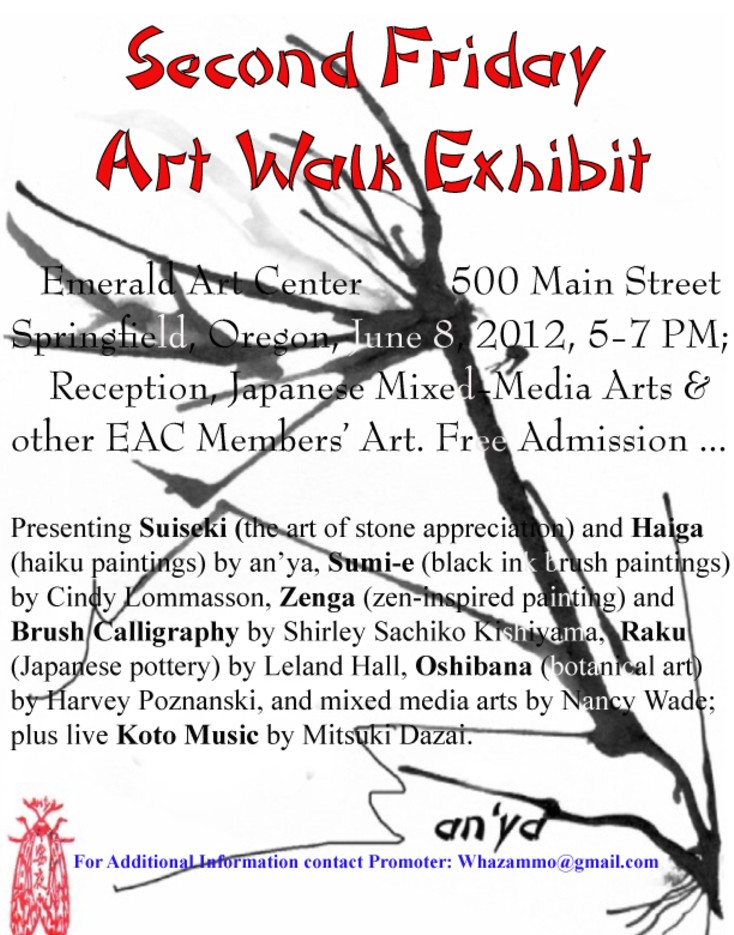
an'ya sent this poster about the Second Friday Art Walk Exhibit. Click the image for a better view.
The new Sketchbook Issue 41 is now on-line. The March / April 2012 Sketchbook contains poems, art and features by one hundred-four writers from twenty-one Countries.
March/April 2012: Cover:
http://poetrywriting.org/Sketchbook7-2MarApr2012-41/Sketchbook_7-2_MarApr_2012_Cover_Emily_Romano_Swan_and_Lily.htm
March/April 2012: Contents Page:
http://poetrywriting.org/Sketchbook7-2MarApr2012-41/0_Contents_Sketchbook_7-2_MarApr_2012_Contents.htm
March/April 2012: SHH2--spring Kigo results:
http://poetrywriting.org/Sketchbook7-2MarApr2012-41/Sketchbook_7-2_MarApr_2012_Karina_Klesko_SHH_2_Spring_Kigo.htm
March/April 2012: "swing" Kukai results:
http://poetrywriting.org/Sketchbook7-2MarApr2012-41/0_Results_Sketchbook_7-2_MarApr_2012_swing_Kukai_Results.htm
March/April 2012: "pond life" Haiku Thread:
http://poetrywriting.org/Sketchbook7-2MarApr2012-41/0_Results_Sketchbook_7-2_MarApr_pond_life_Haiku_Thread_Results.htm
March/April 2012: PTP results:
http://poetrywriting.org/Sketchbook7-2MarApr2012-41/0_Results_Sketchbook_7-2_MarApr_2012_Results_PTPC_Index_Shanna_Baldwin_Moore_Results.htm
From the Editor's Chairs:
http://poetrywriting.org/Sketchbook7-2MarApr2012-41/Sketchbook_7-2_MarApr_2012_From_The_Editor_s_Chair.htm
Announcement: May/June 2012: SHH 3--summer Kigo:
http://poetrywriting.org/Sketchbook7-2MarApr2012-41/Sketchbook_7-2_MarApr_2012_Announcing_SHH_3_Summer_Kigo_for_MayJune_2012_Issue.htm
Announcement: May/June 2012: "wedding / bride" haiku Thread:
http://poetrywriting.org/Sketchbook7-2MarApr2012-41/Sketchbook_7-2_MarApr_2012_Announcing_MayJune_2012_wedding_bride_Haiku_Thread.htm
Announcement: May/June 2012: "cloud(s)" Kukai:
http://poetrywriting.org/Sketchbook7-2MarApr2012-41/Sketchbook_7-2_MarApr_2012_Announcing_May_June_30_2012_cloud_Kukai.htm
Announcement: May/June 2012: PTP Contest:
http://poetrywriting.org/Sketchbook7-2MarApr2012-41/0_Announcement_Sketchbook_7-2_2012_PTPC_MayJune_2012_Shanna_Baldwin_Moore.htm
The editors are now accepting submissions until June 20, 2012 for the next issue: submissions@poetrywriting.org
Karina Klesko, US and John Daleiden, US
jd
Poetrywriting.org/Karina Klesko/Director
www.poetrywriting.org: Sketchbook
Karina Klesko, Senior Editor
John Daleiden, Editor/Webmaster
Charles Trumbull sent this:
Hiroaki Sato sent this to me — it might be of interest to you for your haiku services.
Best,
Charlie
Charles Trumbull
trumbullc@comcast.net
From: Hiroaki Sato
Date: Thursday, May 17, 2012 4:39 AM
To: Charles Trumbull
Subject: Another haiku contest
Dear Charlie,
Would you send this to those who might be interested? I am the judge of the English division
HaikuGrandPrix@nyseikatsu.com、
http://new-haiku.itoen.com/
Yours, Hiro
Deborah P Kolodji sent this:
Hi Curtis,
Could you put out a reminder about the 2012 Tokutomi Haiku Contest. The deadline is coming up - it's May 31st, and I really haven't received a lot of entries so far.
Here's the link: http://youngleaves.org/2012-tokutomi-contest/
This is a 5-7-5 contest, using only one kigo. These rules were set in honor of the founders of the Yuki Teikei Society, Kiyoshi and Kyoko Tokutomi.
The Tokutomis founded the Yuki Teikei Haiku Society in San Jose, California, in 1975. Their vision was to nourish and foster the art of writing haiku in English using the traditional guidelines developed by haiku poets in Japan. As explained by Mrs. Tokutomi, in Japanese "Yu" means "having", "Ki" means "season", "Tei" means formal", and "Kei" means "pattern".
Therefore in the founders' view, "yuki teikei" haiku contains a season word and utilizes a three-line 5-7-5 pattern of syllables. In today's world, literary English language haiku is usually shorter than 5-7-5 syllables, even by members of the Yuki Teikei Society, however this contest continues to honor the vision of the founders of the society.
M. Kei sent this:
Take Five : Best Contemporary Tanka, Volume 4 Published by Keibooks
Perryville, Maryland – May 14, 2012 – Take Five : Best Contemporary Tanka, Volume Four Published
Take Five : Best Contemporary Tanka, the anthology series founded by tanka poet and editor, M. Kei, has announced the publication of Volume Four. Now on sale, it features 260 pages with the largest selection yet of tanka poetry and related forms, making it the single largest volume in the series. It retails for $18.00, and can be bought direct from the printer at CreateSpace.com, or through Amazon.com and other online retailers.
Buy link: https://www.createspace.com/3785119 -- also available from Amazon.com and other retailers.
Sasa Vazic sent this:
A gift haiku book from Damir Janjalija sent to you by his permission.
Hope you will like.
A paper edition will be printed soon.
Best regards,
Sasa
Call for Submissions: An Atlas Poetica Special Feature:
Chiaroscuro - LGBT Tanka
Editor: Janick BELLEAU
Poets are invited to submit their work to a new Atlas Poetica Special Feature on LGBT Tanka.
The title Chiaroscuro is a veiled reference to Torikaebaya Monogatari (literal translation: ‘If only I could exchange them’ story) written around the 12th century in Japan by Anonymous (man or woman, to this day, we do not know). The story, graced with approximately 80 tanka (in the French version), has been translated into English by Rosette F. Willig in 1983 as The Changelings; into German by Michael Stein in 1994 as Die vertauschten Geschwister (lit. ‘The exchanged siblings’) and into French by Renée Garde in 2009 as Si on les échangeait. Le Genji travesti.
Torikaebaya is the tale of a sister and a brother whose mannerisms are those of the opposite sex. Their father, exasperated, decides to present them to the Imperial Court in the sexual identity of their choice; both siblings pursue fabulous careers. The Author touches many themes in this novel: not only are Lesbianism, Gayness, Bisexuality, Transgender tackled but Androgyny as well. The notion of ‘gender’ is played with humour and psychological insight: one might ask, did writers such as Balzac with Séraphîta and Virginia Woolf with Orlando know about Torikaebaya?
The whole book is ‘chiaroscuro’: whether it shows, at times, the emotional distress of the heroine as a divine nobleman; whether it portrays the shy brother as a lady confidant or ultimately, the lover of the Emperor’s naïve daughter; whether it relates to meetings of lovers between dusk and dawn. To learn more about this novel (characters, themes, authorship, translations), please click the links below: in English (http://en.wikipedia.org/wiki/Torikaebaya_Monogatari); in French (http://inalcocej.free.fr/textes-en-ligne/Torikaebaya-fr.rtf). One might also wish to enjoy M. Kei' s review of the book: http://bookworld.editme.com/REVIEW-THE-CHANGELINGS-A-CLASSICAL-JAPANESE-COURT-TALE
You are invited to enter 3-5 tanka. Your five-line poems (no capitalisation, little punctuation) are to be included in the body of the email, without attachments. The tanka, submission open to everyone, should have a positive outlook on LGBT. Poems submitted must be previously unpublished and not under consideration elsewhere. The Editor will accept a pseudonym for poets who prefer to remain anonymous. Complete ATPO guidelines and previous Special Features may be viewed at Atlas.Poetica.org.
Your name, country, email address should be included in the email. Please, do include a bio sketch (75 words max.). Contributions should be emailed to Editor Janick BELLEAU at janick_belleauATyahooDOTca (there is an underbar between the first and last names), the Subject line being “ATPO Special Feature submission - LGBT Tanka”.
Due date for submissions: August 3rd, 2012.
25 successful contributors will have a single poem published OR 25 selected tanka will be included when Chiaroscuro - LGBT Tanka appears as an Atlas Poetica Special Feature in September 2012.
Thank you in advance for your submission.
M. Kei
Editor, Atlas Poetica
A Journal of Poetry of Place in Contemporary Tanka
AtlasPoetica.org
an'ya sent this poster about the Second Friday Art Walk Exhibit. Click the image for a better view.
Sunday, May 13, 2012
Sunday updates
A new issue of Lynx is available. You can find Lynx at:
http://www.ahapoetry.com/ahalynx/272hmpg.html
Scott Owens writes:
Great news! Something Knows the Moment has been named 1 of 5 finalists for the 2012 Next Generation Indie Book Awards.
Thanks for ordering, reading, and supporting Something Knows the Moment.
Charlotte Digregorio recently posed this question:
Does haiku keep you sane?
Read what a number of poets had to say here.
Scott Metz had this to say about Roadrunner:
R'r 12.1 is now up on the website.
It feature three sections of new poetry (glass wombs, a collage of scissors, and not quite ice cream), an interview with john martone by Jack Galmitz, an article on the one-line poetry of Grant Hackett (also by Jack Galmitz), and Scorpion Prize 25 by Bob Perelman.
The submission deadline for 12.2 is August 1st, 2012.
thanks,
Scott Metz
R'r Blog
Roberta Beary was recently featured on Basho's Road:
http://bashosroad.outlawpoetry.com/roberta-beary-timeline/roberta-beary/haiku/
Pris Campbell was recenlty featured on The Outlaw Poetry Network:
http://outlawpoetry.com/2012/05/10/pris-campbell-leave-your-hat-on-night-wind/
Charlotte Digregorio passed this along:
If you can make it, The Cradle of American Haiku Festival in Mineral Point, WI, Friday, July 20 through Sunday, July 22 is a jam-packed weekend of learning and fun! This is the third time the Festival is being offered. Please read the information below:
Gayle Bull invites HSA members to The Cradle of American Haiku 3, a festival in Mineral Point, WI, Friday, July 20 through Sunday, July 22. The Cradle Festivals celebrate the importance of the Midwest in the development of English language Haiku. The first Cradle Festival honored Raymond Roseliep of Dubuque, IA, one of the best early American haiku poets. The second Cradle honored Robert Spiess of Madison, WI, one of the best early poets and editors of English language haiku journals.
This year's Cradle Festival will honor the development of “American Haiku Journal," the first publication devoted exclusively to English haiku. It was founded in Platteville, WI. Don Eulert, one of its founders, will be among honored guests and presenters.
The three days will feature readings, presentations, food and fun. Some of the presenters and panelists are Charles Trumbull, Jerome Cushman, Gayle Bull, Marjorie Buettner, Charlotte Digregorio, Francine Banwarth, Melissa Allen, Bill Pauly, Aubrie Cox, Mike Montreuil and Lidia Rozmus.
The fee for the three-day festival is $45. This will include all presentations, workshops, readings and the reception and Saturday night picnic.
We encourage pre-registration to make it easier to determine the amount of food and facilities needed.
Throughout the Festival, there will be coffee, tea, iced tea, water and goodies on the front porch of Foundry Books for those who just want to sit, relax, talk and write. We look forward to seeing you at the Festival.
Check mineralpoint.com for accommodations. If you have any questions, please contact Gayle Bull at info@foundrybooks.com. She will be happy to send you a registration form.
The Cradle Schedule
Friday, July 20
3 to 7 p.m.–Registration (Foundry Books)
7 – 8 p.m.– Opening Reception and Welcome
8 p.m. – until closing–Open Reading
Saturday, July 21
8 a.m.– Registration (Foundry Books) and Farmers Market at Water Tower Park. (A lot of good inspiration for haiku came from the latter last summer.)
9 a.m.– Welcome
9:15 – 10:15 a.m.– Charlie Trumbull: “Black Haiku: The Uses of Haiku by African-American Poets.”
From the earliest years that haiku has been written in the U.S., African-American poets have been among the foremost experimenters in the genre. The result has been, for the most part, a tradition of haiku writing that runs parallel to what we might call the haiku mainstream. This presentation will trace the history of “black haiku” in America, from the Harlem Renaissance movement of the 1920s and 30s, to the Black Arts movement of the 1960s and 70s, to today’s “blues haiku” of Sonia Sanchez and the jazz haiku of Kalamu ya Salaam.
10:30 – 11:45 a.m.–America Haiku Panel – Don Eulert, who founded “American Haiku” with the late Jim Bull, Gayle Bull, and Charlie Trumbull. Jerome Cushman will moderate the panel.
11:45 a.m. – 1 p.m.– Lunch on your own
1- 2 p.m.– Marjorie Buettner – “There is a Season.” A Memorial Reading, 2011. (First presented at Haiku North America conference, Seattle).
“Whatever circles comes from the center. We circle what we love.” — Rumi.
The memorial reading will have a combination of power point presentation, music and a memorial flyer. It will be an hour-long presentation reviewing the lives and haiku of 22 poets who have died in the past couple of years.
2:30 – 5:30 p.m.– Breakout Sessions
2:30 – 4 p.m.– Charlotte Digregorio, “Polish Your Haiku for Publication.” This workshop will include lecture, analysis of great haiku, and critique of participants’ work. Participants will receive training on the finer points of writing haiku to ensure that their submissions are first-rate. Handouts will include samples of haiku, along with an extensive bibliography and list of resource tools for haikuists to take their writing to publication level. Highly recommended for beginning and intermediate haikuists.
2:30 – 4 p.m. Aubrie Cox — “Why Did My Teachers Lie to Me? Teaching Haiku in and out of the Classroom.” Teaching haiku can be both challenging and rewarding. We will discuss the fundamentals, benefits, and possibilities of teaching how to read and write contemporary English language haiku in classes, workshops, and on a one-on-one basis.
2:30 – 5:30 p.m. Lidia Rozmus — “One brush stroke: sumi-e and traditional haiga” workshop. There will be two back-to-back sessions with each session lasting 1.5 hours. (Limit 10 per session).
4 – 5:30 p.m.– Haiku Workshop. Francine Banwarth, Melissa Allen, Bill Pauly, Charlie Trumbull, and Jerome Cushman. This is a critique session. Bring your haiku or just come and listen to some top poets and editors talk about haiku.
4– 5:30 p.m. Mike Montreuil, Haibun Editor, “One Hundred Gourds – Tell Me a Story”: Writing Haibun. The first half of this 90-minute workshop will present two Japanese Masters of haibun, Basho, the originator of the form, and Issa. A short discussion will follow on why haibun lost its appeal until its resurgence in the late 20th century.
We will also look at a longer haibun from Robert Spiess, who was one of the first writers of English North-American haibun.
Next, modern and shorter haibun: work by Roberta Beary and Jeff Winke. Finally, very short haibun by Larry Kimmel.
The last half of the workshop will focus on writing haibun. Attendees will be asked to either complete a haibun from a partially completed text that Mike will supply or write a haibun using their own ideas. Mike will ask those attending the workshop to rework them and then email them to him, if they wish, so they may be considered for a future issue of “A Hundred Gourds.”
5:30 – 6:30 p.m.– Free time
6:30 – 7:30 p.m.– Midwest Picnic
7:30 – 8:30 p.m.– Open Reading
9- until closing– Public Reading at Wine Bar.
Sunday, July 22
9:30 – 10:30 a.m.– Ginko
10:30 – 11:30 a.m.
Melissa Allen – “Become A Motorcycle: Understanding and Writing Gendai Haiku.” In Japanese, gendai means modern. When applied to haiku, this word signifies that a poem has moved away from traditional haiku poetics, whether in subject matter, structure, or language use. Bring a gendai haiku you have written, if you have one. Please feel free to attend if you don’t, and attend even if you know little or nothing about gendai. We will briefly discuss the nature of gendai and read some well-known examples, such as the motorcycle haiku by Kaneko Tohta, quoted in the workshop’s title. Next, we will discuss our own haiku, and in the process, try to better understand what is meant by gendai.
Noon–until the end. Lunch, ginko readings, and closing remarks at the Gray Dog Deli.
Norman Darlington sent this update:
Darlington Richards are pleased to announce the launch of the Little Book of Yotsumonos.
Preview: http://darlingtonrichards.com/lboy_preview
Purchase: http://darlingtonrichards.com/lboy_buy
John Carley’s recently-designed four-verse renku format is represented by 60 poems, wherein Carley collaborates with such well-known haikai poets as Hortensia Anderson, Lorin Ford, Carole MacRury, Sandra Simpson, William Sorlien and Sheila Windsor, together with an introduction to the form.
“I have always been impressed by John Carley’s knowledge of Japanese linked verse… It is my sincere hope that this new form of linked verse will take root.” —Nobuyuki Yuasa, Professor Emeritus, Hiroshima University, and translator of Basho’s The Narrow Road to the Deep North and Other Travel Sketches (Penguin Classics, 1966).
“the Little Book of Yotsumonos opens up a world of poetic possibility, sourced by the old, both the Chinese and Japanese poetic traditions, yet fresh and original… I suspect few will be able to read this book without wanting to try and compose a yotsumono themselves.” —Sonja Arntzen, Emeritus Professor of East Asian Studies, University of Toronto, and translator of The Kagero Diary and Ikkyu and the Crazy Cloud Anthology.
Preview: http://darlingtonrichards.com/lboy_preview
Purchase: http://darlingtonrichards.com/lboy_buy
Norman & Moira
Darlington Richards Press
http://darlingtonrichards.com/
Ramesh Anand has a new book of poems entitled Newborn Smiles, Cyberwit.net Press, 2012. Newborn Smiles is a 72 pages anthology that contains 100 high quality published haiku and 30 published free verses. Preface is done by Patricia Prime and Kala Ramesh.
He would like to distribute his author’s copy for free excluding the postal charges. Those interested can contact him at rameshsvce@yahoo.com
Newborn Smiles
Copyright 2012 Ramesh Anand
Published by Cyberwit.net Press
Allahabad, India
ISBN: 978-8182532786
Excerpts from Preface Section:
Kala Ramesh
A haiku from this collection has been in my mind ever since I read it.
winter deepens
... lungi shivering on
the beggar's face
Lungi is a piece of cloth that is worn / tied around the waist [something like a sarong], by men. In a hot humid country like India, something that is loosely wrapped around the waist is a more practical way of handling this scorching heat. Since a poor man’s wardrobe would be limited, what he wears in winter might be the same lungi that would have kept him cool in summer too.
Here I clearly see a poor man, in extreme cold weather, hunched and huddled-up, The impact this image creates is note worthy. The poem is rewarding if readers know a bit about lungi, else it could easily pass off as a pedestrian attempt.
Patricia Prime
The main themes of Anand’s haiku concentrate on the seasons, flowers, the weather, and the poet’s family. Anand’s double allegiances to both his Indian background and the world of European haiku emerge through particular motifs. Here, for example, we have references to the monsoon, the mosque, elephants and the wallah, alongside haiku that refer to the more traditional themes of the natural world: spring’s end, winter twilight, autumn dawn, maple leaves and cloud pause.
In a haiku climate which is choc-a-bloc with innovative work, this collection assumes the need for haiku to move the human heart, to confront the everyday, but not to be imprisoned by them, and to hearten the reader to continue his or her own journey through the reading and writing of haiku. And throughout, the image recur, both natural and of the heart, out of which Anand invites his readers to make a journey with him.
Read more about Newborn Smiles on Scribd.
A new issue of Rusty Truck is online:
http://rustytruck.wordpress.com/
My pal, Susan Nelson Myers, and I continue to work on The Frugal Poet cookbook/anthology. For those of you who have not submitted, guidelines are located on this page:
http://www.frugalpoet.com/p/call-for-submissions.html
The Frugal Poets will have the honor of cooking for a good friend and poet who will be traveling through our state next month. We look forward to entertaining our guest. :)
http://www.ahapoetry.com/ahalynx/272hmpg.html
Scott Owens writes:
Great news! Something Knows the Moment has been named 1 of 5 finalists for the 2012 Next Generation Indie Book Awards.
Thanks for ordering, reading, and supporting Something Knows the Moment.
Charlotte Digregorio recently posed this question:
Does haiku keep you sane?
Read what a number of poets had to say here.
Scott Metz had this to say about Roadrunner:
R'r 12.1 is now up on the website.
It feature three sections of new poetry (glass wombs, a collage of scissors, and not quite ice cream), an interview with john martone by Jack Galmitz, an article on the one-line poetry of Grant Hackett (also by Jack Galmitz), and Scorpion Prize 25 by Bob Perelman.
The submission deadline for 12.2 is August 1st, 2012.
thanks,
Scott Metz
R'r Blog
Roberta Beary was recently featured on Basho's Road:
http://bashosroad.outlawpoetry.com/roberta-beary-timeline/roberta-beary/haiku/
Pris Campbell was recenlty featured on The Outlaw Poetry Network:
http://outlawpoetry.com/2012/05/10/pris-campbell-leave-your-hat-on-night-wind/
Charlotte Digregorio passed this along:
The Cradle of American Haiku Festival in Wisconsin Open to the Public
If you can make it, The Cradle of American Haiku Festival in Mineral Point, WI, Friday, July 20 through Sunday, July 22 is a jam-packed weekend of learning and fun! This is the third time the Festival is being offered. Please read the information below:
Gayle Bull invites HSA members to The Cradle of American Haiku 3, a festival in Mineral Point, WI, Friday, July 20 through Sunday, July 22. The Cradle Festivals celebrate the importance of the Midwest in the development of English language Haiku. The first Cradle Festival honored Raymond Roseliep of Dubuque, IA, one of the best early American haiku poets. The second Cradle honored Robert Spiess of Madison, WI, one of the best early poets and editors of English language haiku journals.
This year's Cradle Festival will honor the development of “American Haiku Journal," the first publication devoted exclusively to English haiku. It was founded in Platteville, WI. Don Eulert, one of its founders, will be among honored guests and presenters.
The three days will feature readings, presentations, food and fun. Some of the presenters and panelists are Charles Trumbull, Jerome Cushman, Gayle Bull, Marjorie Buettner, Charlotte Digregorio, Francine Banwarth, Melissa Allen, Bill Pauly, Aubrie Cox, Mike Montreuil and Lidia Rozmus.
The fee for the three-day festival is $45. This will include all presentations, workshops, readings and the reception and Saturday night picnic.
We encourage pre-registration to make it easier to determine the amount of food and facilities needed.
Throughout the Festival, there will be coffee, tea, iced tea, water and goodies on the front porch of Foundry Books for those who just want to sit, relax, talk and write. We look forward to seeing you at the Festival.
Check mineralpoint.com for accommodations. If you have any questions, please contact Gayle Bull at info@foundrybooks.com. She will be happy to send you a registration form.
The Cradle Schedule
Friday, July 20
3 to 7 p.m.–Registration (Foundry Books)
7 – 8 p.m.– Opening Reception and Welcome
8 p.m. – until closing–Open Reading
Saturday, July 21
8 a.m.– Registration (Foundry Books) and Farmers Market at Water Tower Park. (A lot of good inspiration for haiku came from the latter last summer.)
9 a.m.– Welcome
9:15 – 10:15 a.m.– Charlie Trumbull: “Black Haiku: The Uses of Haiku by African-American Poets.”
From the earliest years that haiku has been written in the U.S., African-American poets have been among the foremost experimenters in the genre. The result has been, for the most part, a tradition of haiku writing that runs parallel to what we might call the haiku mainstream. This presentation will trace the history of “black haiku” in America, from the Harlem Renaissance movement of the 1920s and 30s, to the Black Arts movement of the 1960s and 70s, to today’s “blues haiku” of Sonia Sanchez and the jazz haiku of Kalamu ya Salaam.
10:30 – 11:45 a.m.–America Haiku Panel – Don Eulert, who founded “American Haiku” with the late Jim Bull, Gayle Bull, and Charlie Trumbull. Jerome Cushman will moderate the panel.
11:45 a.m. – 1 p.m.– Lunch on your own
1- 2 p.m.– Marjorie Buettner – “There is a Season.” A Memorial Reading, 2011. (First presented at Haiku North America conference, Seattle).
“Whatever circles comes from the center. We circle what we love.” — Rumi.
The memorial reading will have a combination of power point presentation, music and a memorial flyer. It will be an hour-long presentation reviewing the lives and haiku of 22 poets who have died in the past couple of years.
2:30 – 5:30 p.m.– Breakout Sessions
2:30 – 4 p.m.– Charlotte Digregorio, “Polish Your Haiku for Publication.” This workshop will include lecture, analysis of great haiku, and critique of participants’ work. Participants will receive training on the finer points of writing haiku to ensure that their submissions are first-rate. Handouts will include samples of haiku, along with an extensive bibliography and list of resource tools for haikuists to take their writing to publication level. Highly recommended for beginning and intermediate haikuists.
2:30 – 4 p.m. Aubrie Cox — “Why Did My Teachers Lie to Me? Teaching Haiku in and out of the Classroom.” Teaching haiku can be both challenging and rewarding. We will discuss the fundamentals, benefits, and possibilities of teaching how to read and write contemporary English language haiku in classes, workshops, and on a one-on-one basis.
2:30 – 5:30 p.m. Lidia Rozmus — “One brush stroke: sumi-e and traditional haiga” workshop. There will be two back-to-back sessions with each session lasting 1.5 hours. (Limit 10 per session).
4 – 5:30 p.m.– Haiku Workshop. Francine Banwarth, Melissa Allen, Bill Pauly, Charlie Trumbull, and Jerome Cushman. This is a critique session. Bring your haiku or just come and listen to some top poets and editors talk about haiku.
4– 5:30 p.m. Mike Montreuil, Haibun Editor, “One Hundred Gourds – Tell Me a Story”: Writing Haibun. The first half of this 90-minute workshop will present two Japanese Masters of haibun, Basho, the originator of the form, and Issa. A short discussion will follow on why haibun lost its appeal until its resurgence in the late 20th century.
We will also look at a longer haibun from Robert Spiess, who was one of the first writers of English North-American haibun.
Next, modern and shorter haibun: work by Roberta Beary and Jeff Winke. Finally, very short haibun by Larry Kimmel.
The last half of the workshop will focus on writing haibun. Attendees will be asked to either complete a haibun from a partially completed text that Mike will supply or write a haibun using their own ideas. Mike will ask those attending the workshop to rework them and then email them to him, if they wish, so they may be considered for a future issue of “A Hundred Gourds.”
5:30 – 6:30 p.m.– Free time
6:30 – 7:30 p.m.– Midwest Picnic
7:30 – 8:30 p.m.– Open Reading
9- until closing– Public Reading at Wine Bar.
Sunday, July 22
9:30 – 10:30 a.m.– Ginko
10:30 – 11:30 a.m.
Melissa Allen – “Become A Motorcycle: Understanding and Writing Gendai Haiku.” In Japanese, gendai means modern. When applied to haiku, this word signifies that a poem has moved away from traditional haiku poetics, whether in subject matter, structure, or language use. Bring a gendai haiku you have written, if you have one. Please feel free to attend if you don’t, and attend even if you know little or nothing about gendai. We will briefly discuss the nature of gendai and read some well-known examples, such as the motorcycle haiku by Kaneko Tohta, quoted in the workshop’s title. Next, we will discuss our own haiku, and in the process, try to better understand what is meant by gendai.
Noon–until the end. Lunch, ginko readings, and closing remarks at the Gray Dog Deli.
Norman Darlington sent this update:
Darlington Richards are pleased to announce the launch of the Little Book of Yotsumonos.
Preview: http://darlingtonrichards.com/lboy_preview
Purchase: http://darlingtonrichards.com/lboy_buy
John Carley’s recently-designed four-verse renku format is represented by 60 poems, wherein Carley collaborates with such well-known haikai poets as Hortensia Anderson, Lorin Ford, Carole MacRury, Sandra Simpson, William Sorlien and Sheila Windsor, together with an introduction to the form.
“I have always been impressed by John Carley’s knowledge of Japanese linked verse… It is my sincere hope that this new form of linked verse will take root.” —Nobuyuki Yuasa, Professor Emeritus, Hiroshima University, and translator of Basho’s The Narrow Road to the Deep North and Other Travel Sketches (Penguin Classics, 1966).
“the Little Book of Yotsumonos opens up a world of poetic possibility, sourced by the old, both the Chinese and Japanese poetic traditions, yet fresh and original… I suspect few will be able to read this book without wanting to try and compose a yotsumono themselves.” —Sonja Arntzen, Emeritus Professor of East Asian Studies, University of Toronto, and translator of The Kagero Diary and Ikkyu and the Crazy Cloud Anthology.
Preview: http://darlingtonrichards.com/lboy_preview
Purchase: http://darlingtonrichards.com/lboy_buy
Norman & Moira
Darlington Richards Press
http://darlingtonrichards.com/
Ramesh Anand has a new book of poems entitled Newborn Smiles, Cyberwit.net Press, 2012. Newborn Smiles is a 72 pages anthology that contains 100 high quality published haiku and 30 published free verses. Preface is done by Patricia Prime and Kala Ramesh.
He would like to distribute his author’s copy for free excluding the postal charges. Those interested can contact him at rameshsvce@yahoo.com
Newborn Smiles
Copyright 2012 Ramesh Anand
Published by Cyberwit.net Press
Allahabad, India
ISBN: 978-8182532786
Excerpts from Preface Section:
Kala Ramesh
A haiku from this collection has been in my mind ever since I read it.
winter deepens
... lungi shivering on
the beggar's face
Lungi is a piece of cloth that is worn / tied around the waist [something like a sarong], by men. In a hot humid country like India, something that is loosely wrapped around the waist is a more practical way of handling this scorching heat. Since a poor man’s wardrobe would be limited, what he wears in winter might be the same lungi that would have kept him cool in summer too.
Here I clearly see a poor man, in extreme cold weather, hunched and huddled-up, The impact this image creates is note worthy. The poem is rewarding if readers know a bit about lungi, else it could easily pass off as a pedestrian attempt.
Patricia Prime
The main themes of Anand’s haiku concentrate on the seasons, flowers, the weather, and the poet’s family. Anand’s double allegiances to both his Indian background and the world of European haiku emerge through particular motifs. Here, for example, we have references to the monsoon, the mosque, elephants and the wallah, alongside haiku that refer to the more traditional themes of the natural world: spring’s end, winter twilight, autumn dawn, maple leaves and cloud pause.
In a haiku climate which is choc-a-bloc with innovative work, this collection assumes the need for haiku to move the human heart, to confront the everyday, but not to be imprisoned by them, and to hearten the reader to continue his or her own journey through the reading and writing of haiku. And throughout, the image recur, both natural and of the heart, out of which Anand invites his readers to make a journey with him.
Read more about Newborn Smiles on Scribd.
A new issue of Rusty Truck is online:
http://rustytruck.wordpress.com/
My pal, Susan Nelson Myers, and I continue to work on The Frugal Poet cookbook/anthology. For those of you who have not submitted, guidelines are located on this page:
http://www.frugalpoet.com/p/call-for-submissions.html
The Frugal Poets will have the honor of cooking for a good friend and poet who will be traveling through our state next month. We look forward to entertaining our guest. :)
Thursday, April 19, 2012
Thursday updates
Hi Folks,
I'm writing to let you know about The Haiku Foundation Video Archive campaign on IndieGoGo.
Take a moment if you would to check it out. All the tools are there. Get perks, make a contribution, or simply follow updates. If enough of us get behind it, we can make 'The Haiku Foundation Video Archive' happen. This is a word of mouth kind of campaign, so passing this link along and spreading the word is greatly appreciated too. Thanks for having a look, and take care.
Jim Kacian
President
The Haiku Foundation
http://www.indiegogo.com/The-Haiku-Foundation-Video-Archive?a=346480&i=emal
Hi Curtis,
Thought you and your readers would like to hear about the HSA booth at the 52nd Sakura Matsui Japanese Street Festival. It has taken a while to catch my breath, but we were able to reach out to lots of people. I have written up a short article: http://www.turtlelightpress.com/2012/04/haiku-hits-the-streets-of-d-c/ or you can go to my personal Facebook page and check out the wealth of pictures to get a sense of the day, too.
Many thanks,
Rick
***************************
Rick Black
Turtle Light Press
(908) 227-7951
http://www.turtlelightpress.com
***************************
http://darlingtonrichards.com/jrr-cfc
Hello!
We're ready to begin accepting offers of content for the third issue of our Journal of Renga & Renku, which is now listed with the Bibliography of Asian Studies and the MLA International Bibliography. The journal will be:
1. published early 2013
2. available in hardcopy only
3. available for secure online purchase using Paypal
We're looking for a variety of content along the lines of:
1. academic/polemic articles on any aspects of the genre
2. translations of old renga and renku
3. news of renku groups and happenings
4. book articles/reviews
5. letters responding to the contents of previous issues, or on any relevant topic
6. and of course, a showcase of current examples of the genre:
a) in English
b) in any other language, accompanied by an English translation
c) previously published or not (just let us have details of prior publication so we can acknowledge properly)
d) simultaneous offers are fine too, again provided you advise us immediately of acceptance, for purposes of acknowledgement
e) in any of the standard forms: kasen, triparshva, nijûin, jûnichô, shisan, rokku, hyakuin, imachi, yotsumono, etc.
f) in any explorations of the above forms in terms of experimentation with one-line, zip, 5/7/5 or other fixed counts, and even rhyme
g) solo and group work
h) with (preferably) or without notes/reflections on the poem/process from sabaki or renju or both
i) Please include the following text in all poetry submissions: "I hereby confirm that I have obtained consent from all of the participating poets to offer this poem for publication by JRR"
7. We are also holding a contest, the winning poem to appear in JRR3; click here for details: http://darlingtonrichards.com/contest
8. We're open to discussing content ideas we've not covered above, so please write
9. All communications will be acknowledged within two weeks
10. Closing date for sending content: October 1, 2012
11. We are regretfully unable to pay contributors for content at this stage
To gain an idea of the sort of content that interests the editors, leaf through the previews of our previous issues (or, better still, buy them) at http://www.darlingtonrichards.com/jrr
Please send all contributions and other communications to (RengaRenku AT gmail DOT com)
We look forward to hearing from you.
Norman Darlington
Moira Richards
Journal of Renga & Renku
http://darlingtonrichards.com/jrr-cfc
Dear Curtis,
An announcement for Tobacco Road.
Thanks so much,
Carolyn
NEW EDITOR AT ACORN
For the past four-and-a-half years I have derived great pleasure from editing Acorn. It has been a joy to read your submissions and publish your haiku. A delightful bonus was that I got to know so many of you in the haiku community. I cherish the connections we have made and look forward to our continued friendship as fellow poets. I will watch for your poems in Acorn and other haiku journals and eagerly anticipate seeing you at haiku conferences and events.
I thank AC Missias, who founded Acorn in 1998, for giving me the opportunity to assume the role of editor in 2008. And now I have the privilege of handing over the reins to Susan Antolin who will become editor of Acorn beginning with the Fall 2012 issue. As I move on to pursue other interests, I am so fortunate to have found someone whose outstanding abilities as a haiku poet, and whose experience as a haiku journal editor, make me feel certain that Acorn’s reputation as a journal of the highest quality haiku will be continued and even enhanced under her guidance. Sue has published a wonderful collection of haiku titled Artichoke Season (which you should read, if you have not already done so). She is currently president of the Haiku Poets of Northern California, co-editor of Mariposa, the HPNC haiku journal, and editor of Ripples, the newsletter of the Haiku Society of America. Most important, I know and trust her poetic vision.
Poems for the Fall 2012 issue will be read during July and August only. Please send your submissions directly to Susan at acornhaiku@gmail.com. (Please note the new email address. The website will remain the same: www.acornhaiku.com.)
All best,
Carolyn Hall
Carlos Colón talked haiku recently on Kate Archer Kent's Red River Radio (KDAQ, 89.9 FM)
http://www.redriverradio.org/term/carlos-colon
A new Gallery of Haiga from haigaonline featuring Ron C. Moss and Michael Dylan Welch
http://www.haigaonline.com/gallery-sp2012/gallery.html
Many Thanks.
Ron
Tuesday, April 10, 2012
Tuesday updates
Susumu Takiguchi sent this update:
WHC NEWS
10 April 2011
Re: New Issue of World Haiku Review is now online: April 2012 Issue
The World Haiku Club is pleased to announce that the April 2012 Issue of World Haiku Review is now online. Click on:
https://sites.google.com/site/worldhaikureview2/whr/home
Rohini, our Technical Editor, is continuing her noble and arduous task of retrieving and rescuing poems, articles, treatises, reports, contributions etc. of the past World Haiku Review issues 2001 - 2007, which got tragically lost in mysterious circumstances. Her first effort is focused on saving, recovering and rescuing only. She will then gradually sort them out and give them shape. If you happen to come across any of these invaluable items of the past WHR issues, by all means let us know.
We do hope that you will enjoy this issue of World Haiku Review.
Kengin,
Susumu Takiguchi
Managing Editor & Acting Editor-in-Chief, World Haiku Review
Chairman, The World Haiku Club
Kala Ramesh
Deputy Editor-in-Chief, World Haiku Review
Rohini Gupta
Technical Editor, World Haiku Review
Gabriel Rosenstock sent this update about his new book. Click the title to download more information.
THE INVISIBLE LIGHT
Infrared photographs by Ron Rosenstock
Poetry by Gabriel Rosenstock
Sasa Vazic sent the following Japan-Lithuania haiku contest link:
http://www.worldhaiku.net/news_files/jp_lithu_haikucontest/En_Contest.pdf
Norman Darlington sent the following update:
JOURNAL OF RENGA & RENKU sale price ends soon
JOURNAL OF RENGA & RENKU, Issue 2
There is less than a week left to take advantage of the introductory price of US$19.95. At midnight Saturday 14 April 2012, JRR2 reverts to the cover price of US$25. If you haven't ordered your copy yet, you can securely order now at http://darlingtonrichards.com/jrr . Preview JRR2 Table of Contents at http://www.darlingtonrichards.com/index.php/journal-of-renga-renku/preview-issue-2/
Norman Darlington
Moira Richards
Journal of Renga & Renku
http://www.darlingtonrichards.com/
Follow us on Facebook at http://www.facebook.com/journal.of.renga.renku
Claudia Coutu Radmore sent the following link to their Ottawa KaDo group:
http://haikukado.wordpress.com
Rick Black sent the following update:
April 2012
In conjunction with National Poetry Month, two events are being held in Camden, N.J., to launch a new collection of haiku by Nick Virgilio, a lifelong resident and one of the most beloved haiku poets in the country.
On Friday, April 27th, the Paul Robeson library at Rutgers University-Camden will host an exhibition of Virgilio’s papers as part of their “American Haiku Masters” collection; and then on Sunday, April 29th, a community reading of the new book, Nick Virgilio: A Life in Haiku, will be held at Sacred Heart Church in Camden.
Virgilio, who started writing in the 1960s, was one of the pioneers of haiku in the U.S. He wrote thousands of haiku ranging in subject matter from the Vietnam war to water lilies, from prostitutes on street corners to cicadas on a hot summer night.
“Virgilio was intensely American, with a generosity of heart and spirit that recall Walt Whitman,” said Rod Willmot, a Canadian haiku poet and former publisher of Burnt Lake Press, which issued Virgilio’s first book, Selected Haiku. “He was a people’s poet, touching readers through the universality of what moved him and the honesty and dedication with which he wrote.”
“When I found out that so many of his poems had never been published, I jumped at the opportunity,”
said Rick Black, founding editor of Turtle Light Press, a Virginia-based publisher which is releasing the new collection. “In particular I have always loved his poems about his brother’s death in Vietnam as well as life on the streets of Camden.”
Haiku, short nature poems of 17 syllables or less, originated in Japan several hundred years ago; they became popular in the U.S. at the start of the 20th century and are still loved and written by many people today, from school children to Pulitzer Prize winning poets.
Edited by Raffael de Gruttola, a former president of the Haiku Society of America, the book contains more than 100 unpublished haiku as well as 25 old favorites, excerpts of an interview with Virgilio on Marty Moss-Coane’s “Radio Times” show, two essays by Virgilio on writing, a tribute by Monsignor Michael Doyle of Sacred Heart Church, an afterword by poet Kathleen O’Toole, photos and facsimiles of some of the original manuscripts.
More than twenty years after his death, Virgilio is still a beloved poet today. He was a regular commentator on the public radio program Weekend Edition with Scott Simon in its early years and was instrumental in helping to found the Walt Whitman Center for the Arts & Humanities. Some of his poems have even inspired street murals near Sacred Heart Church and elsewhere.
The Rutgers exhibition, which runs on Friday, the 27th from noon to 1:30 p.m., highlights original manuscripts, book art, and journals. It will feature a short reading from the new book as well as remarks by the publisher and editor. To R.S.V.P. for lunch or more information, contact curator Elizabeth Moser at: haikumasters@gmail.com
Similarly, a large crowd is expected at Sacred Heart to participate in the community reading on Sunday, the 29th. Featured speakers will include Monsignor Michael Doyle, Tony Virgilio (Nick’s surviving brother), Henry Brann (president of the Nick Virgilio Haiku Association), Raffael de Gruttola, Rick Black and others. For more information or directions to the church, please call 856-966-6700 or email: parish@sacredheartcamden.org
“I think it’ll be a wonderful celebration of Nick’s life,” said Monsignor Michael Doyle, pastor of Sacred Heart. “He created beauty out of the gutters of Camden and, by reading these new poems, the entire community will be uplifted.”
Dear haiku poets, you are invited to participate in The First "International Kukai" (HAIKU CONTEST).
The Kigo (THEME) is SPARROW/S no other form of the word will be accepted.
Send THREE haiku which include SPARROW/S to:
Email: international_kukai@yahoo.com
Subject: April_submission
Submission Deadline: April 10, 2012
Voting Deadline: April 20th 2012
Example:
winter solitude—
only a sparrow
to share my meal
—Rita Odeh
tinywords, 2007
Read the full direction page at this link (you must scroll down):
http://rita-odeh.blogspot.com/
Rita Odeh & John Daleiden
ro / jd
Shonan Village Centre, November 28th- 29th, 2012
The ITF SHONAN VILLAGE CENTER Competition for tanka in English
Call for Submissions: Open to everyone
Entry Fee: None
Submission Period: April 1st – June 30th, 2012
Address for submissions: ITF SHONAN VILLAGE CENTER Competition
c/o Nihon Kajin Club
Shuei Bldg. 2F, 1-12-5 Higashigotanda,
Shinagawa ku, Tokyo, 141-0022, Japan
Rules of Entry:
1. Tanka must be previously unpublished and not under consideration elsewhere.
2. Post two copies of each tanka, with your name and address on one copy only.
Entry is by mail only.
3. Any theme is acceptable. (Five line form only)
4. Judging is anonymous.
5. Winning tanka and commended tanka will be published in the Festival brochure.
in SHONAN VILLAGE CENTER 2012
(ITF SHONAN VILLAGE CENTER 2012)
ITF SHONAN VILLAGE CENTER will be held by NIHON KAJIN CLUB, the Japan Tanka Poets’ Society. The schedule is as follows:
November 28th Registration at SHONAN VILLAGE CENTER
29th The 7th International Tanka Festival in SHONAN VILLAGE CENTER
(10:00~17:00)
At SHONAN VILLAGE CENTER
(JR Zushi )
Awarding ceremony, Keynote speech, Tanka workshop, Minispeech, Tanka Poetry reading etc.
WHC NEWS
10 April 2011
Re: New Issue of World Haiku Review is now online: April 2012 Issue
The World Haiku Club is pleased to announce that the April 2012 Issue of World Haiku Review is now online. Click on:
https://sites.google.com/site/worldhaikureview2/whr/home
Rohini, our Technical Editor, is continuing her noble and arduous task of retrieving and rescuing poems, articles, treatises, reports, contributions etc. of the past World Haiku Review issues 2001 - 2007, which got tragically lost in mysterious circumstances. Her first effort is focused on saving, recovering and rescuing only. She will then gradually sort them out and give them shape. If you happen to come across any of these invaluable items of the past WHR issues, by all means let us know.
We do hope that you will enjoy this issue of World Haiku Review.
Kengin,
Susumu Takiguchi
Managing Editor & Acting Editor-in-Chief, World Haiku Review
Chairman, The World Haiku Club
Kala Ramesh
Deputy Editor-in-Chief, World Haiku Review
Rohini Gupta
Technical Editor, World Haiku Review
Gabriel Rosenstock sent this update about his new book. Click the title to download more information.
THE INVISIBLE LIGHT
Infrared photographs by Ron Rosenstock
Poetry by Gabriel Rosenstock
Sasa Vazic sent the following Japan-Lithuania haiku contest link:
http://www.worldhaiku.net/news_files/jp_lithu_haikucontest/En_Contest.pdf
Norman Darlington sent the following update:
JOURNAL OF RENGA & RENKU sale price ends soon
JOURNAL OF RENGA & RENKU, Issue 2
There is less than a week left to take advantage of the introductory price of US$19.95. At midnight Saturday 14 April 2012, JRR2 reverts to the cover price of US$25. If you haven't ordered your copy yet, you can securely order now at http://darlingtonrichards.com/jrr . Preview JRR2 Table of Contents at http://www.darlingtonrichards.com/index.php/journal-of-renga-renku/preview-issue-2/
Norman Darlington
Moira Richards
Journal of Renga & Renku
http://www.darlingtonrichards.com/
Follow us on Facebook at http://www.facebook.com/journal.of.renga.renku
Claudia Coutu Radmore sent the following link to their Ottawa KaDo group:
http://haikukado.wordpress.com
Rick Black sent the following update:
April 2012
‘The Bard of Camden’ to be Honored With New Edition of Poems
In conjunction with National Poetry Month, two events are being held in Camden, N.J., to launch a new collection of haiku by Nick Virgilio, a lifelong resident and one of the most beloved haiku poets in the country.
On Friday, April 27th, the Paul Robeson library at Rutgers University-Camden will host an exhibition of Virgilio’s papers as part of their “American Haiku Masters” collection; and then on Sunday, April 29th, a community reading of the new book, Nick Virgilio: A Life in Haiku, will be held at Sacred Heart Church in Camden.
Virgilio, who started writing in the 1960s, was one of the pioneers of haiku in the U.S. He wrote thousands of haiku ranging in subject matter from the Vietnam war to water lilies, from prostitutes on street corners to cicadas on a hot summer night.
“Virgilio was intensely American, with a generosity of heart and spirit that recall Walt Whitman,” said Rod Willmot, a Canadian haiku poet and former publisher of Burnt Lake Press, which issued Virgilio’s first book, Selected Haiku. “He was a people’s poet, touching readers through the universality of what moved him and the honesty and dedication with which he wrote.”
“When I found out that so many of his poems had never been published, I jumped at the opportunity,”
said Rick Black, founding editor of Turtle Light Press, a Virginia-based publisher which is releasing the new collection. “In particular I have always loved his poems about his brother’s death in Vietnam as well as life on the streets of Camden.”
Haiku, short nature poems of 17 syllables or less, originated in Japan several hundred years ago; they became popular in the U.S. at the start of the 20th century and are still loved and written by many people today, from school children to Pulitzer Prize winning poets.
Edited by Raffael de Gruttola, a former president of the Haiku Society of America, the book contains more than 100 unpublished haiku as well as 25 old favorites, excerpts of an interview with Virgilio on Marty Moss-Coane’s “Radio Times” show, two essays by Virgilio on writing, a tribute by Monsignor Michael Doyle of Sacred Heart Church, an afterword by poet Kathleen O’Toole, photos and facsimiles of some of the original manuscripts.
More than twenty years after his death, Virgilio is still a beloved poet today. He was a regular commentator on the public radio program Weekend Edition with Scott Simon in its early years and was instrumental in helping to found the Walt Whitman Center for the Arts & Humanities. Some of his poems have even inspired street murals near Sacred Heart Church and elsewhere.
The Rutgers exhibition, which runs on Friday, the 27th from noon to 1:30 p.m., highlights original manuscripts, book art, and journals. It will feature a short reading from the new book as well as remarks by the publisher and editor. To R.S.V.P. for lunch or more information, contact curator Elizabeth Moser at: haikumasters@gmail.com
Similarly, a large crowd is expected at Sacred Heart to participate in the community reading on Sunday, the 29th. Featured speakers will include Monsignor Michael Doyle, Tony Virgilio (Nick’s surviving brother), Henry Brann (president of the Nick Virgilio Haiku Association), Raffael de Gruttola, Rick Black and others. For more information or directions to the church, please call 856-966-6700 or email: parish@sacredheartcamden.org
“I think it’ll be a wonderful celebration of Nick’s life,” said Monsignor Michael Doyle, pastor of Sacred Heart. “He created beauty out of the gutters of Camden and, by reading these new poems, the entire community will be uplifted.”
The First "International Kukai" Invitation
Dear haiku poets, you are invited to participate in The First "International Kukai" (HAIKU CONTEST).
The Kigo (THEME) is SPARROW/S no other form of the word will be accepted.
Send THREE haiku which include SPARROW/S to:
Email: international_kukai@yahoo.com
Subject: April_submission
Submission Deadline: April 10, 2012
Voting Deadline: April 20th 2012
Example:
winter solitude—
only a sparrow
to share my meal
—Rita Odeh
tinywords, 2007
Read the full direction page at this link (you must scroll down):
http://rita-odeh.blogspot.com/
Rita Odeh & John Daleiden
ro / jd
The 7th International Tanka Festival 2012
Shonan Village Centre, November 28th- 29th, 2012
The ITF SHONAN VILLAGE CENTER Competition for tanka in English
Call for Submissions: Open to everyone
Entry Fee: None
Submission Period: April 1st – June 30th, 2012
Address for submissions: ITF SHONAN VILLAGE CENTER Competition
c/o Nihon Kajin Club
Shuei Bldg. 2F, 1-12-5 Higashigotanda,
Shinagawa ku, Tokyo, 141-0022, Japan
Rules of Entry:
1. Tanka must be previously unpublished and not under consideration elsewhere.
2. Post two copies of each tanka, with your name and address on one copy only.
Entry is by mail only.
3. Any theme is acceptable. (Five line form only)
4. Judging is anonymous.
5. Winning tanka and commended tanka will be published in the Festival brochure.
The 7th International Tanka Festival
in SHONAN VILLAGE CENTER 2012
(ITF SHONAN VILLAGE CENTER 2012)
ITF SHONAN VILLAGE CENTER will be held by NIHON KAJIN CLUB, the Japan Tanka Poets’ Society. The schedule is as follows:
November 28th Registration at SHONAN VILLAGE CENTER
29th The 7th International Tanka Festival in SHONAN VILLAGE CENTER
(10:00~17:00)
At SHONAN VILLAGE CENTER
(JR Zushi )
Awarding ceremony, Keynote speech, Tanka workshop, Minispeech, Tanka Poetry reading etc.
Monday, March 26, 2012
Monday updates
Pamela A. Babusci sent this update:
Pamela A. Babusci
Moonbathing Issue 6 is now accepting submissions. I have additional copies of Moonbathing issue 5. If you wish to purchase a copy(ies) please e-mail me.
Moonbathing will publish two issues a year: Fall/Winter and Spring/Summer.
SUBMISSION GUIDELINES:
Moonbathing will feature only women poets. Send a maximum of 10 tanka per submission period. Submission deadlines:
Spring/Summer: In-hand Deadline: May 15th spring/summer themes or non-seasonal only
Fall/Winter: In-hand deadline: Dec. 15th
fall/winter theme or non-seasonal only
No previously published tanka or simultaneous submissions; no tanka that has been posted on-line on a personal website/blog.
SUBMISSION ADDRESSES:
Send your tanka IN THE BODY OF AN E-MAIL to: Pamela A. Babusci: moongate44(at)gmail(dot)com PLEASE NO ATTACHMENTS. E-mail submissions ONLY.
I hope that all tanka poets who have their work accepted will support Moonbathing by purchasing a copy or a subscription. If Moonbathing is to survive it will need your support and I will be most grateful for it.
DONATIONS MOST WELCOME
DISCLAIMER:
Moonbathing does not assume liability for copyright infringement or failure to acknowledge previously published tanka.
COPIES/SUBSCRIPTIONS:
Subscriptions: $12 for one year (two issues) U.S. and Canada; $6 for single issue. International: $16
(two issues) $8 single issue U.S. dollars; send US cash or international M.O.—payable to Pamela A. Babusci to: Moonbathing Editor
150 Milford Street Apt. 13 Rochester, NY 14615-1810 USA PLEASE NOTE: I will be moving into a new apt. by the end of May, so, please check with me for my new address before mailing me-thanks!
The Editor of Moonbathing is looking forward to receiving your best tanka. If you have any questions, feel free to e-mail Pamela A. Babusci moongate44(at)gmail(dot)com
Respectfully submitted,
Pamela A. Babusci, Editor of Moonbathing
M. Kei sent this update:
Keibooks Announces Atlas Poetica 11 : A Journal of Poetry of Place in Contemporary Tanka
Press Release – For Immediate Release – Please post to all appropriate venues
15 March 2012 – Perryville, Maryland, USA
Today Keibooks releases Atlas Poetica 11, the latest issue of the highly regarded journal. Atlas Poetica continues its tradition of focussing upon a topic of particular interest in the field of tanka, kyoka, and gogyoshi poetry in English. This issue emphasizes responsive tanka--sequences written by two or more authors in a 'call and response' fashion. Includes a nonfiction article by Dr. Carmella Braniger, several examples of responsive tanka, and a review of a collection of responsive tanka. As always, it publishes individual tanka, kyoka, and gogyoshi, tanka prose and sequences, book reviews, announcements, and other items of interest.
Contributors to ATPO 11 include:
Alexis Rotella, André Surridge, Autumn Noelle Hall, Bob Lucky, Brendan Slater, Brigid Fayers, Bruce D. Reed, Bruce England, Carmella Braniger, Charles Tarlton, Christina Nguyen, Claire Everett, David Edwards, Dawn Bruce, Eric Greinke, Gary LeBel, Gary Severance, Genie Nakano, Ignatius Fay, Jacob Kobina Ayiah Mensah, James Won, Jenny Ward Angyal, Johannes S. H. Bjerg, John Daleiden, Kath Abela Wilson, Laura Maffei, Leslie Ihde, Lisa Tibbs, Lorne Henry, Lucas Stenland,Luminita Suse, M. Kei, Margaret L. Grace, Magdalena Dale, Marilyn Hazelton, Marilyn Humbert, Mary Hind, Mel Goldberg, Melissa Allen, Mike Montreuil, Mira N. Mataric, Nancy Ellis Taylor, Natalie Perfetti, Neal Whitman, Oprica Padeanu, Owen Bullock, Patricia Prime, Peggy Castro, Pravat Kumar Padhy, Raquel Bailey, Randy Brooks, Rodney Williams, S. M. Abeles, Sherry Steiner, Sonam Chhoki, Steven Carter, T. J. Edge, Taro Aizu, Terry Ingram, Tessa J. Wooldridge, Tish Davis, Tracy Davidson, William Cullen, Jr.
Purchase direct from the printer at: <https://www.createspace.com/3776889>
or at Amazon.com or your favorite online retailer.
Keibooks
P O Box 516
Perryville, MD 21903
AtlasPoetica.org
--
M. Kei
Editor, Atlas Poetica
A Journal of Poetry of Place in Contemporary Tanka
Donna with Haiku Chronicles sent this update:
http://us2.campaign-archive1.com/?u=c8a43a56321fd4f4f97df3f7d&id=8a95cfe9ee&e=1307b4d6a5
Richard Krawiec sent this update:
Thought you might like to have this link to the Frank Stasio show The State of Things, which featured a chilling monologue by Jeff Alguire, an argument scene between a mother and adult daughter featuring Jessicia Hieroniums and Christine Rogers, and discussion of my play Creeds by director Paul Paliyenko.
http://wunc.org/tsot/archive/Creeds.mp3/view?searchterm=creeds
The first two nights the audiences have been great, and the cast outstanding. Ticket sales are good but I'm sure there will be walk-ups available every night.(It is March Madness time) If you can, go on a Friday or Saturday, when Anya Russian opens the show with a stunning Dance Overture. It only runs through April 1, Thursday through Sunday, at Common Ground Theater in Durham.
--
Come see my controversial play, CREEDS, March 22 - April 1
Common Ground Theater, Durham
http://www.brownpapertickets.com/event/224259
Check out my websites!
http://www.press53.com/BioRichardKrawiec.html
http://www.rkeditor.com/
http://jacarpress.com/index.html
Michael Dylan Welch sent this update:
U.S. Postage Stamp with Tanka Translation Released March 24
Michael Dylan Welch is pleased to announce that he and Emiko Miyashita have a waka (tanka) translation appearing on the back of a U.S. postage stamp, in an edition of 15,000,000 copies, that will be released on March 24, 2012. You can read more about the stamp at the United States Postal Service website (https://store.usps.com/store/browse/uspsProductDetailMultiSkuDropDown.jsp?productId=S_468240&categoryId=promo_CherryBlossomCentennial). The translation, shared below, is from their 2008 artbook, 100 Poets: Passions of the Imperial Court (https://sites.google.com/site/graceguts/translations/hyakunin-isshu) (Tokyo: PIE Books). This “forever” stamp celebrates the 100th anniversary of the cherry trees in Washington, D.C.
ひさかたのひかりのどけき春の日にしづ心なく花の散るらん
hisakata no hikari nodokeki harunohi ni shizugokoro naku hana no chiruran
Ki no Tomonori (c.850–c.904)
the light filling the air
is so mild this spring day
only the cherry blossoms
keep falling in haste—
why is that so?
Translated by Emiko Miyashita and Michael Dylan Welch
Ray Rasmussen sent this update:
Contemporary Haibun Online 8:1 April 2012 -> Celebrating its 8th Year
http://contemporaryhaibunonline.com/
Haibun Today 6:1 March 2012 -> A New Look and New Editorial Staff
http://haibuntoday.com/
A Hundred Gourds 1:2 March 2012 -> AHG A Second Solid Issue
http://ahundredgourds.com
Notes from the Gean 3:4 March 2011 -> Read it Like a Book!
http://notesfromthegean.com/
Sasa Vazic sent this update:
Hi Curtis,
May I kindly ask you to publish this announcement?
DON'T FORGET TO SUBMIT YOUR WORK TO HAIKU REALITY. THANK YOU !
http://haikureality.webs.com/indexeng.htm
Sasa Vazic, Editor
Thank you and best wishes,
Sasa
And finally:
The Frugal Poets will sample two recipes sent by contributors to The Frugal Poet: Recipes and Poems for Lean Times anthology/cookbook today. Even though we have an October 31, 2012 deadline, Susan and intend to sample every recipe so please don't delay. The sooner you contribute, the quicker we can cook. Please send a poem, a personal history of the recipe (what it means to you) and a recipe.
Complete guidelines are available at the following URL:
http://www.frugalpoet.com/p/call-for-submissions.html
MOONBATHING
A JOURNAL OF WOMEN'S TANKA
EDITORPamela A. Babusci
Moonbathing Issue 6 is now accepting submissions. I have additional copies of Moonbathing issue 5. If you wish to purchase a copy(ies) please e-mail me.
Moonbathing will publish two issues a year: Fall/Winter and Spring/Summer.
SUBMISSION GUIDELINES:
Moonbathing will feature only women poets. Send a maximum of 10 tanka per submission period. Submission deadlines:
Spring/Summer: In-hand Deadline: May 15th spring/summer themes or non-seasonal only
Fall/Winter: In-hand deadline: Dec. 15th
fall/winter theme or non-seasonal only
No previously published tanka or simultaneous submissions; no tanka that has been posted on-line on a personal website/blog.
SUBMISSION ADDRESSES:
Send your tanka IN THE BODY OF AN E-MAIL to: Pamela A. Babusci: moongate44(at)gmail(dot)com PLEASE NO ATTACHMENTS. E-mail submissions ONLY.
I hope that all tanka poets who have their work accepted will support Moonbathing by purchasing a copy or a subscription. If Moonbathing is to survive it will need your support and I will be most grateful for it.
DONATIONS MOST WELCOME
DISCLAIMER:
Moonbathing does not assume liability for copyright infringement or failure to acknowledge previously published tanka.
COPIES/SUBSCRIPTIONS:
Subscriptions: $12 for one year (two issues) U.S. and Canada; $6 for single issue. International: $16
(two issues) $8 single issue U.S. dollars; send US cash or international M.O.—payable to Pamela A. Babusci to: Moonbathing Editor
150 Milford Street Apt. 13 Rochester, NY 14615-1810 USA PLEASE NOTE: I will be moving into a new apt. by the end of May, so, please check with me for my new address before mailing me-thanks!
The Editor of Moonbathing is looking forward to receiving your best tanka. If you have any questions, feel free to e-mail Pamela A. Babusci moongate44(at)gmail(dot)com
Respectfully submitted,
Pamela A. Babusci, Editor of Moonbathing
M. Kei sent this update:
Keibooks Announces Atlas Poetica 11 : A Journal of Poetry of Place in Contemporary Tanka
Press Release – For Immediate Release – Please post to all appropriate venues
15 March 2012 – Perryville, Maryland, USA
Today Keibooks releases Atlas Poetica 11, the latest issue of the highly regarded journal. Atlas Poetica continues its tradition of focussing upon a topic of particular interest in the field of tanka, kyoka, and gogyoshi poetry in English. This issue emphasizes responsive tanka--sequences written by two or more authors in a 'call and response' fashion. Includes a nonfiction article by Dr. Carmella Braniger, several examples of responsive tanka, and a review of a collection of responsive tanka. As always, it publishes individual tanka, kyoka, and gogyoshi, tanka prose and sequences, book reviews, announcements, and other items of interest.
Contributors to ATPO 11 include:
Alexis Rotella, André Surridge, Autumn Noelle Hall, Bob Lucky, Brendan Slater, Brigid Fayers, Bruce D. Reed, Bruce England, Carmella Braniger, Charles Tarlton, Christina Nguyen, Claire Everett, David Edwards, Dawn Bruce, Eric Greinke, Gary LeBel, Gary Severance, Genie Nakano, Ignatius Fay, Jacob Kobina Ayiah Mensah, James Won, Jenny Ward Angyal, Johannes S. H. Bjerg, John Daleiden, Kath Abela Wilson, Laura Maffei, Leslie Ihde, Lisa Tibbs, Lorne Henry, Lucas Stenland,Luminita Suse, M. Kei, Margaret L. Grace, Magdalena Dale, Marilyn Hazelton, Marilyn Humbert, Mary Hind, Mel Goldberg, Melissa Allen, Mike Montreuil, Mira N. Mataric, Nancy Ellis Taylor, Natalie Perfetti, Neal Whitman, Oprica Padeanu, Owen Bullock, Patricia Prime, Peggy Castro, Pravat Kumar Padhy, Raquel Bailey, Randy Brooks, Rodney Williams, S. M. Abeles, Sherry Steiner, Sonam Chhoki, Steven Carter, T. J. Edge, Taro Aizu, Terry Ingram, Tessa J. Wooldridge, Tish Davis, Tracy Davidson, William Cullen, Jr.
Purchase direct from the printer at: <https://www.createspace.com/3776889>
or at Amazon.com or your favorite online retailer.
Keibooks
P O Box 516
Perryville, MD 21903
AtlasPoetica.org
--
M. Kei
Editor, Atlas Poetica
A Journal of Poetry of Place in Contemporary Tanka
Donna with Haiku Chronicles sent this update:
http://us2.campaign-archive1.com/?u=c8a43a56321fd4f4f97df3f7d&id=8a95cfe9ee&e=1307b4d6a5
Richard Krawiec sent this update:
Thought you might like to have this link to the Frank Stasio show The State of Things, which featured a chilling monologue by Jeff Alguire, an argument scene between a mother and adult daughter featuring Jessicia Hieroniums and Christine Rogers, and discussion of my play Creeds by director Paul Paliyenko.
http://wunc.org/tsot/archive/Creeds.mp3/view?searchterm=creeds
The first two nights the audiences have been great, and the cast outstanding. Ticket sales are good but I'm sure there will be walk-ups available every night.(It is March Madness time) If you can, go on a Friday or Saturday, when Anya Russian opens the show with a stunning Dance Overture. It only runs through April 1, Thursday through Sunday, at Common Ground Theater in Durham.
--
Come see my controversial play, CREEDS, March 22 - April 1
Common Ground Theater, Durham
http://www.brownpapertickets.com/event/224259
Check out my websites!
http://www.press53.com/BioRichardKrawiec.html
http://www.rkeditor.com/
http://jacarpress.com/index.html
Michael Dylan Welch sent this update:
U.S. Postage Stamp with Tanka Translation Released March 24
Michael Dylan Welch is pleased to announce that he and Emiko Miyashita have a waka (tanka) translation appearing on the back of a U.S. postage stamp, in an edition of 15,000,000 copies, that will be released on March 24, 2012. You can read more about the stamp at the United States Postal Service website (https://store.usps.com/store/browse/uspsProductDetailMultiSkuDropDown.jsp?productId=S_468240&categoryId=promo_CherryBlossomCentennial). The translation, shared below, is from their 2008 artbook, 100 Poets: Passions of the Imperial Court (https://sites.google.com/site/graceguts/translations/hyakunin-isshu) (Tokyo: PIE Books). This “forever” stamp celebrates the 100th anniversary of the cherry trees in Washington, D.C.
ひさかたのひかりのどけき春の日にしづ心なく花の散るらん
hisakata no hikari nodokeki harunohi ni shizugokoro naku hana no chiruran
紀友則
Ki no Tomonori (c.850–c.904)
the light filling the air
is so mild this spring day
only the cherry blossoms
keep falling in haste—
why is that so?
Translated by Emiko Miyashita and Michael Dylan Welch
Ray Rasmussen sent this update:
Contemporary Haibun Online 8:1 April 2012 -> Celebrating its 8th Year
http://contemporaryhaibunonline.com/
Haibun Today 6:1 March 2012 -> A New Look and New Editorial Staff
http://haibuntoday.com/
A Hundred Gourds 1:2 March 2012 -> AHG A Second Solid Issue
http://ahundredgourds.com
Notes from the Gean 3:4 March 2011 -> Read it Like a Book!
http://notesfromthegean.com/
Sasa Vazic sent this update:
Hi Curtis,
May I kindly ask you to publish this announcement?
DON'T FORGET TO SUBMIT YOUR WORK TO HAIKU REALITY. THANK YOU !
http://haikureality.webs.com/indexeng.htm
Sasa Vazic, Editor
Thank you and best wishes,
Sasa
And finally:
The Frugal Poets will sample two recipes sent by contributors to The Frugal Poet: Recipes and Poems for Lean Times anthology/cookbook today. Even though we have an October 31, 2012 deadline, Susan and intend to sample every recipe so please don't delay. The sooner you contribute, the quicker we can cook. Please send a poem, a personal history of the recipe (what it means to you) and a recipe.
Complete guidelines are available at the following URL:
http://www.frugalpoet.com/p/call-for-submissions.html
Monday, March 19, 2012
Monday updates
A new issue of Notes from the Gean is available. Colin Stewart Jones sent this:
Hi Curtis,
Could you please post this for your readers? I have included User Instructions for those who are unfamiliar with the flip format.
NftG 3:4 is on the stands
http://notesfromthegean.com/
There are too many great works to mention individually but thank you all for your contributions and support.
The new flip format works on all browsers and platforms and devices. We have an interactive table of contents and full search facility. Readers also have the option to print, download, or add annotations
Enjoy!
Colin Stewart Jones
Editor-in-Chief
Notes from the Gean

Charlotte Digregorio sent this:
Hello, Haikuists,
Attached is the press release for Haikufest to be held Saturday, April 28, in Skokie, IL. We hope a lot of haikuists/aspiring haikuists will join us!
Members (family and friends) can RSVP to me. The public will RSVP to the Library.
We have ten readers so far, and I'd really like to nail down a definite number soon.
I think three more readers will be plenty, and I'll cut it off at that.
Generally, each reader can read three published haiku (or haiku accepted for publication) in a haiku journal/haiku anthology. If you have had more than three haiku published or accepted for publication, please read no more than four haiku. Remember, HSA members only.
If you have any questions about this requirement, please contact me.
Also, readers should introduce themselves and briefly state how they discovered haiku, why they write it, and what inspires them to write (or something else that they feel is relevant).
Please read each haiku slowly and twice, since they are short and we want the audience to grasp them.
Thanks!
Charlotte Digregorio
Midwest Regional Coordinator
Haiku Society of America
Karina Klesko sent this:
Hello Curtis Dunlap,
Would you be so kind as to place this Haiku announcement on your Tobacco Road Blog:
The Second Showcase Haiku Haijin (SHH) Contest. The theme is any Spring Kigo. For complete details see this link:
Second Showcase Haiku Haijin (SHH) Contest
http://poetrywriting.org/SketchbookAnnouncements/Sketchbook_7-1_JanFeb_2012_Announcement_April_20_2012_Sketchbook_SHH_Contest_2.htm
Thank you Curtis
Poetrywriting.org/Karina Klesko/Director
www.poetrywriting.org
Sketchbook
Karina Klesko, Senior Editor
John Daleiden, Editor/Webmaster
kk / jd
Richard Krawiec sent this:
I'm hoping you can come see my play CREEDS at Common Ground March 22 - April 1(link below). It's based on the story of Bonnie and Robert Hanssen. He was an Opus Dei Catholic who became a double agent for the Russians. The cast is killer, led by Lori Mahl(Actors Equity) who made a career for several decades in NYC. She was actually onstage with Carol Channing and Tyne Daly. Also starring Jeff Alguire(Best Actor Award 2011 The Independent). Even the minor roles are filled with seasoned performers from Playmakers, REP, Burning Coal, and Manbites Dog.
Let me know if you can make it and I can arrange you a friends discount. See the link below
richard
--
Come see my controversial play, CREEDS, March 22 - April 1
Common Ground Theater, Durham
http://www.brownpapertickets.com/event/224259
--
Check out our website - Poetry contests coming up.
http://www.jacarpress.com/
http://www.rkeditor.com/
Theresa Williams has a new haibun chapbook entitled The Galaxy to Ourselves. Details are available at the following URL:
http://thegalaxytoourselves.yolasite.com/
Norman Darlington sent this:
http://www.darlingtonrichards.com/index.php/journal-of-renga-renku/products-page/
JRR2 is live! 278 pages of Poetry, Essays, Translations and Commentaries - that's almost 100 pages more than our last issue - Issue 2 of Journal of Renga & Renku is on sale now. Just $19.95 for the first month before we revert to the cover price of $25.
This issue includes:
— Essays from Chris Drake, H. Mack Horton, John Carley, Jeremy Robinson, Charles Tomlinson, Dylan McGee, Jeffrey Angles and Molly Vallor.
— A solo shisan by Nobuyuki Yuasa marks the anniversary of the devastating tsunami and earthquake that struck Japan one year ago.
— 47 poems including 30 shisan, and the results and judge's commentary of the 2011 JRR renku contest adjudged by Eiko Yachimoto, in which four poems placed, four received Honourable Mentions, and ten more were critiqued/appreciated in part.
— And much, much more...
Purchase JRR2 here: http://www.darlingtonrichards.com/index.php/journal-of-renga-renku/products-page/
Preview the Table of Contents and Editorial here: http://www.darlingtonrichards.com/index.php/journal-of-renga-renku/preview-issue-2/
Journal of Renga & Renku is listed with the Bibliography of Asian Studies and the MLA International Bibliography
Saturday, March 10, 2012
Ralf Bröker - Three Questions

1) Why do you write haiku?
Haiku has become the hiking song melody of my life. It helps me watch the world and it carries my mindfulness. Haiku gives me pencil, paper and words to notice my here and now. It enables me to deal with my past and to be curious about the future. In rare moments my haiku are more than I am; it allows other people to get to know me a bit. Of course, I don’t see and can’t find my way most of the day. But I am not afraid: I hope to be a whistling haiku pupil for the rest of my life.
2) What other poetic forms do you enjoy?
I like to read all kind of lyrical poems. A good poem makes me dream - and sometimes leads me into nightmares. It shows me a world – and examines my inside. Aside from haiku I love haibun. Its prose technique and haiku spirit open a story, a thought, a feeling, so much more to readers.
3) Of the many wonderful haiku you've written, what do you consider to be your top three?
Wonderful? Many? A very few times a wonder has found its way into my words and shines into a reader’s mind. My primary merit was not to disturb …
mist--
the sound of a fast car
becomes light
Mainichi Daily, 1/6/2010
Snowflake in my hand
if I was dead
it would stay
Asahi, 1/15/2010
cherry tree park
everything pink
on the front page
Vancouver Cherry Blossom Haiku Invitational 2011
If you are enjoying this series and have not contributed, please consider sharing your response - whether it be for haibun, haiku or tanka - to the three little questions that Ralf answered. You must be a published poet to participate.
Thursday, March 8, 2012
One quick update
Norman Darlington forwarded this email from Stephen Gill:
SUNDAY, MARCH 11, 16:30 (G.M.T.), repeated SATURDAY, MARCH 17, 23:30 (G.M.T.)
B.B.C. RADIO 4, ‘THE NARROW ROAD TO THE DISASTER ZONE’
In Japan, this becomes March 12 (Mon.), 01:30 and March 18 (Sun.), 08:30. Listen live here: http://www.bbc.co.uk/iplayer/console/bbc_radio_fourfm or listen during the week at your own convenient time on the i-player here: http://www.bbc.co.uk/iplayer/radio . Go to the A-Z strip and see if the programme is there under N for ‘Narrow’ (or type ‘Narrow Road’ in the search box at top right). The 28-minute feature should be available on that site for listening for at least one week; maybe more.
The programme is about a recent visit to Tochigi, Fukushima and Miyagi prefectures in the north of Japan, tracing part of haiku poet Basho’s Oku no Hosomichi route as much as possible, but presenting a contemporary, hopefully somewhat poetic, account of the present situation there. I proposed this feature to the BBC back in April last year, but they took forever to commission it, which meant we had to travel at the coldest time of year. It was tough. Because of time constraints, the producer, Julian May, who escorted me with a microphone through Tohoku (a la ‘Sora’), has been putting the thing together without a bona fide script, although we did manage to agree on a rough running order of many of the takes. I could not write the script before we went, and was given no time to write it afterwards. In fact, I had to present ‘live’ in the field and come up with poems on the spur of the moment! Anyway, I did a lot of research before we left, so some classical Japanese haiku and tanka poems should be in there, too. I also interviewed and translated several contemporary Tohoku poets’ work. Fingers crossed that it works and that the wonderful people we met up there shine, even via their voice-overs! A great deal of material had to be left out, but has been 'archived' for possible future use. The BBC describe the programme thus... http://www.bbc.co.uk/programmes/b01d26qk .
If you wish to donate money to a group that will use it well, might I suggest It's Not Just Mud http://itsnotjustmud.com/cant-volunteer-donate/ , with whom Julian and I squeezed in a day of work. You can see some photos of the trip on my Facebook page: http://www.facebook.com/media/set/?set=a.244391975643866.58666.100002191964463&type=3 .
I hope you enjoy the programme.
Best regards,
Stephen (Tito)
SUNDAY, MARCH 11, 16:30 (G.M.T.), repeated SATURDAY, MARCH 17, 23:30 (G.M.T.)
B.B.C. RADIO 4, ‘THE NARROW ROAD TO THE DISASTER ZONE’
In Japan, this becomes March 12 (Mon.), 01:30 and March 18 (Sun.), 08:30. Listen live here: http://www.bbc.co.uk/iplayer/console/bbc_radio_fourfm or listen during the week at your own convenient time on the i-player here: http://www.bbc.co.uk/iplayer/radio . Go to the A-Z strip and see if the programme is there under N for ‘Narrow’ (or type ‘Narrow Road’ in the search box at top right). The 28-minute feature should be available on that site for listening for at least one week; maybe more.
The programme is about a recent visit to Tochigi, Fukushima and Miyagi prefectures in the north of Japan, tracing part of haiku poet Basho’s Oku no Hosomichi route as much as possible, but presenting a contemporary, hopefully somewhat poetic, account of the present situation there. I proposed this feature to the BBC back in April last year, but they took forever to commission it, which meant we had to travel at the coldest time of year. It was tough. Because of time constraints, the producer, Julian May, who escorted me with a microphone through Tohoku (a la ‘Sora’), has been putting the thing together without a bona fide script, although we did manage to agree on a rough running order of many of the takes. I could not write the script before we went, and was given no time to write it afterwards. In fact, I had to present ‘live’ in the field and come up with poems on the spur of the moment! Anyway, I did a lot of research before we left, so some classical Japanese haiku and tanka poems should be in there, too. I also interviewed and translated several contemporary Tohoku poets’ work. Fingers crossed that it works and that the wonderful people we met up there shine, even via their voice-overs! A great deal of material had to be left out, but has been 'archived' for possible future use. The BBC describe the programme thus... http://www.bbc.co.uk/programmes/b01d26qk .
If you wish to donate money to a group that will use it well, might I suggest It's Not Just Mud http://itsnotjustmud.com/cant-volunteer-donate/ , with whom Julian and I squeezed in a day of work. You can see some photos of the trip on my Facebook page: http://www.facebook.com/media/set/?set=a.244391975643866.58666.100002191964463&type=3 .
I hope you enjoy the programme.
Best regards,
Stephen (Tito)
Wednesday, March 7, 2012
Wednesday updates
Scott Owens sent this update:
Hi, all,
Just a quick reminder that next Tuesday (3/13) is the next Poetry Hickory. At 4:00, Maureen Sherbondy will lead a workshop on using art as inspiration for writing. Then at 5:30 we will have Open Mic readings from Bill Mills, Kim Teague, and Patricia Deaton and featured readings from Maureen and Malaika King Albrecht. Visit www.poetryhickory.com for more detail on our featured writers and Maureen's workshop. The workshop, by the way, is only $10, and I still have several slots open for anyone interested in participating.
As always, Taste Full Beans Coffeehouse in downtown Hickory will host us, and Main Street Rag will sponsor us.
Looking ahead a bit, in case you haven't heard, at 6:00 on March 20, Taste Full Beans is also hosting a Book Release Party for my new book, For One Who Knows How to Own Land.
Call me (828-234-4266) or email me with questions.
Scott also sent this:
Hey, Curtis,
I hope you can join me for the Book Release Party for my new book, For One Who Knows How to Own Land, at 6:00 on Tuesday, March 20, at Taste Full Beans Coffeehouse in downtown Hickory. I will bring wine and snacks. I'll read a little, talk a little, and hopefully sell and sign a few books. The new one will be $15.
My other books will also be on sale as follows:
Country Roads $20
Something Knows the Moment $10
The Nature of Attraction $5
Paternity $10
The Fractured World $10
Everybody is welcome, so bring friends.
A flier with more details about the new book is attached.
Hope to see you there.
Scott Owens
www.scottowenspoet.com
www.scottowensmusings.blogspot.com
www.poetryhickory.com
www.wildgoosepoetryreview.com
www.234journal.com
www.poetrycouncilofnc.wordpress.com
Billie Wilson sent this:
Hello Haiku Folk,
Just a friendly reminder that the in-hand deadline is fast approaching for The Robert Spiess Memorial Haiku Awards for 2012. I think this year's theme is especially intriguing and look forward to how it will be interpreted by haiku poets in their entries:
"Haiku have three forms or manifestations: the written, which enters the eye; the spoken, which enters the ear; and the essential . . . which enters the heart." [Prompted in part by a passage by Sa'in al-Din ibn Turkah.] (from A Year’s Speculations on Haiku by Robert Spiess and published by Modern Haiku Press, 1995).
Guidelines are at Modern Haiku's website: http://www.modernhaiku.org/spiesscontest2012.html
All the best,
Billie
Charlotte Digregorio sent this:
Hello, Haikuists:
Please see the attachment, and let me know how many of you plan to attend, including your family/friends, so I can pass this information along to the Library. The Library wants Patrons and The Public to RSVP directly to them, but I will provide them with our numbers.
Thanks.
Charlotte
Hello,
I would be grateful if you could post/share information about this year’s Katikati Haiku Contest, a contest that is held only every 2 years. All proceeds from the contest go towards the Haiku Pathway project in Katikati, the largest collection of haiku “stones” outside Japan.
For the pathway’s 10th anniversary in 2010, 10 new poem boulders were added to the collection ... plus one more, thanks to a surprise gift from the local council. Members of Katikati Lions are now investigating a project to extend the pathway upstream, which will include new poems added to the outdoor gallery.
Please find a page of information about the contest here:
http://www.poetrysociety.org.nz/katikaticontest2012
Many thanks for your help,
Sandra Simpson
secretary, Katikati Haiku Pathway Focus Committee
Penny Harter sends the following:
I spent this past week as author-in-residence at St. Mary of the Lake School in Medford, NJ. (As you can tell, the woman in the photo below is not of me but of another author who also visited the school.)
You will find a photo, feature article about my and her visits to the school, and a very brief video clip of me teaching haiku (stressing that all 5-7-5 verses are not haiku) to 4th grade at:
http://www.phillyburbs.com/news/local/burlington_county_times_news/author-in-residence-a-highlight-of-read-across-america-week/article_f6cf06ac-5b6a-506c-b2e8-a046b4102ada.html
I worked with both 4th and 7th grades, and they wrote haiku, haibun (wonderful haibun which I will encourage the 7th graders to submit), and various prose and verse pieces in response to the Hubble Space Telescope photos.
_____________________________
Author-in-residence a highlight of Read Across America week
www.phillyburbs.com
Rick Black sent this update:
Dear Curtis,
We are pleased to let you and the haiku community know that the winner of the 2012 Turtle Light Press Haiku Chapbook Contest is Graham High's "The Window That Closes." It was an especially difficult job this year to pick a winner as so many of the manuscripts were of a high caliber. An honorable mention was taken by Duro Jaiye's "There Was a Time."
TLP plans to publish the winning manuscript in Spring/Summer 2013. We are also going to do an e-anthology to highlight some of the wonderful haiku found in so many of the entries and will let you know when it's up. Here's a link to the full announcment: http://www.turtlelightpress.com/2012-tlp-haiku-chapbook-competition-winner/
Many thanks to all of the contestants who entrusted their poems to us and, of course, to you for sharing the news!
Sincerely,
Rick Black and Kwame Dawes
Judges, TLP 2012 Haiku Chapbook Competition
Susumu Takiguchi sent this:
WHC NEWS 01 March 2012
WORLD HAIKU REVIEW
Re: Call for Submissions for the Next Issue
Dear Kuyu,
The next issue of World Haiku Review (WHR) is planned for Spring 2012 (end March or early April).
As for haiku poems in English or in English translation, send in by e-mail anything you like, traditional or non-traditional on any topic, free or formal style, kigo or muki, up to ten poems which have not been published or are not considered for publication elsewhere to both: kalaramesh8@gmail.com AND susumu.takiguchi@btinternet.com Please use the font "Ariel", size 12 and present your haiku in the simplest and most straightforward format, all starting from the left margin, avoiding fanciful layout and formation. Please do not forget to write your country with your full name. Suggested themes: Life and late winter and/or spring scenes
The only criterion for selection is quality. Please therefore send in your finest works as soon as you can.
For this issue the deadline is Sunday 25 March. So, please hurry. We ourselves will put selected haiku poems in either the Neo-classical, Shintai (or new style) or Vanguard sections according to their characteristics. You, as the writer, therefore need not worry abouth this classification. Just send what happens to come out best and we will do the rest.
As for other works relating to haiku (haibun, articles, essays, haiga or bookreviews on haiku etc.), just send in whatever you think would deserve publication in WHR. Once again, quality is the key.
If you have books which you wish to be reviewed, send a review copy to me.
I will mention some indications about our selection below for those who may be interested to know them. (For detailed explanation, visit the Editorial of WHR August 2011 at: http://sites.google.com/site/worldhaikureview2/whr-august-2011)
We wish to continue to endeavour to present a unique haiku magazine which, while deeply rooted in tradition, is full of new ideas, innovative features or critical views. It will continue to aim at the highest standards and top quality as always.
Kengin to all,
Susumu Takiguchi
Managing Editor and Acting Editor-in-Chief, World Haiku Review
Chairman, The World Haiku Club
Hi, all,
Just a quick reminder that next Tuesday (3/13) is the next Poetry Hickory. At 4:00, Maureen Sherbondy will lead a workshop on using art as inspiration for writing. Then at 5:30 we will have Open Mic readings from Bill Mills, Kim Teague, and Patricia Deaton and featured readings from Maureen and Malaika King Albrecht. Visit www.poetryhickory.com for more detail on our featured writers and Maureen's workshop. The workshop, by the way, is only $10, and I still have several slots open for anyone interested in participating.
As always, Taste Full Beans Coffeehouse in downtown Hickory will host us, and Main Street Rag will sponsor us.
Looking ahead a bit, in case you haven't heard, at 6:00 on March 20, Taste Full Beans is also hosting a Book Release Party for my new book, For One Who Knows How to Own Land.
Call me (828-234-4266) or email me with questions.
Scott also sent this:
Hey, Curtis,
I hope you can join me for the Book Release Party for my new book, For One Who Knows How to Own Land, at 6:00 on Tuesday, March 20, at Taste Full Beans Coffeehouse in downtown Hickory. I will bring wine and snacks. I'll read a little, talk a little, and hopefully sell and sign a few books. The new one will be $15.
My other books will also be on sale as follows:
Country Roads $20
Something Knows the Moment $10
The Nature of Attraction $5
Paternity $10
The Fractured World $10
Everybody is welcome, so bring friends.
A flier with more details about the new book is attached.
Hope to see you there.
Scott Owens
www.scottowenspoet.com
www.scottowensmusings.blogspot.com
www.poetryhickory.com
www.wildgoosepoetryreview.com
www.234journal.com
www.poetrycouncilofnc.wordpress.com
Billie Wilson sent this:
Hello Haiku Folk,
Just a friendly reminder that the in-hand deadline is fast approaching for The Robert Spiess Memorial Haiku Awards for 2012. I think this year's theme is especially intriguing and look forward to how it will be interpreted by haiku poets in their entries:
"Haiku have three forms or manifestations: the written, which enters the eye; the spoken, which enters the ear; and the essential . . . which enters the heart." [Prompted in part by a passage by Sa'in al-Din ibn Turkah.] (from A Year’s Speculations on Haiku by Robert Spiess and published by Modern Haiku Press, 1995).
Guidelines are at Modern Haiku's website: http://www.modernhaiku.org/spiesscontest2012.html
All the best,
Billie
Charlotte Digregorio sent this:
Hello, Haikuists:
Please see the attachment, and let me know how many of you plan to attend, including your family/friends, so I can pass this information along to the Library. The Library wants Patrons and The Public to RSVP directly to them, but I will provide them with our numbers.
Thanks.
Charlotte
Katikati Haiku Contest
Hello,
I would be grateful if you could post/share information about this year’s Katikati Haiku Contest, a contest that is held only every 2 years. All proceeds from the contest go towards the Haiku Pathway project in Katikati, the largest collection of haiku “stones” outside Japan.
For the pathway’s 10th anniversary in 2010, 10 new poem boulders were added to the collection ... plus one more, thanks to a surprise gift from the local council. Members of Katikati Lions are now investigating a project to extend the pathway upstream, which will include new poems added to the outdoor gallery.
Please find a page of information about the contest here:
http://www.poetrysociety.org.nz/katikaticontest2012
Many thanks for your help,
Sandra Simpson
secretary, Katikati Haiku Pathway Focus Committee
Penny Harter sends the following:
I spent this past week as author-in-residence at St. Mary of the Lake School in Medford, NJ. (As you can tell, the woman in the photo below is not of me but of another author who also visited the school.)
You will find a photo, feature article about my and her visits to the school, and a very brief video clip of me teaching haiku (stressing that all 5-7-5 verses are not haiku) to 4th grade at:
http://www.phillyburbs.com/news/local/burlington_county_times_news/author-in-residence-a-highlight-of-read-across-america-week/article_f6cf06ac-5b6a-506c-b2e8-a046b4102ada.html
I worked with both 4th and 7th grades, and they wrote haiku, haibun (wonderful haibun which I will encourage the 7th graders to submit), and various prose and verse pieces in response to the Hubble Space Telescope photos.
_____________________________
Author-in-residence a highlight of Read Across America week
www.phillyburbs.com
Rick Black sent this update:
Dear Curtis,
We are pleased to let you and the haiku community know that the winner of the 2012 Turtle Light Press Haiku Chapbook Contest is Graham High's "The Window That Closes." It was an especially difficult job this year to pick a winner as so many of the manuscripts were of a high caliber. An honorable mention was taken by Duro Jaiye's "There Was a Time."
TLP plans to publish the winning manuscript in Spring/Summer 2013. We are also going to do an e-anthology to highlight some of the wonderful haiku found in so many of the entries and will let you know when it's up. Here's a link to the full announcment: http://www.turtlelightpress.com/2012-tlp-haiku-chapbook-competition-winner/
Many thanks to all of the contestants who entrusted their poems to us and, of course, to you for sharing the news!
Sincerely,
Rick Black and Kwame Dawes
Judges, TLP 2012 Haiku Chapbook Competition
Susumu Takiguchi sent this:
WHC NEWS 01 March 2012
WORLD HAIKU REVIEW
Re: Call for Submissions for the Next Issue
Dear Kuyu,
The next issue of World Haiku Review (WHR) is planned for Spring 2012 (end March or early April).
As for haiku poems in English or in English translation, send in by e-mail anything you like, traditional or non-traditional on any topic, free or formal style, kigo or muki, up to ten poems which have not been published or are not considered for publication elsewhere to both: kalaramesh8@gmail.com AND susumu.takiguchi@btinternet.com Please use the font "Ariel", size 12 and present your haiku in the simplest and most straightforward format, all starting from the left margin, avoiding fanciful layout and formation. Please do not forget to write your country with your full name. Suggested themes: Life and late winter and/or spring scenes
The only criterion for selection is quality. Please therefore send in your finest works as soon as you can.
For this issue the deadline is Sunday 25 March. So, please hurry. We ourselves will put selected haiku poems in either the Neo-classical, Shintai (or new style) or Vanguard sections according to their characteristics. You, as the writer, therefore need not worry abouth this classification. Just send what happens to come out best and we will do the rest.
As for other works relating to haiku (haibun, articles, essays, haiga or bookreviews on haiku etc.), just send in whatever you think would deserve publication in WHR. Once again, quality is the key.
If you have books which you wish to be reviewed, send a review copy to me.
I will mention some indications about our selection below for those who may be interested to know them. (For detailed explanation, visit the Editorial of WHR August 2011 at: http://sites.google.com/site/worldhaikureview2/whr-august-2011)
We wish to continue to endeavour to present a unique haiku magazine which, while deeply rooted in tradition, is full of new ideas, innovative features or critical views. It will continue to aim at the highest standards and top quality as always.
Kengin to all,
Susumu Takiguchi
Managing Editor and Acting Editor-in-Chief, World Haiku Review
Chairman, The World Haiku Club
Subscribe to:
Posts (Atom)