Sunday, May 30, 2010

John W. Sexton - Three Questions

John W. Sexton (Republic of Ireland) was born in 1958 and is a novelist, radio scriptwriter, short-story writer and poet.

He is the author of four poetry collections: The Prince's Brief Career, (Cairn Mountain Press, 1995); Shadows Bloom / Scáthanna Faoi Bhláth, a book of haiku with translations into Irish by Gabriel Rosenstock (Doghouse, 2004); Vortex (Doghouse, 2005); and Petit Mal (Revival Press 2009).

He is also the blog poet Jack Brae Curtingstall.

He is a past nominee for The Hennessy Literary Award and his poem The Green Owl won the Listowel Poetry Prize 2007. In 2007 he was awarded a Patrick and Katherine Kavanagh Fellowship in Poetry.


1) Why do you write haiku?

I'm a full-time writer and poet and currently write haiku, quite honestly, to keep my mind focussed and my heart still. I spend some time each day writing minimalist notation into my haiku notebook because it serves three essential functions: it helps me to hone my observation, my empathy and my powers of description. In my view minimalist notation is the best form of practice for a writer. When I teach haiku in schools (I spend most of the school-year working under Poetry Ireland's Writers-In-Schools Scheme) I always underline those three essentials for my students and ask them to practice minimalist notation as well.

My first introduction to haiku was in the early 70's when I was a teen and came, like many of my generation, upon those tiny collections from the Peter Pauper Press. I immediately fell in love with Issa and a few lesser-knowns like Ryusui and Sokan. Being an Irishman I have an innate sense of place, it's a Celtic thing, and so haiku resonated with that immediately.

My own haiku practice for the next 30 years was mainly 5-7-5 and took the form of the odd haiku entering my mainstream poetry. Then, in 2004 I began a year-long, very intensive haiku apprenticeship under the Irish haijin Gabriel Rosenstock. It was a liberating and revelatory experience.

2) What other poetic forms do you enjoy?

All of them. Poetry should not be limited to a single approach otherwise it will become stultified and narrow. My haiku informs my other poetry and the other way round. In recent years, however, I have found minimalist forms have been taking a greater amount of my time and interest. As well as pure haiku I also like working with gendai and one-line forms; but a personal love (because I am also a prose writer) is haibun, which I find particularly satisfying to attempt.

3) Of the many wonderful haiku you've written what do you consider to be your top three?

I doubt that anything I've written is wonderful, and I always become dissatisfied with my work over time. Which is a good thing, actually, because it's that dissatisfaction that compels me to write more. But here are a few fairly recent ones that I'm happy with for various reasons. I find making a choice extremely difficult, so I'll start with something straightforward, on the assumption that I won't go too far wrong.


rain all day long
with each bite
sunlight from the apple

Haiku Scotland, Issue 18

marlene mountain's theories have become of increasing importance to my own minimalist notation in recent times and I think she is far too under-appreciated. One-line, in all its different approaches, is something I find purifying and stilling.


blue metals fastening the air dragonflies

Roadrunner, November 2007

And finally, an elegy. The late Bill Higginson was a great teacher. I disagreed with him on a variety of issues but he was generous and wise in many things. When he died I felt a genuine sadness even though I knew him only through cyber correspondence. I remember walking out one night sometime after he'd gone and, looking up at the moon, getting a revelation of destiny. And I offered that haiku for him, as a small prayer.


beyond emptiness
the moon filling itself
for certain

i.m. William J. Higginson

The Heron's Nest, December 2008


If you've been enjoying this weekly series and have not contributed, please consider sharing your response (whether it be for haiku or tanka) to the three little questions that John answered. You must be a published poet to participate.

Sunday updates - 5-30-2010

This just in from Dave Russo:

Here is a gallery of photos from last week's Haiku Canada:


Haibun Today (June 2010) is now online

The summer quarterly issue of Haibun Today is now online for your reading pleasure at http://haibuntoday.com

Contributors to the current issue include Hortensia Anderson, Owen Bullock, Anton Capri, Glenn G. Coats, David Cobb, Tish Davis, Cherie Hunter Day, Charles Hansmann, Jeffrey Harpeng, Michele L. Harvey, Keith Heiberg, Graham High, Ruth Holzer, Marleen Hulst, Roger Jones, Bob Lucky, Mary Mageau, Johannes Manjrekar, Francis Masat, Renée Owen, Dru Philippou, Patricia Prime, Ray Rasmussen, Bruce Ross, Cynthia Rowe, Mark Smith, Richard Straw, Diana Webb and Theresa Williams.

Writers are now invited to submit haibun and articles for consideration in the September 2010 issue of Haibun Today. Consult our Submission Guidelines at Haibun Today. Forward any submissions by email to Jeffrey Woodward, Editor, at haibun.today@gmail.com


The Football Haiku World Cup

The Football Haiku World Cup is a project based on the writing of haiku poetry specifically geared to the football World Cup in South Africa in 2010. We want to publish beautiful poetry written by you to accompany the beautiful game.


CONTRIBUTE A FOOTBALL HAIKU

The basic question for the project is "What has the football World Cup ever done for us?" based on the Monty Python question "What have the Romans ever done for us?"

Writers are encouraged to send in a single football-related haiku that they have written in answer to that question.

Writers from anywhere in the world are encouraged to send in work.

Writers can send in haiku in any language, though it would be helpful to us if you can provide an English translation as well (but not necessary). It is a World Cup, after all, which is as much a festival of language as a festival of football.

Send us a single football-related haiku written by you to: enter.haiku@gmail.com

Ffi: http://haikuworldcup.blogspot.com/


THE FOOTBALL HAIKU WORLD CUP TEAM

* Matthew Devereux, Woking, Surrey, England
* Alan Summers. Founder of With Words
* Tim Souster. A primary school teacher in London, England; reviewed
for "The Times Literary Supplement" and "The Financial Times".
* Timmy Killeen runs the English Football Post and is based in Galway, Ireland.
* Peter Ulrik Roeder is the author of "Game Over" and is based in Lyngby, Denmark.
* Adriana Piccardo, creator and administrator of a haiku group at Facebook and is based in Buenos Aires, Argentina.
* Roxana Elena Roseti is an editor on the Romanian newspaper Jurnalul National.


CONTRIBUTE A FOOTBALL HAIKU (AND HOPEFULLY GET PAID FOR IT) OR DOWNLOAD THE FORTHCOMING EBOOK: HOW THE PROJECT WORKS

The basic idea is very simple.

Firstly, there will be an ongoing ebook of the haiku we receive that can be downloaded. People downloading that ebook can choose to pay any amount that they like, based on the same funding model as the seminal Radiohead album "In Rainbows".

Once we have received a decent number of initial haiku, we can then offer the first version of the ebook for download. So please send your haiku to us as soon as possible.

After that, in the long-term, those haiku can be put together along with specially commissioned illustrations for a book that will be published and available in shops at a set price. We are interested to hear from artists and designers.

Of the initial money that is received from those donating for the downloadable ebook, 25% will go to the small team orchestrating and editing the ebook.

25% will be paid equally to contributors of haiku that are selected to be part of the project. 25% will be provided as special prizes to the writers of the three haiku that are voted as the best by readers of the ebook.

The remaining 25% will be given to a football-related good cause voted on by contributors and readers of the ebook.

So if you contribute a poem or download the ebook, please also send over the name of the football-related good cause you would like to see money donated to enter.haiku@gmail.com.

If you are an individual or organisation that would like to become a partner or patron or supporter of the project, and would be able to contribute financially to it to help us make it happen (no matter how small a contribution), please also contact us immediately at enter.haiku@gmail.com.

In exchange for your contribution we will provide you with a link in the ebook.

Please send us a single football-related haiku written by you to: enter.haiku@gmail.com

Ffi: http://haikuworldcup.blogspot.com/

Wednesday, May 26, 2010

Poets and Poems - Joseph Milford


ALABAMA GRANDPA

He would walk out to the garden and eat an onion like an apple.
He wore the camel's hair and leather but did not sup on cicadas and tupelo honey.
He would take the buttermilk in a tall glass and stir in the cornbread.
He would take dead birds and taxidermy them and put them on the mantelpiece.
He would cut wooden swords for you from plyboard, shields too.
He would use the hearing-aid faltering as a way to ignore usual bullshit.
He would shoot up insulin in a matter of fact way, talking of football.
He would let crows fly out of his crow's feet around his watery eyes.
He would not comfort you--he would reassure you--hand you a set of tools.
He would plant the okra plant the squash plant the 'maters husk the hewn.
He would never complain he would never swear he would never part his hair.
He would not own a gun or talk bad about my mom or abandon a friend.
He would not cry when rattlesnake killed Snowball the cat but he cried for Fred the terrier.
He would never leave the table without a burp and he loved those Cheez-Its.
He would claim only once to have seen a UFO, and it was only real for me in his voice.
He would build miniature cities and dollhouses and sheds that were replicas of his shed.
He would become the bear that talks to me in my dreams, and he would be stern.
He would walk with a walker towards the end he would levitate he would hover.
He would always answer the phone when I called and say, "Hey Buddy-Ro!"
He would whittle, never spit--he would not cantanker--he was even-keel.
He would build a tire-swing for anyone--he would comb his hair back smiling.
He would fix a railroad track in the knick of time and steal two seconds for himself.
He whittled toothpicks of the next nonchalant moments, birds stealing splinters for nests.


If you would like to participate in this series, send a photo of yourself composing a poem or writing or a picture of a location where you enjoy writing, along with one of your poems (the type/genre of poem doesn't matter). This series will allow us to see the various locations that inspire us or where we go to write.

Wednesday updates - 5/26/2010

Mark Brooks sent this:

During the first half of May, the home offices of haijinx relocated from Austin to Georgetown, Texas. As a result, the haijinx wire went offline for a few weeks. The news feed will restart May 21.

Also, since there has been such a disruption to our online presence, the deadline for the haijinx quarterly, a journal focused on putting the hai back in haiku, will be extended until June 1. More details can be found in our original call for submissions and our submissions page

Thanks for your patience!

Mark Brooks
Christopher Patchel
Carmen Sterba
Alan Summers


This just in from Carolyne Rohrig:

2010 San Francisco International Competition

Haiku, Senryu, Tanka and Rengay

Sponsored by: Haiku Poets of Northern California

Deadlines for Haiku, Senryu, and Tanka: In hand, October 31, 2010

Deadlines for Rengay: In hand, November 30, 2010

Details

All entries must be original, unpublished, and not under consideration elsewhere. There is no limit to the number of submissions. A first prize of $100 will be awarded in each of the four categories. For the Haiku contests, second and third prizes of $50 and $25 will be awarded. Contest results will be announced at the first HPNC meeting in January and in the HPNC Newsletter. Winning poems will be published in the Spring/Summer issue of Mariposa, the membership journal of the HPNC. All rights revert to authors after the contest results are announced. This contest is open to all except the HPNC president and, for their respective categories, the contest coordinators and the judges (who will remain anonymous until after the competition, except rengay contest). 

Haiku, Senryu, and Tanka Submission Guidelines

Type or print each entry on two 3 x 5 cards. In the upper left corner of each card identify its category as Haiku, Senryu, or Tanka. On the back of one card only, print your name, address, telephone number and e-mail address (optional). The entry fee is $1.00 per poem. Send haiku, senryu and tanka submissions, along with entry fee, to HPNC, c/o Carolyne Rohrig, 37966 Parkmont Dr., Fremont, CA 94536.

Rengay Submission Guidelines

All rengay must be titled. For two people (Poet A and Poet B) follow this linked format: 3 lines/Poet A, 2 lines/Poet B, 3/A, 3/B, 2/A, 3/B. For three poets (A, B, and C) the format is: 3 lines/A, 2 lines/B, 3 lines/C, 2/A, 3/B, 2/C. Type or print each rengay on three letter-size sheets. Include full authorship information, stanza by stanza, as well as all poets' names, addresses, telephone numbers and e-mail addresses (optional) on one copy only. On the other two copies, mark stanzas with letters only (poet A, poet B, poet C) to indicate the sequence of authorship. The entry fee is $5.00 per rengay. The rengay judge will be announced later. Send rengay submissions to HPNC, c/o Fay Aoyagi, 930 Pine St. #105, San Francisco CA 94108.

Entry Fees

Make checks or money orders payable in U.S. dollars to "Haiku Poets of Northern California (HPNC)." Cash (in U.S. currency) is OK. Enclose a business-size SASE (U.S. first class postage or an IRC) for notification of contest winners. No entries will be returned, with the exception of late submissions, or those received without payment. These will be returned using your SASE; without an SASE these entries will be discarded. 

Thank you for participating in this year's contest.

If you have any questions, please contact Carolyne Rohrig by e-mail (carolyne.rohrig@gmail.com)

http://www.hpnc.org    


Saša Važic sent these updates:

(Scroll down to see the winners in the haiku category.)

~ ~ ~

~ ~ ~

Sunday, May 23, 2010

Marilyn Appl Walker - Three Questions

Marilyn Appl Walker grew up on the High Plains of Kansas near the Colorado border. She is a poet who now lives in Madison, Georgia with her husband, Marshall. In 2002 she became acquainted with haiku after ordering several poetry books. Since 2003, her work has appeared in leading haiku journals and has received honors in Canada, Japan, the United States and the United Kingdom.


1) Why do you write haiku?

There are many reasons but I think mainly my hope is to capture a moment in time and make that certain moment continue to live, much in the way a photo makes a moment live. In addition to sharing my own haiku, it is exciting to be a part of a writing community and look forward to each poet's contribution to the genre.

2) What other poetic forms do you enjoy?

Through the years I have enjoyed rhymes, free verse, and more recently tanka; but haiku has become my first love.

3) Of the many wonderful haiku you've written, what do you consider to be your top three?

As of the moment, these are my choices.


we bring home
the wild magnolia seeds
starlit night

Frogpond, XXVIII.2, 2005
October Winner, HCC, 2006
Haiku Calendar, 2007


winter drizzle
the child's red crayon
worn to a nub

February Runner-Up, HCC, 2008
Haiku Calendar, 2009
The Red Moon Anthology of English Language Haiku of 2008


thunder moon
odor of the rodeo
kicking up

Frogpond, XXXI.1, 2008
July Winner, HCC, 2008
Haiku Calendar, 2009


Photo credit: Marshall Walker, March, 2010

This backyard cherry tree is a highlight of spring.


Many thanks Curtis, for making this series so special.

All Best Wishes,
Marilyn


If you've been enjoying this weekly series and have not contributed, please consider sharing your response (whether it be for haiku or tanka) to the three little questions that Marilyn answered. You must be a published poet to participate.

Sunday updates - 5-23-2010

Sachiyo Ito sent this press release:

Poetry in Motion

Thursday – Saturday, June 10-12, 2010 at 8pm
Joyce SoHo, 155 Mercer Street, New York City (Houston/Prince)
Direction: 6 to Bleecker, R to Prince, B/D/F/V to Broadway-Lafayette
Contact Information
For press ticket requests: Cathy Eilers, Joyce SoHo Program Manager 212-334-9907 or ceilers@joyce.org
For non-press ticket inquiries: Sachiyo Ito, Artistic Director 212-627-0265 or sachiyoito@verizon.net
Box Office: 212-242-0800/www.joyce.org
Ticket: $20 15 (Student/Senior/Dance Pass)

Poetry in Motion is a collaboration of dance, poetry recitation and music.  Created by award-winning New York City based Japanese dancer and choreographer, Sachiyo Ito, it fuses together music, dance and poetry drawn from ancient and modern sources.  Presented through dance, the language of the soul, it aims to deepen and strengthen the connection within ourselves, with others and the world.

Selected poems include Chieko-sho by Japanese modern poet Kotaro Takamura, Before the Beginning by Rainer Rilke, Please Call Me by My True Names by Thich Nhat Hanh, Summer Day by Mary Oliver and Only Breath by Rumi. Guest singers and musicians include Beth Griffith, Elizabeth Knauer, Egil Rostad, and Yukio Tsuji.

The program offerings include two revivals from the 80s and 90s. Please Call Me by My True Names is a revival of the 1981 Joyce SoHo production originally entitled as An Invitation to Bell- reproduced at Lincoln Center in the same year. The dance is based on a poem written by Thich Nhat Hanh about a young boat refugee raped by a sea pirate. The year 2008 marked the 30th anniversary of the poem, but the condition of our society has changed little and Hanh’s voice of humanism is still resonant today. Day-to-day, we are surrounded by tragedies, the adverse conditions of our own humanity and violence stemming from hatred and prejudice. We are in need of finding inner balance and Please Call Me by My True Names invites the audience to contemplate together on a message calling for compassion, reconciliation and inner harmony-the basis for world peace. Another revival is Chieko: the Element, choreographed to the contemporary poem, Chieko-sho. The piece was originally produced in 1985 at Japan Society and the poem will be sung and recited to a score set by Dan Erkkila.

The ensemble piece, Only Breath, features dancers from various disciplines, cultural backgrounds and ethnicities. The dance calls for the coming together of all humanity on earth to form a global village surpassing boundaries of east, west, and other geographical, cultural, and social differences. 

From The New York Times: Peace Quest, Personal And Global

Sachiyo Ito and Company offered a 'Concert Dedicated to World Peace' on Saturday afternoon at the Clark Studio Theater and made the program artistically meaningful as well as idealistically honorable. …In 'An Invitation to Bell,' a production emphasizing processional movements for Ms. Ito and for an ensemble, Jennifer Kato read poems by Thich Nhat Hanh, a Vietnamese monk and peace activist. Many celebrated a spirit of renewal, and the choreography was appropriately calm. But poems about violence and tyranny inspired jagged gesticulations from Ms. Ito. Then order was restored and the audience was invited to join the cast in a meditative walk onstage. Most accepted, stepping serenely while guided by the sounds of a gong and a bell. The unhurried progress became a pilgrimage into peace. (Jack Anderson, December 14, 1999)

Sachiyo Ito has brought together East and West through her delicate and powerful performances of classical, traditional and contemporary Japanese dance for the last 40 years. In 2008, she received the Foreign Minister’s Award from Japanese Foreign Ministry. Born in Tokyo, she has taught at major colleges such as the Juilliard School and New York University since 1972. She holds a M.A. and Ph.D. in Dance from New York University. She was awarded the name, Sachiyo Fujima from the Fujima School of Japanese classical dance in Tokyo. She was Kabuki consultant for the Off-Broadway revival of Stephen Sondheim’s Pacific Overtures, and choreographer for Off-Broadway productions of Shogun Macbeth. Extensive performance credits in Japan, U.S., South America, and Europe include: American Dance Festival, Alice Tully Hall at Lincoln Center, Japan Society, Asia Society, City Center in New York, Kennedy Center in Washington DC, Dublin Theatre Festival, and Bonn International Dance Workshop.

The creation of Joyce SoHo was made possible by the magnanimous support of the LuEsther T. Mertz Charitable Trust.  Joyce SoHo is supported by private funds from the Carnegie Corporation of New York, Robert Sterling Clark Foundation, Doris Duke Charitable Foundation, First Republic Bank, The Andrew W. Mellon Foundation, The Fan Fox and Leslie R. Samuels Foundation and The Shubert Foundation and by public funds from the New York City Council the New York City Department of Cultural Affairs the New York State Council on the Arts, a state agency the American Recovery and Reinvestment Act of 2009 and the National Endowment for the Arts, which believes that a great nation deserves great art.  Special support for Joyce SoHo has been provided by The Harkness Foundation for Dance New York Community Trust Goldman, Sachs & Co. and Foundation for Contemporary Arts.


Three New Tanka Titles published by MET Press

Modern English Tanka Press is pleased to announce the publication of three new collections of fine tanka in English. Two are individual collections and the third is a collaborative effort.

May 1, 2010 – Black Jack Judy and the Crisco Kids: Bronx Memories, by Alexis Rotella, is the latest in a series of fine collections of Rotella’s verse published by MET Press. In a bravura performance, Rotella adopts her husband’s voice to write his “autobiography” in verse. This memorable work evokes a potent sense of time and place, another world, long gone. This is a must read for Rotella fans and for all lovers of fine poetry. M. Kei, editor of Atlas Poetica: A Journal of Poetry of Place in Contemporary Tanka, says, “In Black Jack Judy and the Crisco Kids, Alexis Rotella writes her husband's autobiography as if she had lived it herself. Replete with moments both magical and tragic, she provides a portrait of Italian American life at a time when there were still small farms in New York City, Italians were discriminated against, mothers plotted marriage, and all manner of relatives, friends, neighbors, and coworkers might appear at the dinner table. Each moment is rendered in tanka or kyoka, and occasionally prose or senryu. A piece of broken mirror the shape of Sicily, the curls from a little boy's haircut, a Christmas pizza with a star made of anchovies, and many other details paint a vivid picture of life long ago in a fairy tale country called the Bronx.”

May 2, 2010 – Home to Ballygunge: Kolkata Tanka by William Hart, has been published as a pocket paperback by MET Press of Baltimore, Maryland. Preparations for the book were begun inadvertently in the summer of 1986, when William Hart married his graduate school girlfriend in Kolkata (Calcutta at that time) and met several hundred of his new Bengali relatives. Return visits to India in the years since have convinced Hart that he does indeed have a home in the largely middle-class district of Ballygunge. In writing the poems, Hart tried to portray his Indian family and their city with accuracy, insight, and a bit of magic, as the subjects require. The sixty poems in the cycle borrow from the Japanese waka or tanka for their form. William Hart’s poems and stories have appeared in several hundred journals, newspapers and anthologies, including most periodicals that feature English-language haiku or tanka. Nine of Hart’s poetry collections have been published, along with two well-received novels. One of his haiku collections, Paris, won a Merit Book Award from the Haiku Society of America in 1996. Hart also produces documentary films with his wife for PBS.

May 17, 2010 – Double Take: Response Tanka, by Sonja Arntzen and Naomi Beth Wakan, has been published as a trade paperback by MET Press. It is an extraordinary collection of responsive tanka. Michael Dylan Welch says, “You will surely come back to these poems for a closer reading, returning to each collaborative pairing to dwell in their candor, their echoes, their surprising turns, their drinking in of all it means to be alive.” Angela Leuck writes, “Like the pleasure of a lingering, afternoon tea party, Double Take is a book that you’ll want to read slowly and savour.” Beverley George says, “Double Take demonstrates the power of the compressed poem to delight and satisfy an attentive reader.”

These fine books are available from www.Lulu.com/modernenglishtanka. Publisher information is available online at www.themetpress.com

About MET Press: MET Press (Modern English Tanka Press) is an independent publishing house in Baltimore, Maryland, dedicated to producing work of lasting literary value, especially fine verse. A family business, we treat our customers and partners in publishing like family. We use modern print-on-demand production and distribution methods. Our special mission is to promote the tanka form of poetry and to educate newcomers about this most ancient poetic form.

Contact: Denis M. Garrison, owner, MET Press / Modern English Tanka Press, 443-559-2776
Email to dmg@themetpress.com


best wishes,
Denis
MET Press, www.themetpress.com
dmg@themetpress.com


Dave Russo sent this:

The Haiku Foundation is looking for an Assistant Web Administrator


Paul Conneally sent this:

Photos of Acorn Bank Full Bloom Renga On Sticks


A new issue of Lynx is online:

http://www.ahapoetry.com/ahalynx/252hmpg.html

Sunday, May 16, 2010

Susan Delphine Delaney - Three Questions (Tanka)

Susan Delphine Delaney MD, MS is a psychiatrist practicing in Plano, Texas. Her therapy dog, Gabriella, assists. Susan has been writing small poems since 1968 when a friend gave her a book with the poems of Basho and Issa. Her haiku and senryu have been published in 19 different haiku journals, books and anthologies. Her tanka have appeared in Lynx, American Tanka, Firepearls and Atlas Poetica. Susan is the founding Vice President of the Fort Worth Haiku Society and founded the Haiku Poets of North Texas.


1) Why do you write tanka?

I really never planned to write tanka, as I considered learning to write good haiku a persuit that could last a lifetime. Nonetheless, I published a tanka now and then in Lynx and American Tanka. Then my e-friend M. Kei asked me to write some tanka for Firepearls. Then I was invited to send some to Atlas Poetica.

I believe that some nature moments and some relationship moments fit the tanka form better, as the length of a tanka allows a bigger 'setup' of the situation than a simple kigo could ever provide.

2) What other poetic forms do you enjoy?

Haiku, senryu and free verse. I am particularly fond of renga and have written e-renga with poets from all over the world.

3) Of the many wonderful tanka you've written, what do you consider to be your top three?


sixty years later
still the same
poison ivy vine
clinging to the faucet
near my brother's grave


hugging
a load of knits
warm from the dryer
remembering a baby
now grown


again and again
watching
the breakup of Columbia
through budding branches
of sweet gum


If you've been enjoying this weekly series and have not contributed, please consider sharing your response (whether it be for haiku or tanka) to the three little questions that Susan answered. You must be a published poet to participate.

Contest Results and Publications

Saša Važić sent results to the:


Red Moon Press has several new books available:

Individual Collections

•   Stephen Addiss — Cloud Calligraphy
This volume finds Addiss at his most playful and features 6 of his inimicable haiga as well. “Stephen Addiss creates an interconnected meditation with both brush and ink. Each
poem starts on the page, but finishes in the reader’s mind! His poems are so full of movement they have the power to stop us, and put us back in the moment.” —Stanford M. Forrester, Editor, bottle rockets


•   Dimitar Anakiev — Rustic
Anakiev’s fourth book with RMP (At the Tombstone, Kosovo Peonies, balcony) features 50 recent poems, each reflecting upon a different keyword, and each with copious notes as to the origins of the poem and the concept at hand. ". . . a literary historian’s dream, providing the author’s statement of intent and detailed notes. Reading the individual poems in context shows them to be simple and profound, inviting the reader to join the poet in contem-plating culture, history, and our collective roots in the natural world, including chaos and war.” —Johnye Strickland, Professor Emeritus, University of Arkansas


•   Jim Kacian — where i leave off / waar ik ophoud
Produced by ’t schrijverke of the Netherlands in a bilingual (English / Dutch) edition, this is Kacian’s 15th book devoted to haiku. This one explores the one-line haiku, and includes a mini-essay on the subject, as well as more than 50 examples, along with a selection of his miniature “one-bun,” haibun where the prose is limited to a single sentence. "Kacian breaks new ground by systematically exploring the possibilities of one-line haiku in English.” Max Verhart, Editor, Vuursteen


•   Dietmar Tauchner — as far as i can
This is Tauchner’s long-awaited first full-length book of haiku in English, and he doesn’t disappoint. The book pivots about a visit to the Mauthausen Prisoner Camp, which provides perspective on the poet’s life and pursuits.  “Lean and quiet, the haiku in this excellent collection convey deeply felt connections with nature, other people, and the inner self. They  dignify the commonplace and affirm the unknown and mysterious within the familiar.” —Peggy Willis Lyles, Editor, The Heron’s Nest


•   Jim Westenhaver — long enough
This poet’s first book of haiku suggests he will be a name to watch. This elegiac meditation on the fleeting touch between two people will stay with you. “What is unsaid pulses through long enough, and yet this slim collection of 27 poems overflows itself. Each haiku speaks to the next; the white space between vibrates with increasing energy until the last poem ricochets back to the first, demanding the book be re-read wholly anew.” —Eve Luckring


Annual Publications

•   where the wind turns: The Red Moon Anthology of English-Language Haiku 2009
The fourteenth volume of the most decorated series in haiku history, where the wind turns features 161 poems, 12 linked forms, and 6 critical essays on the reading, writing and study of the genre. “Simply the best thing out there.” —Charles Trumbull, Editor, Modern Haiku


•   contemporary haibun Volume 11
This eleventh volume of the only series devoted to the best haibun and haiga produced in English features 70 poems and 32 haiga.. “contemporary haibun has stood alone, for nearly a decade, as the chief vehicle and bulwark of the burgeoning haibun movement in English.” —Jeffrey Woodward, Editor, Haibun Today


Special Publications

•   Ruth Franke — Schwerelos Gleiten / Slipping through Water
This innovative new book combines short prose and verse (haibun) with visual artistic impressions by the renowned German artist Reinhard Stangl. The 22 haibun invite the reader to enter the atmosphere of the different scenes and allow the multi-layered content to take effect. English versions by David Cobb and Celia Brown. Preface by Jim Kacian. A magnificent production by Wiesenburg, distributed in North America by Red Moon Press.


Coming Soon

•   Carolyn Hall — How to Paint the Finch’s Song
Hall’s second major collection, out in June.

•   Robert Boldman — Selected Haiku
Boldman’s return to haiku after a 25-year hiatus. Publication date to be determined.

As always, thank you for your continuing support.

Jim Kacian
Red Moon Press


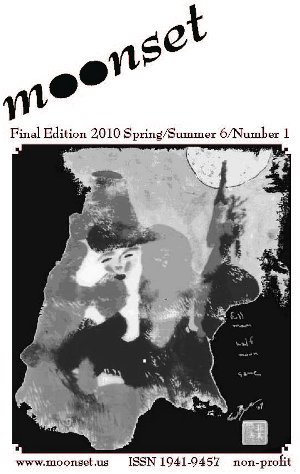
And finally, moonset will cease publication. The final issue should arrive in mailboxes soon. I personally would like to thank everyone involved in bringing this quality journal to life.

Sunday, May 9, 2010

Peggy Heinrich - Three Questions (Tanka)

The Haiku - Three Questions queue finally ran dry this week. Just as I was about to scramble for something to post for my Sunday readers, my inbox alerted me to a message received from, well, an angel coming to my rescue. Peggy Heinrich, who participated in Haiku - Three Questions nearly two years ago, offers her thoughts in this addition to Tanka - Three Questions.

Peggy Heinrich's haiku have appeared in almost every haiku journal here and in Japan. Peeling an Orange, her collection of haiku, published recently by Modern English Tanka Press, has been nominated for a Pushcart Prize. Her mini-chapbook, A Patch of Grass, was published by High/Coo Press. Awards include HSA's Henderson Award and top prize in last year's Yamadera Basho Memorial Museum English Haiku Contest. In the last ten years, her tanka have been published by American Tanka, bottle rockets and other leading tanka journals.

Her longer poems have appeared in many small magazines and university press and in her collection, A Minefield of Etceteras (iUniverse, 2006).


1) Why do you write tanka?

I had been writing haiku for years and had never heard of tanka until they began to surface a few decades ago. To learn more about the form, I studied the anthology Modern Japanese Tanka, edited and translated by Makoto Ueda and The Tanka Anthology, edited by Michael McClintock, Pamela Miller Ness and Jim Kacian. Reading the Ueda anthology, I was particularly drawn to Ishikawa Takuboku's tanka and later discovered Carl Sesar’s wonderful translations of Takubuku's work in Poems to Eat. I was drawn to tanka's offer of a chance to be more expansive and subjective than in haiku and after several attempts, I was hooked.

I was a charter member of Tanka Society of America and participated in a wonderful workshop organized by Pamela Miller Ness that met in New York’s Grand Central Station. The workshop helped me differentiate the essence of haiku from tanka, leading me to write an article on the subject, which I presented at a meeting of the Haiku Society of America's New York group.

When an idea for a poem is stirring in my head, I often find the five lines of a tanka offer me the best way to express it.


2) What other poetic forms do you enjoy?

Longer poems in free verse, where I can call up many details and write until I surprise myself. Sestina, one of the forms in which the rules lead to exciting discoveries. Haiku, as I’ve mentioned above.


3) Of the many wonderful tanka you've written, what do you consider to be your top three?


summer clouds —
from across the room
once, then again
the hollow sound
of the Indian drum

Tanka Café, TSA Newsletter V.4, No.4 12/03
Posted on TSA website as example of material from Tanka Café
A Minefield of Etceteras by Peggy Heinrich, 2005


for the first time
I find myself
alone
and yet . . . .
winter sun

Tanka Café Newsletter 9/04
A Minefield of Etceteras, 2005
moonset, June 2007 – republished


old home movies
Mother still dancing
the Charleston—
day-long snow
fogs the window

1st prize, moonset – Nov. 07
reprinted Ash Moon Anthology on aging 2008


If you've been enjoying this weekly series and have not contributed, please consider sharing your response (whether it be for haiku or tanka) to the three little questions that Peggy answered. You must be a published poet to participate.

Sunday updates - 5/9/2010

Bonnie Proudfoot sent this:

Riverwind, Hocking College's literary magazine, would like to publish 30 Haiku to celebrate its 30th edition. In return for publication, we will send out a copy of the magazine. We have won the CCHA (Community College Humaities Assn.) second prize twice for literary journals. The deadline for submission is May 15th.

Thanks
Bonnie Proudfoot
proudfoot_b@hocking.edu

Haiku are not required to be 5-7-5.


This just in from Ed Baker:

http://thisisvisualpoetry.com/

sure is nice to be in such stellar company...


Ed

Ed also shared this link:

http://didiodatoc.blogspot.com/2010/04/visual-poetry-again.html

Wednesday, May 5, 2010

Wednesday updates - 5/5/2010

May 31 Deadline: Vancouver Cherry Blossom Festival’s Fifth Annual international Haiku Invitational

While some cherry trees are still blooming, you are invited to write your haiku with fresh inspiration. Free to enter (up to two poems each). Poems will be judged by Michael Dylan Welch during the summer. Winning poems will be announced in the fall of 2010 on the VCBF website (www.vcbf.ca) and published in the Haiku Canada Review, Rice Paper, and Ripples, the newsletter of the Haiku Society of America. Top poems in five main categories (Youth, British Columbia, Canada, United States, and International) will also appear on TransLink SkyTrains and buses all over Metro Vancouver, receive celebrity readings by the conductor of the Vancouver Symphony Orchestra during a concert, and be featured in creative ways during the 2011 Festival in the spring of 2011. So don't delay -- submit your cherry blossom haiku by May 31. To submit, go to http://www.vcbf.ca/haiku/haiku-invitational-2010. (You can also read entries from previous years on the site.)


Modern Haiku announces the winners for the Robert Spiess Memorial Haiku Award 2010

http://www.modernhaiku.org/spiessawards2010.html


Atlas Poetica Announces New Special Feature: Canadian Tanka Poets in French and English

http://atlaspoetica.org/?p=185


ukiahaiku 2010 Results

http://www.ukiahaiku.org/pdf/haiku2010_w_Cvr_b.pdf

Sunday, May 2, 2010

Susan Diridoni - Three Questions

Susan Diridoni lives in the San Francisco Bay Area and works as a psychotherapist. In the last few years, her poetry has appeared in: Modern Haiku, bottle rockets, moonset, Mariposa, Modern English Tanka, Ribbons, 3lights, Roadrunner, MASKS. Forthcoming appearances in: Dimitar Anakiev’s (yet to be titled) “Anthology of War”, Presence.


1) Why do you write haiku?

I was a teenager interested in poetry and Zen when I discovered R.H. Blyth’s haiku books. Reading these books made me feel as if I would love Japan—never guessing that later I would travel there often and indeed love that land and its culture. At that time, I was also reading a good deal of other poetry, notably: Rilke, e.e. cummings, William Carlos Williams, paul reps, and contemporary poets of San Francisco. I also wrote poetry (very derivative) and was even published.

Much later, after becoming a psychologist, I began visiting a Trappist Abbey outside of Portland, Oregon. Occasionally I worked in the Pacific Northwest, and I would arrange to visit the Abbey. Then I began a decade of journeying there for Easter. It was being at the Abbey that brought me to the writing of haiku. I found the grounds of the Abbey beautiful—the foliage, trails going up into trees, ponds reflecting skies and the wind upon the water—all against the contemplative quiet and the welcoming community. Some of the guestrooms had long, slim windows which could transform at night in my mind’s eye, turning into real-time Japanese scrolls: moon reflected on a small pond, its surface broken by … koi, an insect, a frog. It seemed that all of this reached a critical mass of lyricism within me, and haiku began bubbling up. All of my initial attempts at haiku emerged from Abbey impressions—in nature, within relationships, and interior currents. After beginning to read contemporary published haiku, my haiku efforts gradually expanded to daily life and beyond.

Many answers given to this question have named dimensions that I, too, find true in writing haiku, especially the aspect of distillation. For me, haiku is the distillation of multi-faceted moments—moments that are exterior, interior, and dynamic.


2) What other poetic forms do you enjoy?

I have less experience writing tanka, but enough to want to continue. In recent years I have been studying poetry with Diane di Prima, who is currently Poet Laureate of San Francisco. Diane’s passionate engagement with the Muse, and her liberal advocacy of the same in her students, make a compelling invitation to explore free verse as well as a wide variety of structured poetry. My readings in poetry are ever growing, including literary journals such as Jubilat and Black Warrior Review, to cite just two. Seems I’m wading into the wide, gossamer river of poetics!


3) Of the many wonderful haiku you’ve written, what do you consider to be your top three?


patches of night
fill the western sky—
my jig-saw memories

bottle rockets #19 / 2008


Epiphany
the unsaid between us
extinguished

Modern Haiku 40.2 / Summer 2009


just east of our troubles the rainbow’s face


Roadrunner X:I / Spring 2010


If you've been enjoying this weekly series and have not contributed, please consider sharing your response (whether it be for haiku or tanka) to the three little questions that Susan answered. You must be a published poet to participate.

Sunday updates - 5/2/2010

Happy 10th Anniversary, Haiku of Kobayashi Issa!

This month marks the 10th anniversary of David G. Lanoue's website devoted to translations of Issa's haiku.

http://haikuguy.com/issa/index.html

David has created a page/wall of comments left by fans of the web site and Kobayashi Issa.

http://haikuguy.com/issa/commentwall.html

Thank you for your hard work David and for your popular web site!


Editors of Magnapoets are accepting submissions for their July 2010 issue. How to submit and a view of the July cover are located here:

http://www.magnapoets.com/

One contributor copy per poet.


Saša Važic' sent this:

Matsuo Basho Poetry Offerings English Haikus wanted


David Grayson sent this:

Hi Curtis,

I wanted to pass along info about a haiku/poetry/art event coming in June in the San Francisco Bay Area.

The O'Hanlon Center for the Arts in Mill Valley (Marin County, CA) is presenting the 7th annual Wabi Sabi celebration. Events include:

- Haiku workshop led by David Grayson. Thursday, June 17, 7-9 p.m. $22.
- Juried gallery exhibit
- Wabi Sabi poetry reading on Thursday, June 10 at 7 p.m. Readers include Duff Axsom, Karen Benke, Dick Brown, CB Follett, Abby Wasserman and Bernie Weiner.

The center is a beautiful facility located one mile from downtown Mill Valley on several acres of beautiful woodland. There are several buildings which provide space for our activities.

For more info, visit http://www.ohanloncenter.org/.


Pris Campbell sent this:

Pris Campbell and Scott Owens collaboration:

http://www.mainstreetrag.com/Campbell_Owens.html

Click the link above to see the cover of The Nature of Attraction. It's a wow. Scott found the artist. The publisher is Main Street Rag Press. Also on that page are our photos, bios and three poems from the book. Right now and until July 12, the book can be bought for the pre-publication price of $3.50 (plus shipping). The number of books printed will depend on pre-publication orders, the number Scott and I buy, and then a certain number of extras for later sales at what will then be $7.00.

Books will be shipped in late July. You have the advantage of getting the low price by ordering early, but not the book in hand until later.

Anyway, I hope some of you will consider it. Working with Scott was fun. We did the collaboration spontaneously and at our leisure over a period of time. Now it's out and I hope you enjoy. The book is poems back and forth about the relationship between a repressed, wary-of-love Norman and wilde childe Sara.

xxPris

Visit my website at http://www.poeticinspire.com
and my blog, Songs To A Midnight Sky at http://poeticinspire.blogspot.com

My latest book, Sea Trails, can be purchased at www.lummoxpress.com for fifteen dollars, plus postage.


Scott Metz sent this:

Roadrunner X:1 has now been retrofitted with MASKS III

http://www.roadrunnerjournal.net/

MASKS is a zine of haiku pen-names (haigo)


Dave Russo has made his photos from this year's Haiku Holiday available. I contributed a photo or two but the majority are his:

http://lilaf.smugmug.com/Poetry/Haiku-Holiday-2010/11966658_dgZyd#847814795_LyJVb

Wednesday, April 28, 2010

Poets and Poems - Pris Campbell


Jump Start

You jump-started my heart.
It beats a forgotten rhythm.
Resurrected are old passions,
hid behind that fake indifference
I wore like a favorite dress.
Tossed are blindfolds I hastily tied
whenever couples kissed.

Aging now, my past
slid over the mountaintop,
a new sun has risen.
I imagine you inside me,
bodies creating our own
1001 nights as we shed
any veils left between us.


Pris Campbell


If you would like to participate in this series, send a photo of yourself composing a poem or writing or a picture of a location where you enjoy writing, along with one of your poems (the type/genre of poem doesn't matter). This series will allow us to see the various locations that inspire us or where we go to write.

Wednesday updates - 4/28/2010

Full Bloom Renga

Paul Conneally sent this:

Our Web Renga for the Full Bloom Renga will run over the two weeks between our live renga session at Cotehele (Sunday 25th April) to Saturday 9th May when we perform the second live renga at Acorn Bank in Cumbria. We are following the wave of blossom from South to North through England.

We welcome submissions for the web renga from anywhere in the world.

Interactive Full Bloom renga page:

http://www.orchardnetwork.org.uk/renga/

I am master poet at the live renga sessions with 3 guest masters selecting the web renga submissions starting with Sheila Windsor, then Alec Finlay and finaly Martin Lucas.

Full Bloom Renga was devised by Anne-Marie Culhane with Jo Salter, Paul Conneally and Alec finlay

All that's best,

Paul


An Invitation to Submit Haiku:

The HSA Members’ Anthology 2010

In 2010, for the 17th consecutive year, the Haiku Society of America (HSA) will publish a members’ anthology. Members are cordially invited to participate! (If you’re not a member, please visit http://www.hsa-haiku.org/join.htm for information about joining.)

This is a wonderful opportunity to examine the work of a cross-section of HSA poets, who are among the best writers of haiku and senryu in the English language, and to see your work in print. The HSA members’ anthology also makes a great gift for family and friends—please consider ordering several copies and give the gift of haiku!

The 2010 HSA members’ anthology will be edited by Scott Mason.

THEME

This year’s anthology will have a theme—BIODIVERSITY—in keeping with the United Nations’ declaration of 2010 as the “International Year of Biodiversity.” Each haiku or senryu must name a particular species of plant or animal (besides humans). Here are two examples by this year’s anthology editor, one apiece with a specific plant and animal reference:

wind-carved sand . . .
I crumble a bayberry leaf
to bring her back


(The Heron’s Nest, Volume X, Number 3, September, 2008) 


sundown:
rock wallabies return
to their Dreaming

(Paper Wasp Jack Stamm Haiku Contest, 2007) 


All terrestrial, aquatic and airborne species qualify. The more “diverse,” the better!

SUBMISSIONS

Each member of the Haiku Society of America may submit up to five haiku or senryu with a specific plant or animal reference. At least one—and possibly more—will be selected for inclusion.

All submissions must be sent by postal mail (no e-mail submissions). Send up to five haiku or senryu (no tanka, haibun, haiga, etc.). Please put all five haiku/senryu on one sheet with your name, address, and e-mail address (if any) at the top.

New work is preferred, but previously published haiku or senryu are acceptable. If a submitted poem has been published—or has appeared in the general results notification for any contest—please provide the type of information shown with the two sample poems above. You will be notified by e-mail which of your haiku or senryu has/have been selected. If you have no e-mail address but wish to be notified, please include an SASE (non-US residents should include an SAE and an IRC if you do not provide an e-mail address).

Deadline: IN HAND by June 30, 2010. Notifications will be sent by July 31, 2010.

PURCHASING COPIES

The number of copies printed will be determined by the number of copies advance-ordered. Thus, we strongly suggest that you order your copies when you submit your haiku or senryu. The cost is US$14.00 per copy postpaid in North America (add US$3.00 postage elsewhere). Remit in US-dollar checks made out to “Haiku Society of America” or cash.

SUBMISSION CHECKLIST

* One page with name, address, and e-mail address (if any) at the top.
* Up to five haiku/senryu, each naming a specific plant or animal (besides humans).
* Previous publication information where applicable.
* Number of copies of the anthology being ordered, along with your payment (ordering a copy is not required for inclusion, however).
* SASE to receive selection information
* All mailed to:

Scott Mason
P.O. Box 682
Mount Kisco, NY 10549 USA

QUESTIONS?

If these instructions are not clear, or if you have other questions, contact Scott Mason by e-mail at hsaanthology@gmail.com or at the post office box address above.


Whirligig

In the second half of May 2010 the first issue of the bilingual (Dutch/English) haiku journal Whirligig will be published.


Objective

With Whirligig it is our intention to exchange haiku between the Dutch language area and the rest of the world. This will work in two ways:


* Through English translations of original Dutch-language haiku, interested people elsewhere will become acquainted with haiku written in the Netherlands and Flanders.

* Through Dutch translations of haiku originally written in other languages, interested people in the Netherlands and Flanders will become acquainted with haiku written in these other languages. (If the original language is not English, the original version may also be presented in addition to an English and a Dutch translation.)


The name

* Whirligig is the English name for the small water beetle Gyrinus natans, the Dutch name of which is schrijvertje or schrijverke (literally: ‘little writer’).


Practical details

* Whirligig will be published twice a year: in May and November.

* The scope will be about 60 pages per issue, the size being A5 (15 x 21 cm). Every volume will be produced as a book, including a title on the spine. The cover will be in full color.

* The annual subscription rate, including postage, will be:

For subscribers in the Netherlands: € 17,50

For subscribers elsewhere in Europe: € 21,50 (GB £19,00) (standard mail)

For subscribers outside of Europe: € 26,00 (US $ 35,00)

* The price per single copy, including postage, will be:

Within the Netherlands: € 9,50

Elsewhere within Europe: € 11,50 (GB £10,00) (standard mail)

Outside of Europe: € 15,00 (US $ 20,00)

* Payments can be made either by bank (Netherlands and Euro countries), through PayPal or in cash (all other countries). Further details will be sent along with the first issue.


Compilation and editing

* The content will consist mainly of haiku (including senryu) and short haibun. In addition, new publications will be noted. No, or almost no, essays or reflective texts will be included.

* In compiling Whirligig both old and new material will be used. Texts therefore will be drawn from earlier publications, while new and unpublished poems will also be included.

* To obtain as yet unpublished work the editor(s) will actively contact haiku poets.

* In compiling the journal and in translating the poems, editor Max Verhart has obtained the assistance of Klaus-Dieter Wirth (Germany), Norman Darlington (Ireland) and Marlène Buitelaar (Netherlands), all of whom have an above standard command of Dutch and English, besides which several other languages are covered by this team.


Submissions

* Unsolicited work may be submitted for publication, to be considered by the editor(s). However, no correspondence will be entered into concerning such submissions.

* It is not necessary to be a subscriber to submit material. However, when unsolicited work by a non-subscriber is published, the author will be expected to buy at least one copy of the issue in which it appears.


Submissions and subscriptions to be sent to:

By email: max@verhart.org

By snailmail:

Whirligig
p.a. Max Verhart

Meester Spoermekerlaan 30

NL-5237 JZ Den Bosch

Netherlands


It’s possible to subscribe from this moment on!

With the subscription please add the postal address where Whirligig should be sent.


Forwarding this mail to other potentially interested parties is highly appreciated.


Kind regards,

Max Verhart

Monday, April 26, 2010

Thomas Heffernan - Three Questions

Thomas Heffernan has been making haiku since the mid-1980s in Okinawa where he co-founded the bilingual haiku magazine Plover/Chidori. His English-language haiku have received a number of Mainichi awards and also Itoen and JAL (Japan Air Lines) prizes; he was awarded the 2006 Kusamakura Grand Prize for haiku. He has published ten books and chapbooks. His The Liam Poems about an ancestral kinsman, the Irish-language Jacobite poet William Heffernan the Blind (as W.B. Yeats called Liam Dall O’hIfearnain), received the 1982 Roanoke-Chowan Prize.

[Photo of Thomas Heffernan and Roberta Beary by Curtis Dunlap]


1) Why do you write haiku?

To put into words traces of things I wonder at… to present what otherwise would be past.


2) What other poetic forms do you enjoy?

Tanka. Ghazals. Sonnets: some are available on the Ploughshares website; others, here and there in my books.


3) Of the many wonderful haiku you’ve written, what do you consider to be your top three?

Some haiku of mine, not necessarily favorites or even representative.

Such a being as this recalls the name of our Okinawan haiku magazine:


a one-legged plover
standing in the empty lot...
winter

Mainichi Daily News, “Haiku Column,” March 9, 1991


even after
the operation
the midnight tomcat

International Herald Tribune/Asahi, July 24, 2002


shop window
reflecting the other side
of the street

Frogpond, Spring/Summer, 2007


now and then
night air moves
the reed curtain


Included in a haibun in Christmas Gifts in South Japan. Laurinburg, NC: St Andrews Press, 2003, 43.


If you've been enjoying this weekly series and have not contributed, please consider sharing your response (whether it be for haiku or tanka) to the three little questions that Tom answered. You must be a published poet to participate.

Monday updates - 4/26/2010

Raffael de Gruttola sent the wonderful reading below. He writes:

This is the piece that Judson Evans, Karen Klein, and I cross-adapted from Katherine Snodgrass' one act play called HAIKU. Katherine is the Director of the Boston Playwright's Theatre at Boston University. We took the dialogue of the play and adapted it as a renku for performance purposes. It was presented at the Mass Poetry Festival last year in October and was videotaped for the local Lowell TV Outlet. Katherine's play won the 1988 Heideman Award-Winning One-Act Play in the US.

Sincerely,
Raffael

Sculling Blackbirds from Eric Sack on Vimeo.


Carole Macrury sent this reminder:

The 11th Tanka Society of America’s International Competition Call for Submissions

Deadline: Postmark date of May 10, 2010.

Eligibility: Open to all, members and non-members alike, except TSA officers and judges.

Regulations: Any number of tanka may be submitted. Entries must be original, in English, unpublished, and not submitted for publication or to any other contest.

Entry Fee: $1.00 per tanka, U.S. funds only. Please make checks/money orders payable to the "Tanka Society of America."

Submissions: Submit each tanka on three separate 3 x 5 inch cards, two with the tanka only (for anonymous judging), the third with the tanka and the author's name and address in the upper left-hand corner. Type or print neatly please.

Submit entries and fees to: Carole MacRury, 1636 Edwards Drive, Point Roberts, WA 98281-8511 USA

Awards: First prize: $100; Second Prize: $50; Third Prize: $25. Amount of prizes may be reduced if an insufficient number of entries are received. Winning poems will be published in Ribbons, the Tanka Society of America journal.

Adjudication: The name(s) of the judge(s) will be announced after the contest.

Rights: All rights revert to the authors after publication.

Correspondence: Unfortunately, entries cannot be returned. Please send a business size SASE for answers to queries or for a list of winning entries. For foreign entries, send a self-addressed envelope and one international reply coupon.


Saša Važic' sent this update:

The 14th annual Mainichi Haiku Contest.

~ ~ ~

Yuki Teikei Haiku Society
Annual Kiyoshi & Kiyoko Tokutomi Memorial Haiku Contest

~ ~ ~

Apokalipsa magazine is issuing a call for

6th HAIKU COMIC OR COMIC OF HAIKU?

If a haiku is always derived from simplicity, brevity, and the use of least words possible – without redundancy, which express the whole dimensionality of a haiku moment, which is the starting point and goal of the haiku masters’ creativity, interpreting a comic we can speak about experimentation with time, i.e., moment. A haiku comic is a multifaceted experiment that incorporates various interpretations of a personal experience in form of a “frozen” moment – a quick sketch or illustration, an “explained” moment in form of banner short stories, which occasionally flirt with animation approaches, and one- or more-page form, which visualises a certain haiku or creates an atmosphere that forms a basis for understanding a certain moment, message or thought within its time frame.

Your haiku comics will be published in the September 2010 issue of Apokalipsa magazine and in its special volume Haiku comic 6 edited by Boris Bac'ic'. A special comic exhibition and projection within the project Ljubljana 2010 – World Book Capital, and Pecs 2010 –European Capital of Culture, is also planned. The authors will be notified about the upcoming events and will receive the publication by regular mail. Please send the contributions until 1 June 2010 to the following address: REVIJA APOKALIPSA, UI. Lili Novy 25, 1000 Ljubljana, marked Haiku comic, or via e-mail (in tif or jpg format, 600dpi BW or 300dpi GRAYSCALE) to the following address: bajabak@gmail.com.
~ ~ ~
Saša also needs your help:

Sasa Vazic, editor of the bilingual Haiku Reality/stvarnost, would like to kindly ask poets to resubmit their work to her email vazicsasa@gmail.com. The fact is her hard disc burned up, so she has lost all emails with submissions.

Haiku Reality is open for submission to all other authors as well.


This just in from M. Kei:

Atlas Poetica Announces New Special Features: Romanian Tanka Poets

24 April 2010 — Perryville, Maryland, USA

Atlas Poetica : A Journal of Poetry of Place in Contemporary Tanka is proud to reveal the new ‘Special Features’ section of its completely redesigned website. The new website, designed by Alex von Vaupel, Technical Director for Atlas Poetica, hosts information about the journal, submission guidelines, ordering information, sample issues, and now the new Special Features section. It is located at .

Atlas Poetica is an international tanka journal that publishes tanka literature in many languages. However, it can be difficult for readers and poets to find venues to enjoy tanka featuring different languages and cultures. Therefore, Atlas Poetica has established the Special Features section to focus on different aspects of the international tanka community.

The first Special Feature is ‘25 Romanian Tanka Poets’ edited by Magdalena Dale and Vasile Moldovan, with an Introduction by Moldovan and translations by Dale and others. The Introduction surveys the history of tanka in Romania from 1878 to the present, and highlights some of the accomplishments of Romanian tanka poets at home and around the world.

The Introduction is followed by twenty-five tanka in the original Romanian accompanied by English translation. Some of the poets featured are well-known to the international tanka community, but other poets are being translated into English for the first time. ‘25 Romanian Tanka Poets’ is a beguiling snapshot of tanka in Romania and provides citations for readers interested in reading more.

More Special Features will be coming soon, including ‘25 Canadian Tanka Poets in French and English,’ edited by Aurora Antonovic and translated by Huguette Ducharme and Mike Montreuil. It is slated to appear the first week of May. It will be followed by ‘25 New Zealand Tanka Poets,’ edited by Patricia Prime. It will appear in the first week of June.

A fourth Special Feature, ‘25 Poems on Lesbian, Gay, Bisexual, and Transgender Themes’ is in the planning stages. It is being edited by Alex von Vaupel. Queries about the LGBT Special Feature can be sent to with a subject line of “LGBT tanka feature”.

Anyone interested in being a Guest Editor for a Special Feature at the Atlas Poetica website will find guidelines on Special Features home page, below the Atlas butterfly that is the symbol of the journal. Anyone interested in being a Guest Editor should familiarize themselves with the project by reading the Special Features section and also a sample issue of the journal archived on the site. Atlas Poetica’s Special Features are published on an irregular schedule.

About Keibooks:

Keibooks is a micropress located in Perryville, Maryland, USA, founded by poet and tall ship sailor, M. Kei. Keibooks publishes select projects reflecting his interest in tanka poetry and the sea. Using print-on-demand technology, Keibooks is able to publish high quality literature in attractive, affordable editions. Keibooks is home to Atlas Poetica : A Journal of Poetry of Place in Contemporary Tanka, and previously published Fire Pearls : Short Masterpieces of the Human Heart, a classic anthology of tanka love poems, as well as several other titles. For more information, visit: <>.

Contact:
M. Kei, publisher and editor
Keibooks
P O Box 1118, Elkton, MD, 21922-1118, USA
Email: Keibooks @ gmail.com
http://stores.lulu.com/keibooks

Wednesday, April 21, 2010

Poets and Poems - Michael Dylan Welch


Flowers on the Roof of Hell

in this world
we walk on the roof of hell
gazing at flowers
                —Issa (1763–1828)

Today Issa came over for dinner.
Nothing fancy, just Thai take-out from the place down the road.
He came on foot, carrying a satchel.
I welcomed him at the door, and he removed his sandals.
The low evening sun sparkled
through the tall glass of water I gave him.
He admired it before he drank it in one go.
I showed him to the living room, where he sat on the couch,
almost delicately. Then, as if conscious
of his bare feet, he curled them up under himself.

We talked of poetry all through dinner,
stray noodles landing on the plain wooden table as we ate.
We talked of favourite poets and poems,
and the challenge of writing freshly about old subjects.
We talked of writing one’s joy in a fiercely crushed world,
of flowers on the roof of hell.

When he told me it was time for him to go,
I asked if I could give him a ride
but he declined, as I knew he would.
He had a long way to travel,
but held a finger to his lips and gently shook his smile.
Then Issa took his sandals in hand
and padded off into the dark.

I opened the satchel he left behind.
Inside it bloomed white asters.

Michael Dylan Welch


If you would like to participate in this series, send a photo of yourself composing a poem or writing or a picture of a location where you enjoy writing, along with one of your poems (the type/genre of poem doesn't matter). This series will allow us to see the various locations that inspire us or where we go to write.